

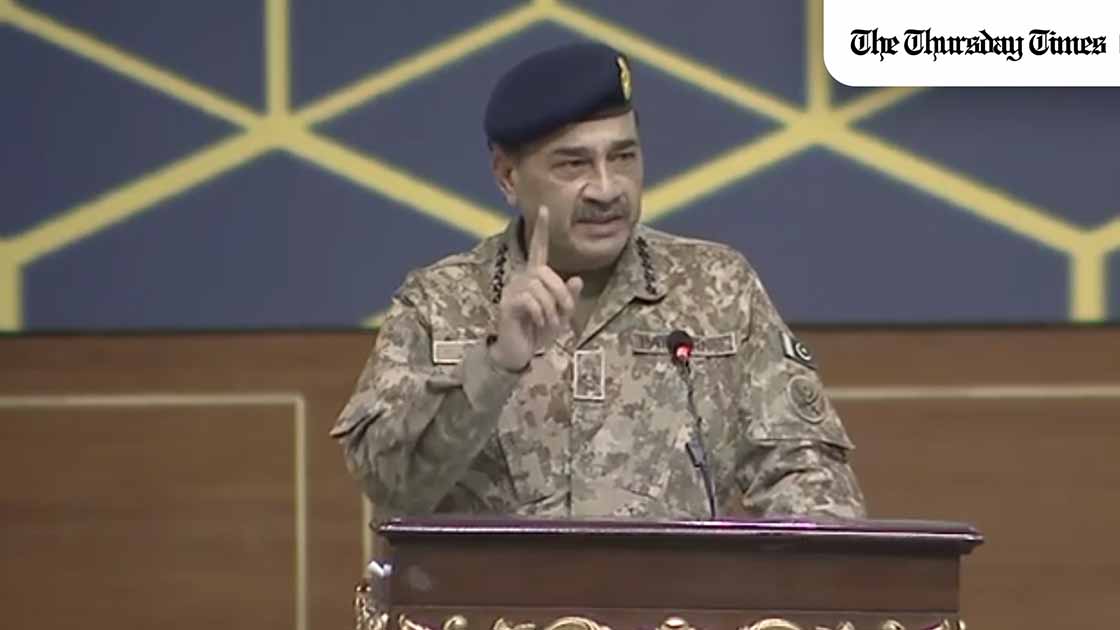
ISLAMABAD (The Thursday Times) — Field Syed Marshal Asim Munir, Pakistan’s chief of defence forces, issued a blunt warning to Afghanistan, saying it must choose between Pakistan and what he called “Fitna al-Khawarij”, a term Pakistani officials increasingly use for militant factions they accuse of orchestrating attacks inside the country.
Speaking at a national Ulama and Mashaikh conference in Islamabad, Syed Asim Munir framed the challenge as both a security threat and a crisis of religious authority. He argued that in any Islamic state, the power to declare jihad, or to issue rulings that amount to it, rests with the state alone, not with individuals, organisations or armed groups.
The speech landed amid renewed concern in Pakistan over militant violence, particularly in areas near the Afghan border, and a public debate over how Islamabad should respond to armed groups it says operate with impunity outside its territory. Asim Munir said Pakistani civilians, including children, were being targeted through terrorism that he described as backed by the Afghan Taliban.
He also made a pointed claim about the composition of militant networks, stating that a majority of those involved across different organisations described as “Khawarij” were Afghan nationals, and that they were crossing into Pakistan to spread instability.
In an address that blended policy with religious symbolism, Field Marshal Asim Munir sought to anchor the state’s position in Islamic history and national identity. He said Pakistan had been granted the honour of being “guardians of the Haramain”, and argued that there were deep parallels between the early Islamic state and modern Pakistan.
He described both as having been founded on the Kalima, and said that this shared foundation carried a special responsibility within the Muslim world. The message appeared designed to reinforce the state’s claim to legitimacy in the religious sphere at a time when extremist narratives compete for influence.
Syed Asim Munir also invoked military operations as evidence of divine support, saying that during Operation Bunyan Marsoos, the help of God was not only witnessed but felt. He presented this as a sign of steadfastness, and urged the Ulama and Mashaikh to play an active role against what he characterised as extremism, misguidance and social fracture.
Field Marshal broadened his remarks to a civilisational theme, arguing that Islam’s first command was to read and learn, and that Muslim societies declined when they abandoned knowledge and the power of the pen. He called on the Ulama to continue guiding the public intellectually, portraying education and moral clarity as core pillars of national resilience.


