
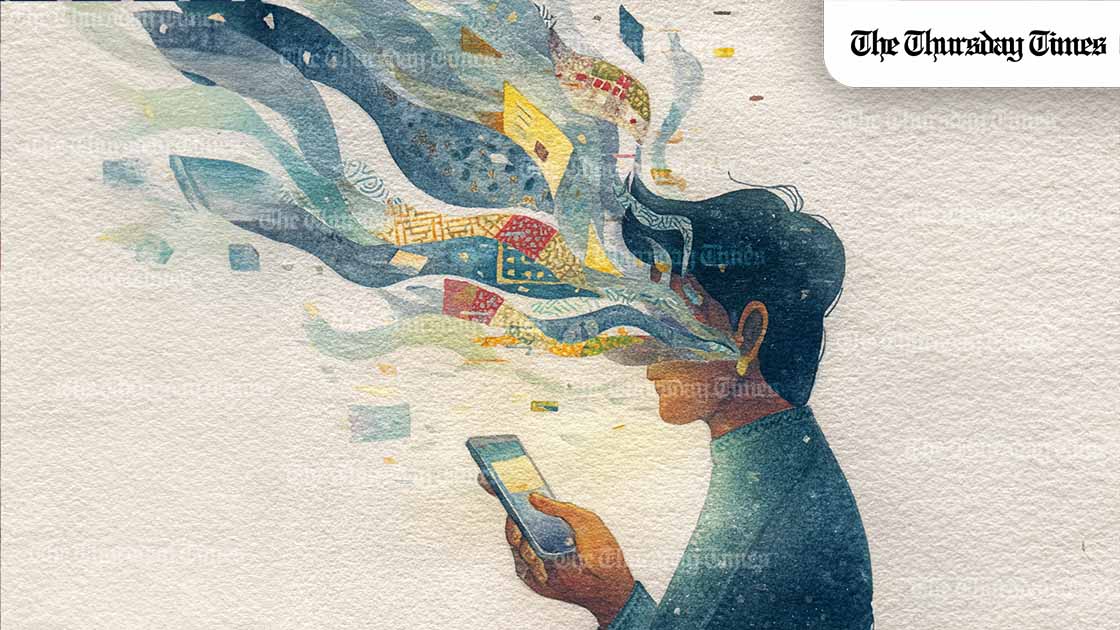

THERE HAS BEEN GROWING CONCERN worldwide over the unchecked infusion of disinformation, commonly referred to as fake news, into public discourse. Pakistan, with its rapidly expanding digital footprint, finds itself particularly exposed. In the contemporary media environment, misinformation does not merely circulate; it embeds itself. Numerous studies indicate that once false information is absorbed, it tends to persist in memory and remains difficult to dislodge, even after factual corrections are issued.
This condition was aptly captured when Oxford Dictionaries nominated post-truth as its Word of the Year in 2016, defining it as circumstances in which objective facts become less influential than emotional appeal and personal belief. A year later, Collins Dictionary declared fake news its Word of the Year, referring to false information presented as legitimate news.
Fake news, as it exists today, constitutes a serious non-traditional security threat. It is typically produced to manipulate opinion rather than inform it, serving vested interests instead of public understanding. Its production is inexpensive and highly accessible; any individual with a smartphone can generate and disseminate content, while credible journalism remains labour-intensive, time-consuming, and costly.
This imbalance has tilted the information ecosystem decisively in favour of falsehood.
Social media platforms have accelerated this trend. Algorithm-driven systems prioritise engagement over accuracy, ensuring that sensational and emotionally charged content travels faster than verified information. As a result, fake news appeals to fear, resentment, and insecurity, deepening polarisation and eroding ethical and social norms. Over time, this weakens citizens’ capacity to distinguish fact from fabrication.
The rewarding of online behaviour is also a factor exacerbating Pakistan’s vulnerability. Much of what appears to be engagement is not engagement at all, but slacktivism: low-effort acts of concern (tweeting a hashtag, sharing a clip, or adding an outrageous quote) that give the illusion of doing something without having to verify anything or be accountable. The rewards in a fast-moving feed are social rather than epistemic. People share not because they have verified, but because sharing signals loyalty, anger, empathy, or belonging. This makes misinformation a kind of badge of identity: to question it is to be treated as a traitor, whereas to repost it is to be seen as an ally.
Under these circumstances, correction becomes psychologically costly because it threatens the social status of being first or being on the “right” side. The outcome is a vicious circle in which visibility and moral signalling matter more than accuracy, and the public sphere becomes less a space for deliberation than a space for emotional alignment. Notably, slacktivism is not an innocent phenomenon. It can incite persecution, cause real-world instability, and force institutions into reactive decision-making based on viral noise rather than verified realities. It also displaces more difficult civic activity, such as lodging complaints, giving testimony, and investigating, by offering a simpler alternative that relieves the urge to “do something” immediately.
Another issue is the emotional economy of fake news. Much misinformation spreads because it offers catharsis: an opportunity to vent anger, humiliation, or fear in a quick post. This impulse, and the relief that comes through venting, is lelochezia. In digital spaces, lelochezia is effectively engineered into the system: outrage is built in, affirmation is reinforced by attention, and repetition is rewarded by affirmation. A common approach in creating false narratives is to design them to maximise this effect by offering a villain, a simple plot, and a sense of urgency to act immediately. Such emotional gratification may become more powerful than the desire to learn what actually occurred.
When corrections arrive, they are anticlimactic and are often seen as attempts to silence “the people”, which only further cements the initial lie. In the long run, this cultivates a generation taught to believe that intensity is evidence and repetition is truth. The synergy of slacktivism and lelochezia in politics is not only plausible; it is emotionally useful, particularly in Pakistan’s politically charged media environment, where trust in institutions is uneven and grievances are genuine, making the resulting mix hard to contain.
These dynamics are not abstract for Pakistan; they have manifested repeatedly in recent years. A striking example was the viral claim that a Punjab College student had been raped by a security guard on campus. The story went viral within hours. Subsequent investigations confirmed that the incident never occurred. Yet the damage was irreversible.
A similar pattern emerged when false reports circulated claiming that the entire crew of a Pakistan International Airlines flight had sought asylum in Canada. Originating from an Afghan account, the story garnered millions of views before being debunked through a community note on platform X.
The UK High Court’s defamation ruling against YouTuber Adil Raja further demonstrates the consequences of digital falsehoods. Raja accused Brigadier Rashid Naseer of manipulating judicial and electoral processes and published multiple allegations across X, Facebook, and YouTube. The court ruled the claims baseless and ordered a public apology.
The philosophical warnings about such conditions are not new. Søren Kierkegaard once observed, “There are two ways to be fooled. One is to believe what isn’t true; the other is to refuse to believe what is true.” Both forms of deception are visible today. Hannah Arendt, in The Origins of Totalitarianism, warned that societies become vulnerable when the distinction between fact and fiction dissolves. Her caution is particularly relevant in a post-truth environment where reality itself becomes negotiable.
This erosion is especially dangerous in Pakistan due to structural vulnerabilities. According to the Economist Intelligence Unit’s 2018 Digital Literacy Index, Pakistan ranked 68th out of 86 countries. As internet penetration increases, low digital literacy produces a population prone to uncritical consumption and dissemination of content.
Unchecked, this environment risks a gradual cognitive decline: a form of collective “brain rot” in which constant exposure to manipulated narratives dulls critical thinking. Countering fake news therefore requires more than reactive debunking. It demands sustained investment in digital literacy, institutional accountability, and a renewed commitment to truth. In an age where the fake so easily becomes truth, safeguarding factual integrity is imperative.


