

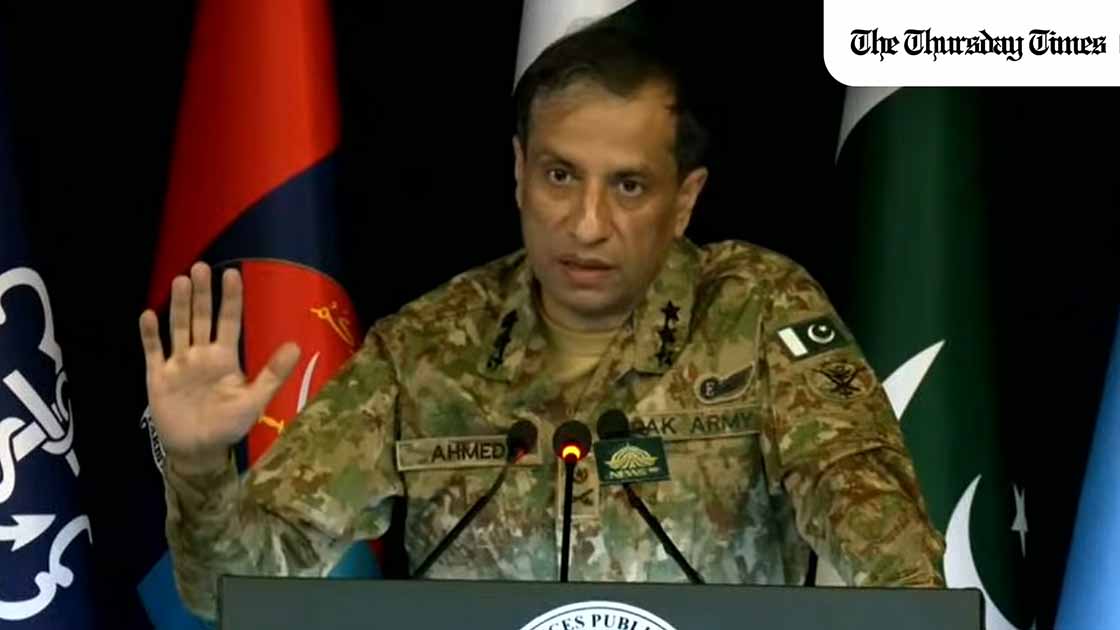
RAWALPINDI (The Thursday Times) — Pakistan’s military has declared terrorism the most serious threat facing the country, warning that any future aggression from across its borders would be met with a decisive response, as officials pointed to 2025 as a watershed year in the long-running counterterrorism campaign.
Speaking at a detailed security briefing, the Director General of Inter Services Public Relations, Lieutenant General Ahmed Sharif, said the fight against militancy was not solely a military effort but a national struggle involving the state, its institutions and the public. He said Pakistan had delivered a decisive reply during what the army refers to as the Battle for Truth, adding that the failure of India’s Operation Sindoor continued to define regional security dynamics.
According to the military, the closure of the Afghan border led to a marked decline in militant violence, while intelligence-based operations became more targeted and effective. General Sharif said security forces carried out more than seventy-five thousand such operations last year, the majority in Khyber Pakhtunkhwa and Balochistan, killing nearly two thousand six hundred militants. More than twelve hundred soldiers and civilians lost their lives in the process.
He traced the resurgence of militant activity to 2021, when political change in Afghanistan followed the Doha agreement. Afghan authorities, he said, had pledged to prevent the use of Afghan territory for terrorism and to protect women’s access to education, but those commitments were not honoured. Instead, Pakistan now sees Afghanistan as a hub for multiple armed groups, including al Qaeda, Islamic State affiliates, the Tehreek-e-Taliban Pakistan, and separatist outfits operating against Pakistan.
The army spokesman said Pakistan repeatedly urged Kabul to act against these groups, but when attacks on Pakistani posts continued, Islamabad responded militarily to defend its sovereignty. Militants, he said, had no link to Islam and were driven by political and economic motives, sustained by what he described as a regional war economy.
Referring to the suicide bombing at a police mosque in Peshawar, General Sharif recalled a visit by Syed Asim Munir, who publicly rejected any religious justification for such violence and vowed to confront militant factions wherever they operate.
General Sharif warned that any attempt by India or Afghanistan to test Pakistan’s resolve would fail, whether undertaken alone or jointly, adding that Pakistan remained the most targeted and most affected country in the global fight against terrorism. He said the state’s policy was clear, lawful and defensive, with no ambiguity over the use of force.
He rejected claims that counterterrorism was only the army’s responsibility, noting that militant attacks routinely targeted markets, schools, offices and residential areas. The sacrifices of civilians, police and paramilitary forces, he said, underscored that the conflict touched every household.
On governance, he stressed that foreign policy decisions rested with the civilian state and the foreign ministry, and that any political dialogue was the government’s prerogative. The military, he said, had never sought talks with political parties. Drawing lessons from other countries, he argued that Pakistan must become a stronger and more self-reliant state, guided by unified civilian and military leadership.
Resources alone, he added, did not determine outcomes. Despite India’s much larger defence budget, Pakistan’s success depended on resolve, clarity of purpose and leadership that directed public funds toward development rather than political narratives.
He concluded by saying Pakistan would continue fighting terrorism on every front, insisting that the country would not be overrun by militant groups or their facilitators. Pakistan, he said, remained steadfast, convinced that it stood on the side of truth.


