

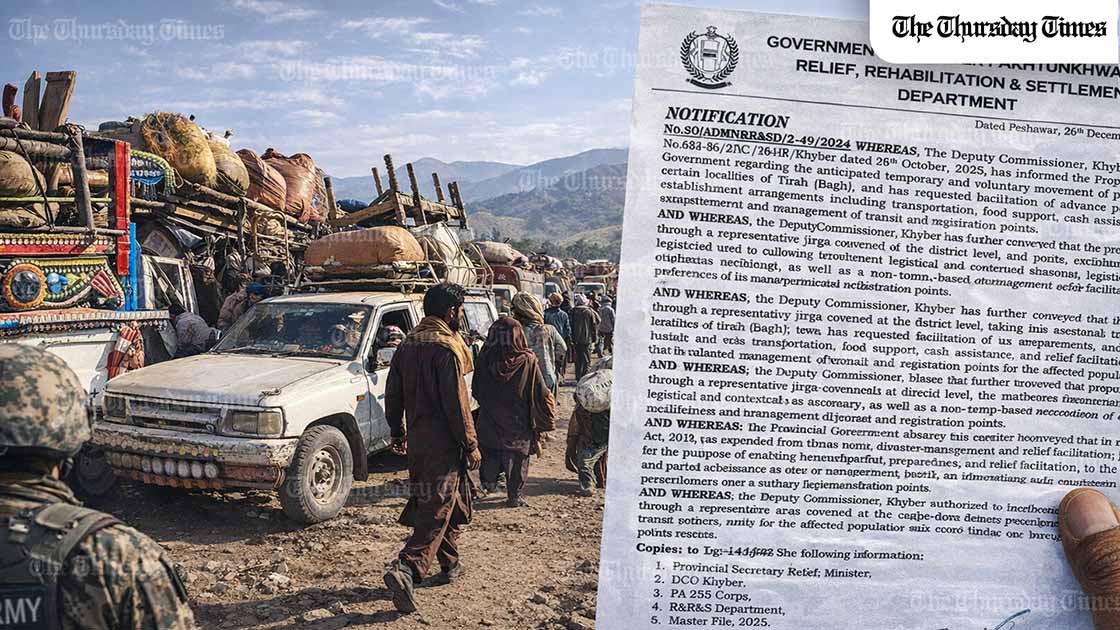
PESHAWAR (The Thursday Times) — A notification issued by the Khyber Pakhtunkhwa government on 26 December 2025 has contradicted claims that the evacuation of residents from Tirah Valley was the result of a military operation, raising serious questions about an alleged campaign of misinformation and the handling of billions in relief funds.
The document issued by the Relief, Rehabilitation and Settlement Department of the KP government, declares a state of emergency in District Khyber to facilitate what it explicitly describes as the anticipated temporary and voluntary movement of population from parts of Tirah Valley. The notification states that the decision was taken by the provincial government and the Khyber District Administration, following requests by the Deputy Commissioner for advance preparedness and relief arrangements.
Crucially, the letter records that the proposed voluntary movement reflected the views and preferences of the local population and was articulated through a representative jirga process convened at the district level in October 2025. It also specifies that the modality would be non-camp-based and guided by seasonal, logistical and contextual considerations. Nowhere in the document is there any reference to a military operation or a military-led decision.
The notification authorises the Provincial Disaster Management Authority, in coordination with the District Administration, to arrange transportation, food, refreshments and the establishment of transit and registration points. It further empowers the Deputy Commissioner, Khyber, to mobilise resources for relief and rehabilitation, and directs that expenditures be charged to the Relief Account, subject to prudent and need-based utilisation.
Following this decision, approximately Rs 4 billion was released by the KP government for evacuation and relief purposes. Critics now allege that a significant portion of these funds has been squandered, while the provincial leadership has sought to deflect responsibility by portraying the displacement as the outcome of a military operation.
Observers familiar with the matter argue that the contents of the official letter make it evident that the displacement was a civilian-led administrative decision, voluntarily agreed by local communities through jirgas, and not the result of any armed campaign. They further claim that a deliberate disinformation drive is being run to mislead the public, shift blame onto the armed forces, and obscure serious mismanagement in the evacuation process, which was formally placed under the authority of the KP government.
Sources also point out that, despite not being responsible for the decision to evacuate, the Pakistan Army stepped in to assist residents during extreme weather conditions, providing logistical support and transportation under its public service mandate. They argue that this humanitarian role is now being misrepresented to suggest military culpability for a process that was clearly documented as voluntary and civilian-directed.
The revelations have triggered renewed calls for transparency, an independent audit of the Rs 4 billion relief fund, and a public explanation from the KP government over why its own official notification contradicts the narrative currently being promoted.
As scrutiny intensifies, the Tirah Valley episode is fast becoming a test case for accountability, governance credibility, and the integrity of disaster management in Khyber Pakhtunkhwa.


