
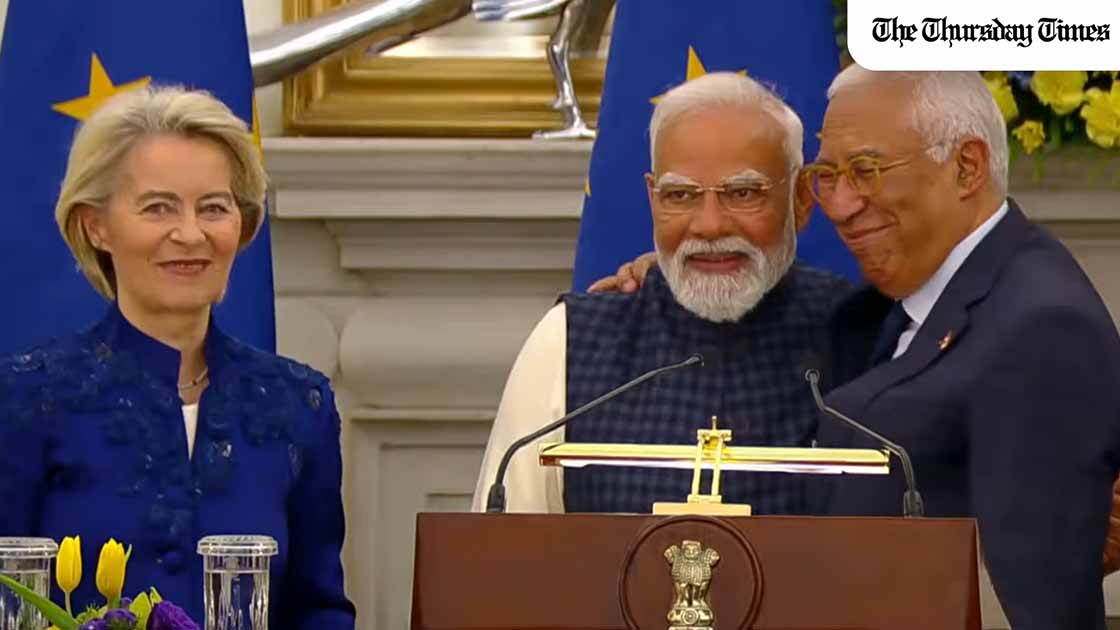
NEW DELHI (The Thursday Times) — After nearly two decades of intermittent negotiations, the European Union and India have concluded a sweeping free trade agreement that both sides are hailing as a turning point in their economic and strategic relationship.
EU President Ursula von der Leyen has called the EU–India trade agreement ‘the mother of all deals’ pic.twitter.com/6giUewCfJi
— The Thursday Times (@thursday_times) January 27, 2026
The accord, finalised at a high level summit in New Delhi, aims to reduce or eliminate tariffs on the vast majority of goods traded between the two economies and to expand access for services, investment and technology. European leaders described the deal as one of the most consequential trade pacts the bloc has signed in years, while Indian officials framed it as a catalyst for growth, manufacturing and export diversification.
At its core, the agreement is designed to open India’s tightly regulated market to European products such as automobiles, machinery, chemicals, pharmaceuticals, wine and olive oil, while giving Indian exporters improved access to Europe for textiles, leather goods, engineering products and marine exports. Officials on both sides said the pact could save billions of euros in annual duties and significantly boost bilateral trade volumes over the next decade.
The deal arrives at a moment of profound change in the global trading system. With supply chains being reshaped by geopolitical tensions, rising protectionism and new industrial policies in the United States and China, Brussels and New Delhi are both seeking to reduce their exposure to single markets and to anchor new strategic partnerships.
European Commission President Ursula von der Leyen said the agreement would strengthen economic resilience and reinforce shared values on sustainable growth, labour standards and environmental protections. Indian Prime Minister Narendra Modi called it a milestone that would help integrate India more deeply into global value chains while preserving national development priorities.
Negotiators had struggled for years over sensitive issues including agricultural market access, data protection rules, intellectual property, labour rights and environmental standards. While the final text makes significant concessions on industrial tariffs, several politically sensitive agricultural products have been excluded or granted extended transition periods.
The agreement also includes chapters on digital trade, services, government procurement and regulatory cooperation, signalling a broader ambition to move beyond traditional tariff reductions toward deeper economic integration.
Before the pact can take effect, it must be ratified by the European Council, the European Parliament and India’s cabinet, a process expected to take several months. Some European lawmakers and Indian industry groups have already indicated they will scrutinise the final terms closely, particularly on environmental commitments and protections for domestic producers.


