
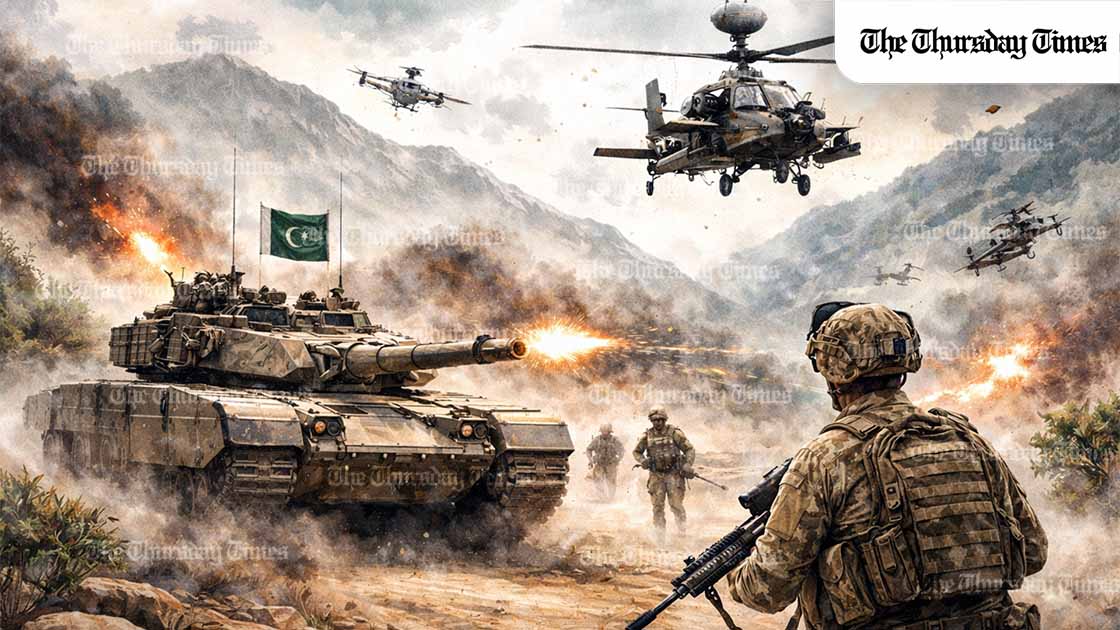

The battlefield of the 21st century is no place for nostalgia or hesitation. It is a theatre of unforgiving steel and fire where the line between survival and annihilation is drawn by capability, preparedness and resolve.
The persistent narrative that Pakistan’s security forces are engaged in a low-intensity skirmish against poorly equipped insurgents reflects a dangerous misunderstanding of contemporary conflict. What confronts the state today is a hybridised militant ecosystem strengthened by transnational financing, external sanctuaries and the diffusion of advanced weaponry left behind in Afghanistan after the withdrawal of foreign powers.
The adversary encountered in Balochistan’s rugged expanses or within the valleys of the tribal belt in KPK is not an unsophisticated irregular fighter; he is equipped with modern optics, encrypted communications, precision rifles, RPGs and battlefield awareness tools that fundamentally reshape engagement.
Within this operational reality, the deployment of main battle tanks, armed drones and attack helicopters is a necessity. When militant formations possess fortified positions, modern surveillance tools and lethal ambush capability, confronting them with outdated or limited resources places soldiers and civilians at unacceptable risk.
Contemporary threats demand contemporary responses. Battlefield superiority is not about spectacle; it is about survival, speed and control of escalation before violence spreads further.
Recent operations underscore this necessity. Israeli night-vision goggles were captured from the Balochistan Liberation Army, and reports indicate that India has provided indirect funding to the TTA in Afghanistan. The threat is local but transnational, reinforcing the imperative of preparedness.
Many countries have historically employed both tanks and attack helicopters in internal or counter-terrorism operations:
- United States: Abrams tanks and Apache/Cobra helicopters in Afghanistan, Iraq and Somalia.
- Russia: Mi-24 Hinds and armoured columns in Afghanistan, Chechnya and Syria.
- India: Vijayanta tanks during Operation Blue Star and attack helicopters in Kashmir against freedom fighters.
- Syria: T-72 tanks and helicopters against rebel-held cities and ISIS.
- Iraq: Abrams tanks and Mi-28 helicopters to reclaim Mosul and Ramadi from ISIS.
- Sri Lanka: Tanks and Mi-24s in the final phase against LTTE militants.
- Philippines: Armoured vehicles and AW109 helicopters to dislodge Maute militants in Marawi.
- Nigeria: T-72 tanks and Mi-24/35 helicopters against Boko Haram.
- Turkey: Altay/Leopard tanks and T129 ATAK helicopters against PKK militants.
- Myanmar: Tanks, jet fighters and helicopters used against ethnic armed organisations and the People’s Defence Force.
Decisive capability shortens confrontations. Prolonged engagements without sufficient resources extend instability, endanger civilians and disrupt national infrastructure.
Energy corridors, industrial zones and development projects cannot operate in contested areas. Rapid, capable interventions protect both lives and livelihoods.
Visible strength reassures populations, sustains troop morale and undermines militant propaganda. Operational credibility is a force multiplier: it deters adversaries and reinforces the perception of state control.
Technological evolution further underscores this necessity. The spread of drones, precision explosives and advanced weaponry among irregular actors has narrowed the gap once separating state forces from militants.
Those who criticise Pakistan for employing tanks, helicopters and drones against terrorists ignore both operational reality and global precedent. From the United States to Russia, from Sri Lanka to Turkey, even the world’s strongest militaries have repeatedly applied overwhelming force when confronting armed insurgency.
To single out Pakistan for doing the same is not principled concern; it is wilful distortion. Such narratives undermine national security and embolden violent actors. The use of modern capability is not excess; it is necessity, and those attacking that necessity position themselves against stability rather than in defence of it.
Ultimately, soldiers on the front line are citizens entrusted with national defence. Expecting them to confront fortified adversaries without modern protection is a failure of responsibility. Modern equipment is not aggression; it is survival, efficiency and the elimination of threats with minimal chaos.


