

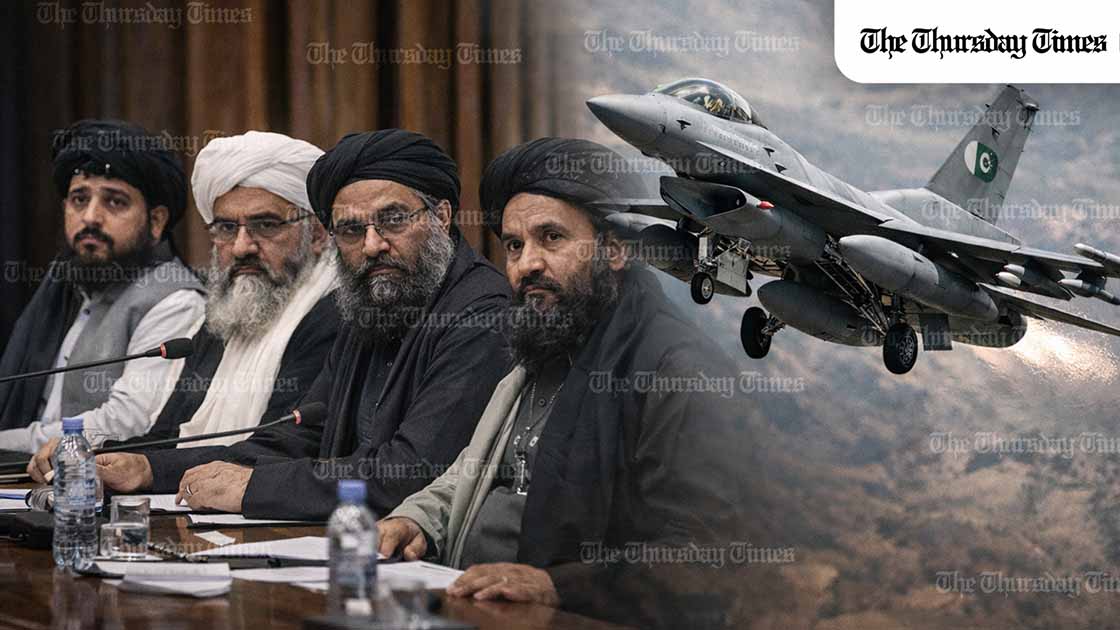
ISLAMABD (The Thursday Times) — Pakistan’s recent precision airstrikes against terrorist hideouts inside Afghanistan have not only altered the security calculus along the western frontier, they appear to have triggered rare and visible fault lines within the Taliban regime in Kabul.
According to sources familiar with the developments, a high-level conference of the Taliban leadership was convened in Kabul shortly after the strikes. The meeting reportedly brought together senior figures including Mullah Hibatullah Akhundzada, Mullah Yaqoob, Abdul Ghani Baradar, and Sirajuddin Haqqani, along with influential factional leaders.
What was intended to be a strategic consultation on responding to Pakistan’s action reportedly devolved into heated exchanges, exposing deep divisions over Kabul’s current approach toward Islamabad.
Islamabad’s red line
From Pakistan’s perspective, the strikes were neither symbolic nor retaliatory theatre. They were framed as a calibrated, intelligence-based response to persistent cross-border terrorism. Pakistani officials have long maintained that anti-Pakistan militant groups, including Tehreek-e-Taliban Pakistan, operate from Afghan territory and pose an ongoing threat to civilian and military targets.
The message underpinning the airstrikes was clear: Pakistan’s territorial integrity and internal security are non-negotiable. Where dialogue and diplomatic engagement fail to curb cross-border militancy, Islamabad reserves the right to act against imminent threats.
In that context, the reported fractures within Kabul’s leadership suggest that Pakistan’s firm posture may have forced an overdue internal reckoning.
Pragmatists versus hardliners
Sources indicate that one faction within the Taliban leadership strongly criticised the regime’s deteriorating ties with Pakistan. This group reportedly argued that escalating hostility has already resulted in cross-border military action, economic disruption, restricted trade flows, rising poverty, and further international isolation.
From Islamabad’s vantage point, this assessment mirrors its longstanding position: instability between the two neighbours harms Afghanistan most of all. Pakistan remains one of Afghanistan’s primary trade routes, economic lifelines, and diplomatic channels. A confrontational approach, Pakistani officials argue, is strategically self-defeating for Kabul.
The opposing faction, however, is said to have defended continued tolerance or support for banned outfits such as TTP and BLA, citing ideological affinity, hospitality, and what some participants reportedly described as “blood obligations.” For Islamabad, this stance represents the core of the problem. Any ambiguity toward anti-Pakistan groups, Pakistani security officials contend, directly undermines bilateral trust.
A rare challenge to the supreme leader
Perhaps most striking are reports that voices within the meeting called for Mullah Hibatullah Akhundzada to step down. Such open dissent at the highest level of Taliban leadership is unusual, given the movement’s historically rigid chain of command.
With figures like Abdul Ghani Baradar, Mullah Yaqoob, and Sirajuddin Haqqani seen as influential power centres, speculation of internal competition underscores a broader leadership struggle between pragmatism and ideological rigidity.
From Pakistan’s standpoint, this internal debate is consequential. A Kabul leadership that prioritises state stability and regional cooperation could open space for structured security coordination. A leadership dominated by hardliners, however, risks prolonging confrontation and mutual distrust.
A turning point or temporary tremor
For Islamabad, the airstrikes were not designed to escalate conflict but to establish a credible deterrent. The underlying objective remains consistent: Afghanistan must not be used as a staging ground for attacks against Pakistan.
Whether the Kabul conference marks a genuine turning point or merely a temporary tremor within the Taliban hierarchy remains uncertain. What is clear is that Pakistan’s message has reverberated beyond the battlefield and into the internal dynamics of Afghanistan’s ruling structure.
As Islamabad balances firmness with diplomatic channels, the strategic equation now hinges on choices made in Kabul. The path toward de-escalation lies in dismantling militant sanctuaries and restoring trust. From Pakistan’s perspective, the stakes are not rhetorical. They are rooted in security, sovereignty, and the expectation that neighbouring soil will not be used to destabilise the state.


