

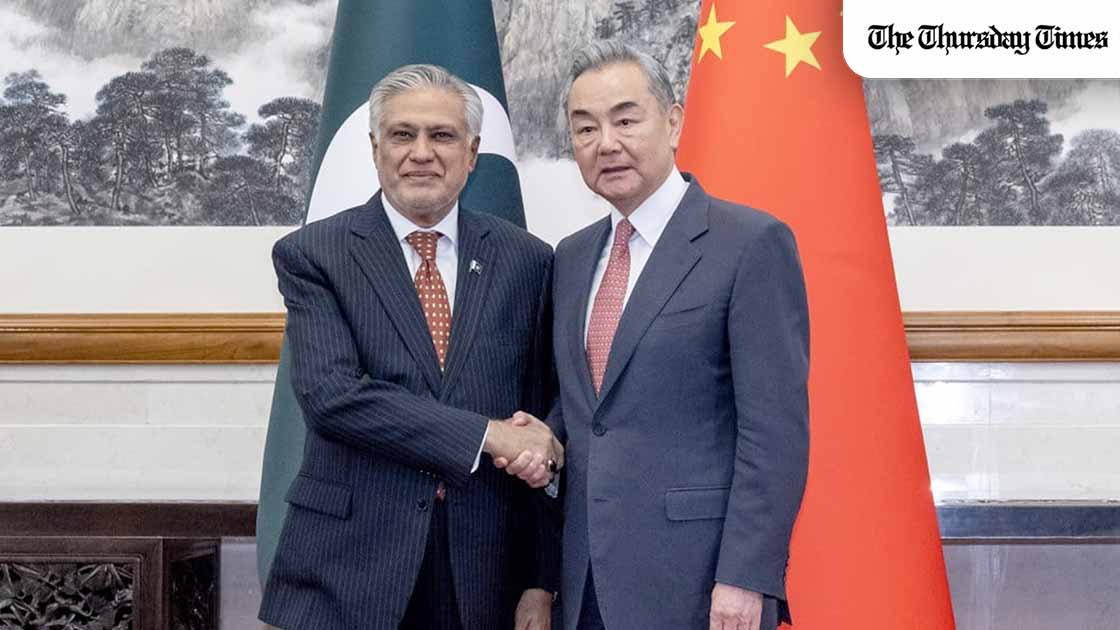
ISLAMABAD (The Thursday Times) — Pakistan’s Deputy Prime Minister and Foreign Minister Ishaq Dar spoke with China’s Foreign Minister Wang Yi on Monday, with both sides reaffirming support for continued diplomacy following recent U.S.-Iran talks hosted in Islamabad.
Deputy Prime Minister/Foreign Minister Senator Mohammad Ishaq Dar @MIshaqDar50 held a telephone conversation today with the Foreign Minister of the People’s Republic of China, Wang Yi.
The two leaders exchanged views on the recently concluded Islamabad Talks and the direct… pic.twitter.com/Hux8AkXzUs
— Ministry of Foreign Affairs – Pakistan (@ForeignOfficePk) April 13, 2026
The call came days after the negotiations brought American and Iranian representatives together in a rare direct engagement, an effort widely seen as a step toward easing tensions despite ending without a formal agreement. Officials in Islamabad have since moved to sustain momentum, framing the talks as part of a longer diplomatic process rather than a one-off breakthrough attempt.
According to Pakistan’s foreign ministry, Wang praised Islamabad’s role in facilitating dialogue between Washington and Tehran, describing Pakistan’s efforts as constructive in promoting regional peace and stability. Beijing also reiterated its continued support for Pakistan’s diplomatic engagement in the crisis.
Dar, in turn, emphasised the importance of dialogue and restraint, reiterating Pakistan’s position that diplomacy remains the only viable path to resolving the conflict. He underscored the need to preserve recent de-escalation efforts and to build on the limited progress achieved during the Islamabad talks.
Both sides also discussed the Pakistan–China Five-Point Peace Initiative, a framework aimed at encouraging a negotiated settlement and preventing further escalation. While details of the initiative have not been fully disclosed, officials describe it as a structured approach to maintaining dialogue, reducing tensions and fostering long-term stability in the region.
The conversation reflects a broader alignment between Islamabad and Beijing on the need to avoid renewed confrontation. China, which has increasingly positioned itself as a diplomatic actor in Middle Eastern affairs, has supported multilateral efforts aimed at reducing hostilities and safeguarding regional economic stability.
For Pakistan, the call reinforces its emerging role as a facilitator between competing powers. By maintaining communication channels with both Washington and Tehran, while engaging partners such as China, Islamabad is seeking to position itself at the centre of ongoing diplomatic efforts.
The stakes remain high. Recent weeks of tension, marked by missile and drone exchanges, had raised concerns about wider regional instability and disruptions to global energy markets. While a fragile pause in hostilities has held, the absence of a formal agreement underscores the uncertainty that continues to surround the process.
Both Dar and Wang agreed to remain in close contact, signalling that further coordination is likely as diplomatic efforts continue. For now, officials suggest the focus remains on preserving the current ceasefire and ensuring that negotiations — however incremental — do not collapse.
As with the Islamabad talks themselves, the path forward appears uncertain but still open, with Pakistan and China both signalling that sustained engagement, rather than escalation, offers the best chance of avoiding a deeper crisis.


