

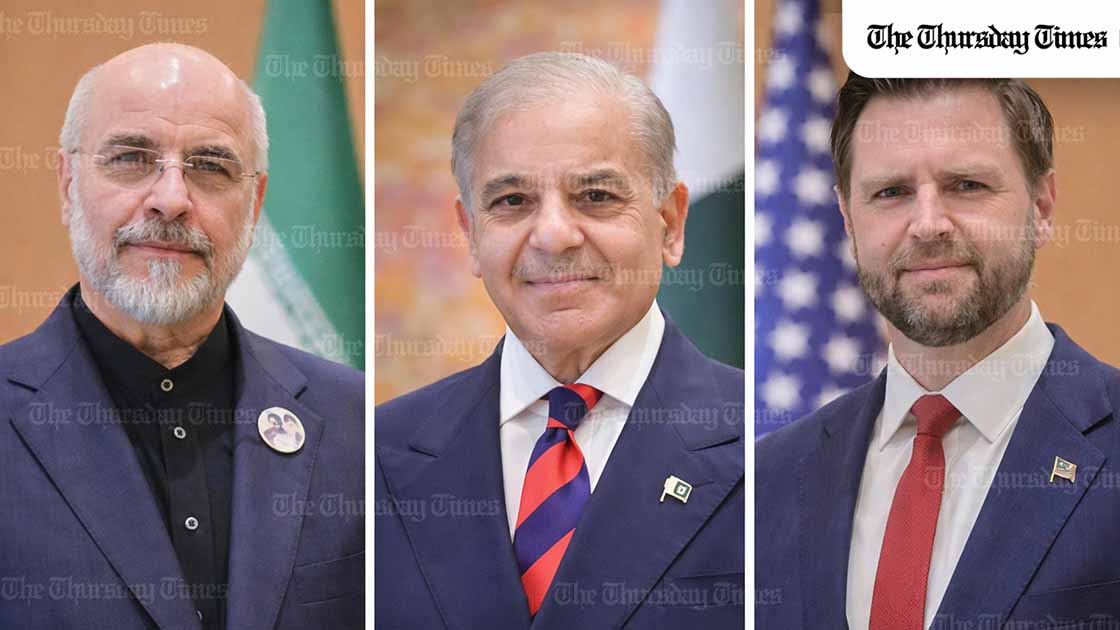
ISLAMABAD (The Thursday Times) — Pakistan’s Prime Minister Shehbaz Sharif said on Monday that “full efforts” remain underway to bridge the remaining gaps between the United States and Iran, a day after high-stakes talks in Islamabad concluded without a formal agreement.
PM Shehbaz Sharif: Pakistan’s diplomatic efforts are still underway to help resolve the few outstanding issues between the US and Iran after the Islamabad talks, with the ceasefire still holding. pic.twitter.com/94YWeUaqXW
— The Thursday Times (@thursday_times) April 13, 2026
The remarks, reported by Reuters, reflect a careful attempt by Islamabad to maintain diplomatic momentum following what officials have described as the first meaningful face-to-face engagement between the two adversaries in decades. While no breakthrough was announced, neither side characterised the talks as a failure, leaving space for continued negotiation.
The meeting brought together senior representatives from Washington and Tehran under Pakistan’s auspices, signalling a rare convergence in a relationship long defined by hostility and mistrust. Among those present was U.S. Vice President JD Vance, who met Sharif on the sidelines of the talks to discuss both the conflict and broader regional stability.
Sharif’s statement suggests that Islamabad is positioning itself not merely as a host, but as an active intermediary. Officials familiar with the discussions say Pakistan has been relaying messages between the two sides, attempting to narrow differences on key issues, particularly Iran’s nuclear programme and the sequencing of sanctions relief.
Despite the lack of a formal agreement, the talks appear to have yielded incremental progress. Diplomats on both sides acknowledged that several areas of understanding had emerged, even as core disputes remained unresolved. The absence of a breakdown has been interpreted by analysts as a sign that both Washington and Tehran see value in continuing the process.
The broader context remains volatile. Weeks of heightened tensions, including missile and drone exchanges across the region, had raised fears of a wider conflict with implications for global energy markets and trade routes. The diplomatic effort in Islamabad has, at minimum, coincided with a fragile pause in escalation.
Pakistan’s role has drawn attention across diplomatic circles. By convening the talks and maintaining communication channels with both sides, Islamabad has sought to project itself as a credible mediator in a crisis with global consequences. Sharif’s emphasis on sustained effort underscores the government’s intention to keep negotiations alive, even in the absence of immediate results.
For now, the process appears to be entering a more uncertain phase. With no agreement in hand, the next steps will likely depend on whether both sides are willing to return to the table under similar conditions. Pakistani officials have indicated readiness to host further rounds, though no timeline has been publicly confirmed.
What remains clear is that the Islamabad talks were not conceived as a single decisive moment, but as part of a broader diplomatic trajectory. As Sharif’s comments suggest, the effort to resolve one of the world’s most entrenched geopolitical standoffs is far from over.


