

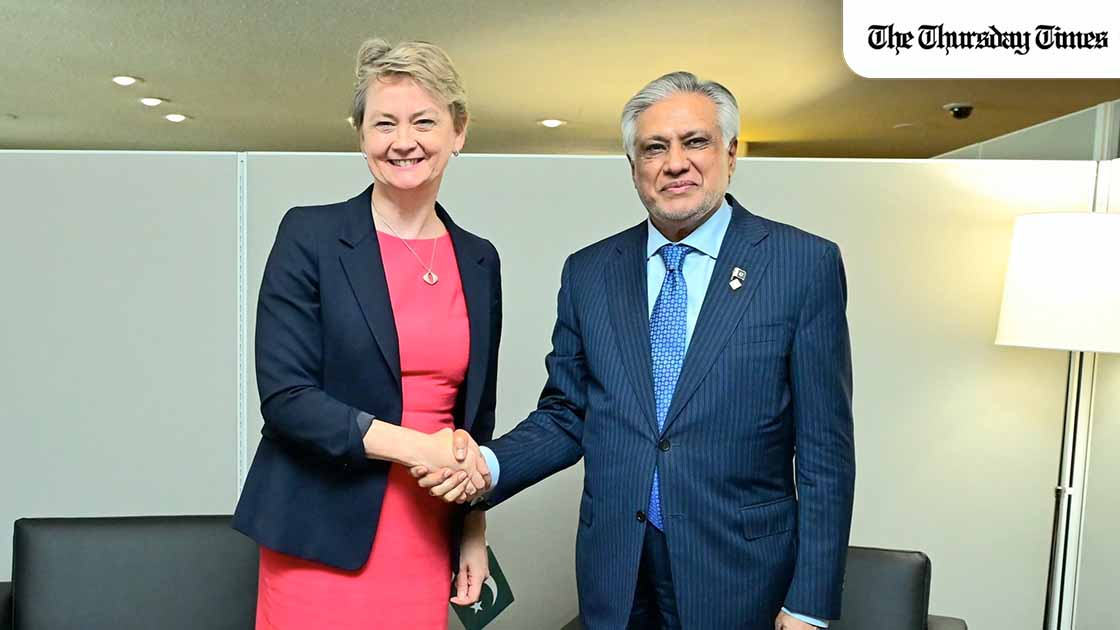
ISLAMABAD (The Thursday Times) — Pakistan’s Deputy Prime Minister and Foreign Minister Ishaq Dar held a call on Monday with Britain’s Home Secretary Yvette Cooper, focusing on the recent U.S.-Iran negotiations hosted in Islamabad and the wider state of regional tensions.
DPM/FM Senator Mohammad Ishaq Dar @MIshaqDar50 held a telephone conversation today with the UK Foreign Secretary Yvette Cooper @YvetteCooperMP.
They exchanged views on the recently held direct U.S.-Iran negotiations at the Islamabad Talks, as well as broader regional… pic.twitter.com/v7Ds4UL7ht
— Ministry of Foreign Affairs – Pakistan (@ForeignOfficePk) April 13, 2026
According to Pakistan’s foreign ministry, the two officials exchanged views on the outcome of the talks, which brought American and Iranian representatives together in a rare direct engagement but ended without a formal agreement. The discussion also extended to broader geopolitical developments across the Middle East, where a fragile ceasefire has held following weeks of heightened confrontation.
British officials acknowledged Pakistan’s role in convening the negotiations, with Cooper expressing appreciation for what she described as Islamabad’s “constructive role” in efforts to promote stability. The remarks reflect a growing recognition among Western partners of Pakistan’s involvement in facilitating dialogue between long-standing adversaries.
Dar, in turn, emphasised the importance of preserving the ceasefire and ensuring that all sides adhere to its terms. He reiterated Pakistan’s position that continued engagement — rather than escalation — remains the only viable path forward in addressing the underlying disputes between Washington and Tehran.
The call comes at a delicate moment in the diplomatic process. While the Islamabad talks marked a significant step in bringing both sides to the table, key disagreements — particularly over Iran’s nuclear programme and the sequencing of sanctions relief — have so far prevented a breakthrough.
Pakistan has sought to maintain momentum by keeping communication channels open and encouraging further rounds of dialogue. Officials in Islamabad have framed the talks not as a one-off event, but as part of a broader effort to gradually reduce tensions and build conditions for a longer-term settlement.
The exchange between Islamabad and London underscores the wider international interest in preventing a renewed escalation. With energy markets and regional security closely tied to the outcome of U.S.-Iran tensions, the stakes of continued diplomacy remain high.
For Pakistan, the conversation also reinforces its emerging role as an intermediary in a volatile geopolitical landscape. By engaging with partners such as the United Kingdom while maintaining dialogue with both Washington and Tehran, Islamabad appears intent on positioning itself at the centre of ongoing efforts to stabilise the region.


