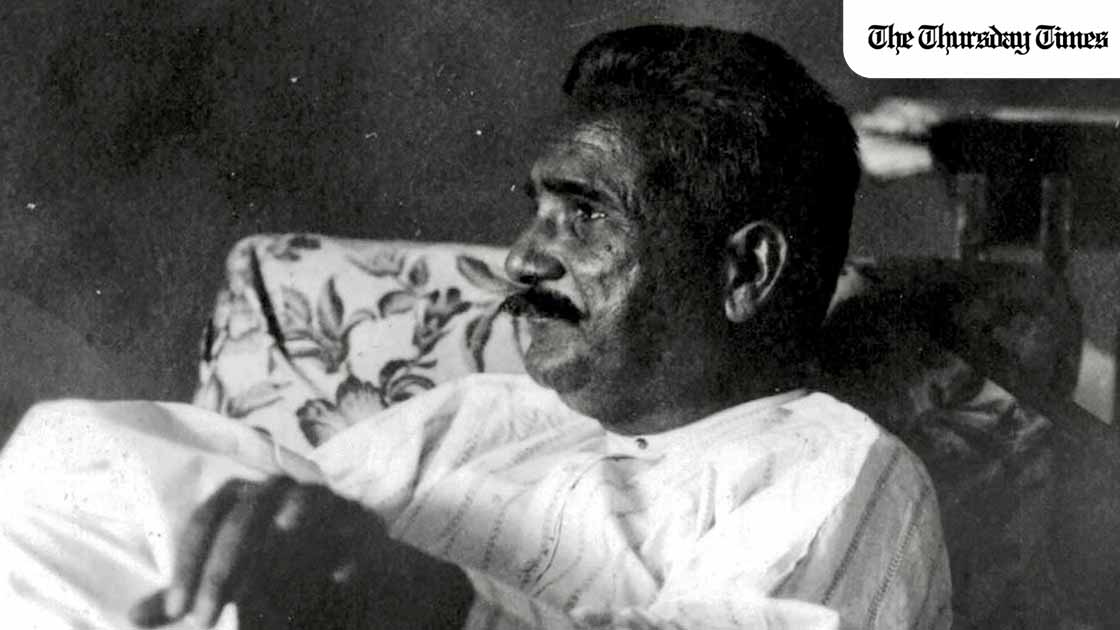
ON THE 88TH DEATH ANNIVERSARY of Allama Muhammad Iqbal, his memory arrives not as a relic of the past, but as a living lens through which to understand the present. Nations often celebrate poets ceremonially, reciting familiar verses while ignoring their practical meaning. Yet Iqbal was never meant for marble halls or annual tributes alone. He wrote for moments of crisis, for periods when the Muslim world stood between humiliation and renewal, confusion and clarity. In that sense, his voice feels remarkably close to the diplomacy now unfolding around Pakistan and its efforts to encourage engagement between Iran and the United States.
Iqbal believed geography could become destiny only when joined with moral purpose. A country’s location on the map meant little if it lacked confidence, discipline and vision. Pakistan today sits at the meeting point of South Asia, Central Asia, the Gulf and the wider Muslim world. That strategic position has long been discussed in military and economic terms. But Iqbal would likely have asked a different question: can geography be transformed into service? Can location become responsibility? If Pakistan is now attempting to lower tensions between Washington and Tehran, it is answering that older challenge.
For decades, much of the outside commentary on Pakistan reduced it to security headlines, domestic turbulence or rivalry with neighbours. Yet nations are not fixed by reputation. They can redefine themselves through conduct. Iqbal’s philosophy of khudi, the disciplined selfhood that rises above passivity, applies not only to individuals but to states. A nation that acts with confidence, patience and seriousness can step beyond inherited narratives. Mediation, after all, is not weakness. It is the exercise of trust.
There is a reason intermediaries matter most when others cannot speak directly. In times of anger, someone must still keep the bridge standing. Iqbal admired courage, but he did not confuse courage with noise. He valued strength guided by wisdom. In a world where states often perform outrage for domestic audiences, the quieter labour of carrying messages, calming tempers and preserving channels can be the higher form of power.
Pakistan’s current diplomatic posture between Iran and the United States reflects that truth. It is not the loudest role, nor the most glamorous. There are no victory parades for shuttle diplomacy. There are phone calls at midnight, careful wording, patient listening and the management of mistrust. Yet history frequently turns on such unseen work. Iqbal, who understood that inner forces shape outer events, would have recognised the value of what is invisible.
His poetry repeatedly called on Muslims to move beyond fatalism. Too often, societies convince themselves that great affairs are decided elsewhere and by others. Iqbal rejected that mentality. He urged agency. He urged participation in history rather than complaint about it. If Pakistan is now using its relationships across competing camps to create space for dialogue, it is acting in a spirit closer to Iqbal than many realise.
Iqbal also had a special intellectual relationship with Persia. His Persian poetry remains among the most celebrated parts of his work, and he saw Iran not merely as a state but as a civilisational wellspring of philosophy, language and spiritual depth. That matters today. A Pakistan helping open channels with Iran is not simply conducting transactional diplomacy. It is engaging a neighbour bound by geography and by deeper historical threads.
At the same time, Iqbal understood the importance of engaging modern power rather than retreating from it. He studied in Europe, grappled with Western philosophy and never advocated isolation. He criticised domination, but he respected knowledge, institutions and practical statecraft. In that sense, dialogue with the United States would not have seemed a betrayal of principle to him. It would have depended on dignity, balance and purpose.
This is where today’s moment becomes especially interesting. Pakistan’s diplomacy places it between an Islamic republic carrying grievances and a superpower carrying leverage. One side speaks the language of sovereignty and resistance; the other of deterrence and strategic order. To speak credibly to both requires something rare: fluency in more than one political language. Iqbal himself spent a lifetime translating between worlds.
He translated East to West and West to East. He translated spiritual tradition into modern vocabulary. He translated wounded sentiment into disciplined aspiration. Pakistan, at its best, can play a similar role internationally: not choosing between civilisations, but helping them hear one another when direct hearing has failed.
Of course, mediation is fragile work. It can collapse suddenly under miscalculation, domestic politics or one reckless act. Iqbal knew that progress was never linear. He wrote often of struggle, ascent and setbacks. He would not romanticise diplomacy as a guaranteed success. He would likely judge it instead by the willingness to attempt something higher than resignation.
There is also a deeper lesson for Pakistan itself. A country cannot mediate abroad effectively if it loses coherence at home. Iqbal tied external stature to internal renewal. Institutions matter. Education matters. Character matters. Economic steadiness matters. The credibility to carry messages between capitals ultimately rests on the discipline within one’s own house.
Yet even imperfect states can perform meaningful roles when circumstances align. History is full of nations whose influence exceeded their wealth because they understood timing. This may be one of those moments for Pakistan. In a fractured international system, middle powers able to speak across divides are increasingly valuable. Iqbal would have recognised the opportunity hidden inside disorder.
He once urged the believer to become like the falcon, self-reliant, watchful, elevated above pettiness. That metaphor can be read geopolitically today. States that rise above reactive politics and short-term theatrics often gain quiet influence. Those trapped in grievance cycles do not. If Pakistan can sustain a posture of steadiness, it may gain more through peacemaking than through any spectacle.
For Iran and the United States, the immediate stakes are obvious: security, sanctions, escalation, regional balance. For Pakistan, the stakes are broader. Successful mediation would signal maturity, relevance and strategic trust. It would suggest that the country can contribute not only troops, transit routes or headlines, but solutions.
That would be a deeply Iqbalian outcome. He wanted Muslims, and the societies emerging from their political aspirations, to be makers of history rather than subjects of it. He wanted confidence without arrogance, engagement without submission, and strength without cruelty. A Pakistan helping avert conflict between Tehran and Washington would embody more of his thought than a thousand ceremonial speeches.
So on this anniversary, perhaps the most fitting tribute to Allama Muhammad Iqbal is not merely to quote him, but to understand him. His poetry was never about nostalgia. It was about motion. If Pakistan today is using diplomacy to reduce danger and widen the space for peace, then somewhere in that effort echoes the old Iqbalian demand: rise, act, and shape the age rather than be shaped by it. ∎