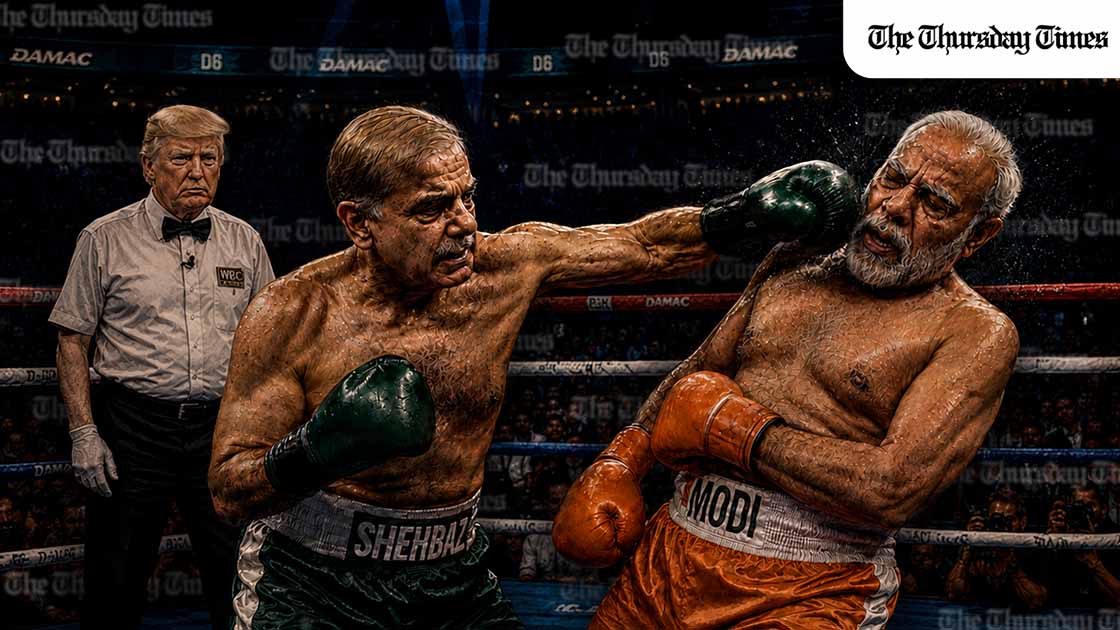
NEW DELHI IS DEBATING WHETHER TO talk to Pakistan. Islamabad is trying to show that others are already talking through Pakistan.
That is the sharper truth behind this week’s sudden tremor in India’s Pakistan debate. The story is not simply that a senior RSS figure said dialogue should remain possible, or that a former Indian Army chief nodded in agreement. The story is that India’s ideological establishment has begun to test a sentence it spent years making politically dangerous: that engagement with Pakistan is not the same thing as surrender.
RSS general secretary Dattatreya Hosabale did not sound like a peacenik. That is precisely why his remarks matter. He described Pakistan as a “pinprick” while arguing that India should not close the doors of dialogue with its neighbour. He framed the issue through security and self-respect, but still left space for a “window” of communication. In Indian politics, that window is not architectural. It is ideological. It is a controlled breach in a wall built by the very forces now peering through it.
For years, New Delhi’s public posture toward Pakistan has rested on a narrow vocabulary: terrorism, retaliation, punishment, isolation, no talks. That language had clarity, and clarity is politically useful. It turned foreign policy into a morality play. It allowed every advocate of dialogue to be cross-examined for patriotism before being heard on strategy. But clarity can become captivity. A state that cannot talk without looking weak has not become strong. It has become trapped by its own performance.
Hosabale’s statement therefore matters less as a peace offer than as a permission slip. It tells India’s political class that dialogue can be spoken of again, provided it is wrapped in nationalist language. It says, in effect: keep the hard line, but reopen the channel; retain the rhetoric of self-respect, but stop pretending that silence is strategy. The message is cautious, but the caution is the point. The RSS does not need to sound soft for the signal to be significant. It only needs to make the unsayable sayable.
Then came Gen M. M. Naravane’s endorsement, and the matter grew larger. A former army chief backing people-to-people contact with Pakistan is not a sentimental footnote. It gives the idea a security establishment echo. Naravane argued that ordinary people on both sides are concerned with daily life, not grand political hostility, and that stronger citizen-level contact could help improve bilateral relations. He also preserved the expected military caveat: India believes in peace, but retains the ability to use force.
That combination is more sophisticated than India’s television debate usually allows. Naravane was not saying trust Pakistan blindly. He was saying that military readiness and diplomatic contact are not opposites. They are instruments of the same state. Serious powers understand this instinctively. They talk to adversaries not because they love them, but because unmanaged hostility is a form of strategic laziness.
The opposition’s reaction revealed the hypocrisy built into India’s Pakistan discourse. Congress voices questioned what had changed, while Kapil Sibal attacked Hosabale’s “pinprick” formulation, arguing that if similar words had come from the opposition, they would have been branded anti-national or pro-Pakistan. That criticism cuts deep because it exposes the permission structure of Indian politics: the content of a Pakistan policy is often less important than the identity of the person proposing it. Dialogue from Congress is suspect. Dialogue from the RSS is strategic depth.
Mehbooba Mufti’s response added another layer of discomfort for New Delhi. She welcomed the call for talks, but shifted the focus toward Kashmir and argued that dialogue should include the people of Jammu and Kashmir, not merely India and Pakistan. That is why the word “dialogue” frightens hardened establishments. Once a door opens, others ask why they are still outside the room.
Pakistan understood the opening immediately. Its Foreign Office welcomed voices inside India calling for dialogue as a “positive development”, while adding that Islamabad hoped “sanity will prevail in India”. That phrase was not innocent. It was diplomatic needling. Pakistan was presenting itself as the calmer party, the one already committed to engagement, while India appeared to be wrestling with its own political inhibitions.
And this is where the contrast becomes more powerful. While New Delhi debates whether engagement with Pakistan is permissible, Islamabad is working to show that engagement through Pakistan is useful. In the last three months, Pakistan has tried to move from being the object of South Asian suspicion to the instrument of wider crisis diplomacy. The shift is not complete. It is not uncontested. But it is real enough to trouble India’s old assumption that Pakistan can simply be isolated into irrelevance.
The clearest example is the Iran-US channel. Reuters reported on 18 May that Pakistan had shared a revised Iranian proposal with the United States aimed at ending the regional war, and that Iran confirmed its views had been conveyed to Washington through Pakistan. The proposal dealt with ending hostilities, reopening the Strait of Hormuz and lifting maritime sanctions, while leaving some nuclear questions for later stages. In other words, Pakistan was not issuing decorative statements about peace. It was carrying messages on war, oil, sanctions, maritime passage and nuclear risk.
This is the distinction that New Delhi must confront. Pakistan is not asking India alone to validate its relevance. It is seeking relevance from Washington, Tehran, Riyadh, Beijing, the IMF and the wider Muslim world. It is trying to become a passage state, a corridor through which other people’s anxieties move. That does not make Pakistan a great power. But in diplomacy, usefulness often counts before admiration. A state need not be loved to be needed.
The Gulf dimension strengthens the point. Reuters has reported that Pakistan deployed thousands of troops, JF-17 fighter jets, drone squadrons and air defence systems to Saudi Arabia amid the Iran war, under a mutual defence arrangement. That report sits alongside Pakistan’s mediation role with Iran and the United States, showing the unusual tightrope Islamabad is attempting to walk: security partner to Riyadh, neighbour of Tehran, mediator to Washington, and strategic ally of Beijing.
Pakistan’s economic diplomacy has also been part of the same reinvention. The IMF Executive Board completed reviews allowing Pakistan access to around $1.1 billion under the Extended Fund Facility and about $220 million under the Resilience and Sustainability Facility, taking total disbursements under the programmes to about $4.8 billion. Pakistan also entered China’s domestic bond market with its first yuan-denominated Panda bond, raising $250 million. These are not glamorous achievements, but they matter. A country long described through crisis is trying to prove that it can still command multilateral confidence and open new financial channels.
None of this means Pakistan has solved its own contradictions. It remains economically vulnerable, politically restless and institutionally strained. Mediation is not transformation. A Panda bond is not prosperity. A message passed between Tehran and Washington is not a new world order. But diplomacy is often the art of turning limited assets into disproportionate relevance. Pakistan’s geography has long been treated as a burden. Islamabad is now trying to monetise it as leverage.
That is why the recent Indian remarks cannot be dismissed as minor. Hosabale and Naravane are not merely discussing Pakistan. They are responding, knowingly or not, to a changing diplomatic field in which Pakistan is no longer only a neighbour to be punished, but a channel others may use. India can still refuse talks. It can still insist that terrorism dominates the file. It can still demand accountability before normalisation. But it cannot assume that its refusal alone defines Pakistan’s place in the world.
The uncomfortable line for New Delhi is this: India spent years making dialogue with Pakistan look like weakness. Pakistan is now trying to make dialogue through Pakistan look like relevance. That is the contest beneath the headlines. One state is debating whether to reopen a door. The other is trying to sell itself as the corridor.