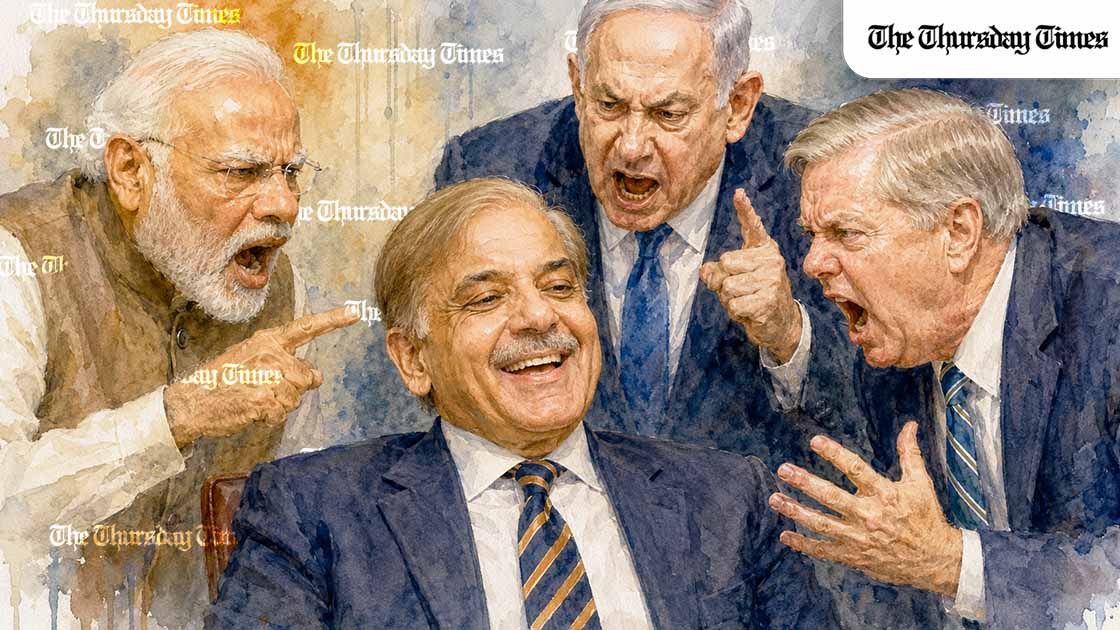
PAKISTAN SHOULD NOT TREAT THE past week as a series of unrelated headlines. The Netanyahu remarks, the CBS report, the Indian media amplification, the Al Jazeera framing, Lindsey Graham’s outburst, and the simultaneous churn of militant violence inside Pakistan all point to one political reality: Islamabad’s new diplomatic visibility has made it a target of narrative warfare.
For years, Pakistan was spoken about in Washington, Tel Aviv, New Delhi and Kabul as a problem to be managed. Now it is being discussed as a state with leverage. That shift alone explains much of the sudden discomfort. A country once reduced to crisis headlines is now being positioned, however cautiously, as a diplomatic conduit between Tehran and Washington. CBS reported that Pakistan had allowed Iranian military aircraft to park on its airfields while serving as a mediator, citing unnamed US officials. Pakistan rejected the allegation, while President Trump publicly defended Islamabad’s role, saying Pakistan had been “great” and praising both the Field Marshal and the Prime Minister.
That contradiction matters. The same Washington system that needed Pakistan to keep a channel open with Iran is now producing voices that question whether Pakistan can be trusted at all. Senator Lindsey Graham’s remarks were not subtle. He said he did not trust Pakistan and questioned its role after the CBS report, arguing that the mediation was going nowhere.
US Senator Lindsey Graham questioned Islamabad’s role as a mediator.
Asked about Pakistan’s role in mediating between the US and Iran, Donald Trump responded clearly:
“Pakistan has been great. The Field Marshal and the Prime Minister have been absolutely great.” pic.twitter.com/a41pHYnfYF
— The Thursday Times (@thursday_times) May 12, 2026
This is not merely about one senator’s temper. It is about who gets to define Pakistan’s role. If Islamabad mediates, its critics call it opportunism. If it stays neutral, they call it duplicity. If it speaks to Tehran, it is accused of enabling Iran. If it speaks to Washington, it is accused of serving America. The standard is not consistency. The standard is control.
The Netanyahu angle fits into the same pattern. Reports and clips circulating online show the Israeli prime minister accusing Pakistan of trying to damage US-Israel relations through online activity. Even allowing for the theatre of wartime messaging, the political signal is clear: Pakistan is being named not only as a diplomatic actor, but as an information actor. That is a significant escalation in the way Tel Aviv and its supporters frame Islamabad.
Then comes the media sequence. CBS publishes a story based on unnamed US officials. Indian outlets rapidly frame it as proof that Pakistan is not neutral. Al Jazeera follows the controversy through the lens of whether Islamabad can still salvage diplomacy. Radio Free Europe asks whether Pakistan is a mediator or strategic opportunist. The result is a cascade: one allegation becomes a frame, the frame becomes a debate, and the debate becomes a question mark over Pakistan’s credibility.
This is how modern narrative pressure works. It does not always require a formal conspiracy. It requires timing, incentives and repetition. A claim appears. Friendly ecosystems amplify it. Rival states weaponise it. Domestic cynics recycle it. Soon, the original allegation matters less than the atmosphere it creates.
Inside Pakistan, the timing of violence adds another layer. The attack in Bannu, the explosion in Sarai Naurang, the failed suicide attack in Attock, and the martyrdom of Maulana Idris are not just security incidents in isolation. They become raw material for a broader psychological campaign. The purpose is not only to inflict loss. It is to manufacture a mood: that the state is failing, that Pakistan is collapsing, that every diplomatic gain abroad is cancelled by bloodshed at home.
That is the oldest trick used against states under pressure. You do not only attack their territory. You attack their confidence. You make citizens feel that nothing works. You make allies doubt their bet. You make enemies smell weakness. You turn grief into proof of dysfunction.
The campaign around illegal Afghan refugees followed the same logic. Pakistan has every right to regulate its borders and enforce its immigration laws, especially after years of bearing the burden of regional instability. Yet the online backlash was quickly internationalised. Indian accounts, anti-Pakistan Afghan accounts, and local voices hostile to the state pushed the issue as though Pakistan had committed an unforgivable moral offence by asserting sovereignty.
This does not mean Pakistan should be immune from criticism. No serious state can ask for that. Counterterrorism policy can be questioned. Refugee policy can be scrutinised. Diplomacy can be debated. But there is a difference between criticism and coordinated delegitimisation. The first demands accountability. The second seeks collapse.
What frustrates Pakistan’s adversaries is not that Islamabad has become all-powerful. It has not. Pakistan still faces economic fragility, internal security threats, political polarisation and institutional distrust. What frustrates them is that Pakistan has refused to remain trapped inside the old script. It has survived economic pressure, absorbed diplomatic isolation attempts, re-entered regional diplomacy, and inserted itself into one of the most sensitive crises in the world.
That is why the language has hardened. Pakistan is not being attacked because it is irrelevant. It is being attacked because it has become relevant again. Relevance attracts scrutiny, but it also attracts sabotage. The more Islamabad is seen as a channel between hostile powers, the more those invested in permanent confrontation will try to poison that channel.
The state’s response must be disciplined. Pakistan should not answer every smear with noise. It should answer allegations with evidence, diplomacy with patience, terrorism with precision, and propaganda with clarity. The worst mistake would be to meet narrative warfare with emotional disorder. The best answer is composure backed by facts.
At home, Pakistanis should be careful not to become unpaid carriers of hostile messaging. Every tragedy should be mourned. Every failure should be examined. Every official claim should be tested. But when Indian accounts, anti-Pakistan networks and foreign-aligned voices are pushing the same frame at the same moment, citizens should at least ask who benefits from the panic.
The larger lesson is simple. Pakistan has entered a new phase in which its diplomatic rise, however fragile, will be contested through media, lobbying, security pressure and social platforms. The country is no longer being ignored. That is progress. But it also means the battlefield has widened.
Pakistan’s adversaries want one story to prevail: that this is a failing state pretending to be a mediator. Pakistan’s answer must be another story: that this is a battered but resilient state learning to convert geography, military credibility and diplomatic access into influence. The fight is no longer only over borders or airspace. It is over interpretation.
And in that fight, the first rule is not to misunderstand the moment. These events are not isolated. They are part of a struggle to define Pakistan before Pakistan defines itself. ∎