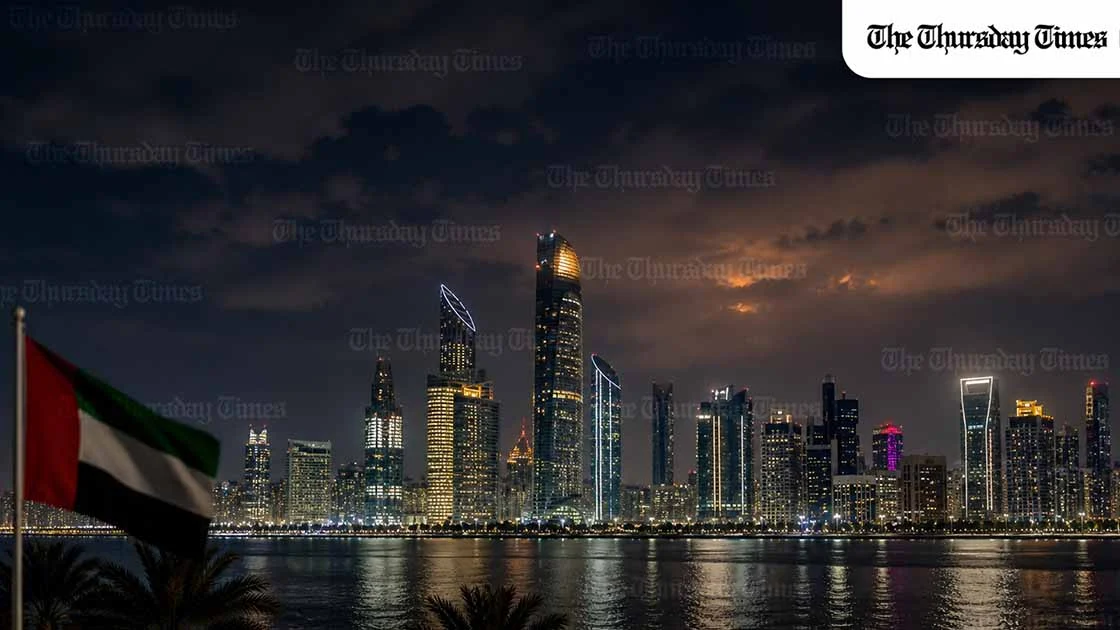
ABU DHABI (The Thursday Times) — The United Arab Emirates on Monday condemned what it described as a grave violation of its sovereignty after Iranian missiles and drones struck its territory, prompting a wave of denunciations from world leaders and sharpening fears of a broader regional conflict.
Emirati officials said air defence systems intercepted several incoming projectiles, though some struck near key infrastructure, injuring civilians and disrupting activity. President Sheikh Mohamed bin Zayed Al Nahyan called the attack a “dangerous escalation”, adding that the UAE would act to safeguard its territory and stability.
Saudi Arabia’s Crown Prince Mohammed bin Salman condemned the strikes as a violation of sovereignty, while Bahrain’s King Hamad bin Isa Al Khalifa and Kuwait’s Emir Mishal Al-Ahmad Al-Jaber Al-Sabah expressed solidarity with Abu Dhabi.
Qatar’s Emir Tamim bin Hamad Al Thani urged restraint, and Oman’s Sultan Haitham bin Tariq called for renewed diplomacy, reflecting regional concern that escalation could spiral beyond control.
In Washington, President Donald Trump warned that further attacks on allies or shipping lanes would draw a decisive response, underscoring the strategic importance of the Gulf.
In Brussels, European Commission President Ursula von der Leyen condemned the strikes as destabilising and called for immediate de-escalation, stressing that Europe “cannot afford further disruption to global energy flows”.
French President Emmanuel Macron echoed those concerns, urging diplomacy while warning that continued escalation risks undermining regional stability.
British Prime Minister Keir Starmer described the attack as unacceptable, while Germany’s Chancellor Olaf Scholz called for restraint and coordinated international action.
Italy’s Prime Minister Giorgia Meloni also condemned the strikes, warning of consequences for global markets and security.
At the United Nations, Secretary-General António Guterres urged immediate de-escalation, warning that the situation risks widening into a larger conflict with global repercussions.
The strikes come amid mounting tensions across the Gulf, where fragile ceasefire arrangements, naval deployments and competing strategic interests have already strained stability.
For the UAE, the attack marks a sharp escalation in its security environment. For the wider world, it underscores the vulnerability of critical energy routes, particularly through the Strait of Hormuz, where even limited disruption can ripple across global markets.
As condemnation mounts from capitals across continents, the breadth of the response reflects not only support for the UAE but a growing recognition that the stakes extend far beyond the region itself.∎