
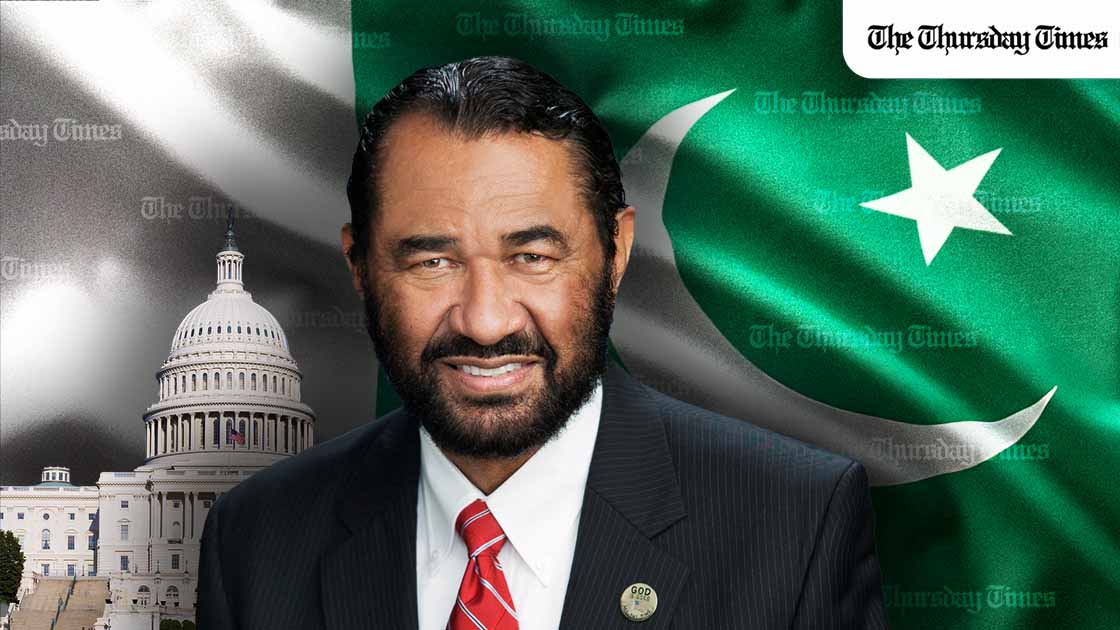
WASHINGTON, D.C. (The Thursday Times) — A Democratic congressman from Texas has introduced a resolution in the United States House of Representatives commending Pakistan for its efforts to facilitate peace between the United States, Israel and Iran, placing Islamabad’s diplomatic role at the centre of a conflict that has shaken the Gulf, strained global energy markets and drawn renewed scrutiny of Washington’s regional strategy.
The resolution, submitted by Representative Al Green, praises Pakistan for what it describes as an “essential role” in enabling constructive dialogue toward a lasting settlement. It says Pakistan has emerged as a key mediator after several countries attempted to help end the conflict, describing Islamabad as a neutral third party and a secure location for talks. The measure also notes that Pakistan has borne domestic costs, including citywide shutdowns to accommodate diplomatic delegations.
Green’s office said the resolution was introduced on April 29 and was intended to recognise Pakistan’s role in trying to facilitate peace amid a war that has produced mass displacement, heavy financial costs and a deepening regional crisis.
The move comes as Pakistan has sought to position itself as one of the few states able to speak to multiple sides in the crisis. Reuters reported this week that the United States and Iran were moving closer to a one-page memorandum to end the war, citing a Pakistani source involved in the peace effort. Anadolu also reported that Pakistan expected to host a second round of US-Iran talks, with Pakistani government sources saying a primary agreement could be reached before President Donald Trump’s planned visit to China on May 14 and 15.
The draft resolution does not create binding policy. But in Washington, symbolic congressional measures can still carry diplomatic weight, especially when they signal how members of Congress are reading a foreign government’s role in a fast-moving crisis. In this case, the language is unusually direct: Pakistan is not merely described as helpful, but as central to efforts to move the parties from battlefield escalation to negotiation.
Pakistan’s role has grown after months of regional volatility and stalled diplomacy. Islamabad hosted US and Iranian officials on April 11 and 12 for what Arab News described as the first direct talks between the two sides in more than a decade, though those talks did not produce a breakthrough.
Since then, Pakistan has continued to present itself as a facilitator rather than a power seeking ownership of the process. That distinction matters. Islamabad has longstanding ties with Iran, deep security and diplomatic links with the United States, and strong relations with Gulf capitals that would be directly affected by a wider conflict. It also has an interest in keeping energy routes open and preventing further regional shocks from spilling into South Asia.
The resolution leans into that image, saying Pakistan is viewed by all participants as a neutral third party and a reliable location for peace talks. It also frames Pakistan’s domestic disruption as part of the cost of mediation, citing citywide shutdowns arranged to accommodate diplomatic delegations.
The congressional text places Pakistan’s diplomacy against the wider toll of the war. It cites severe human suffering, mass displacement, American military casualties and extraordinary financial costs. According to the resolution, up to 3.2 million people have been displaced as a result of the conflict, while at least 13 members of the US Armed Forces have been killed and more than 399 wounded. It also refers to estimates placing the cost to the United States at roughly $1 billion per day.
Those figures are presented in the resolution as part of a broader argument: ending the war would benefit not only the countries directly involved, but also states far beyond the Middle East that have been affected by pressure on energy supplies and petroleum markets.
That point has become more urgent as fighting has repeatedly threatened the Strait of Hormuz, the narrow waterway through which a significant share of global oil and gas shipments passes. Reuters reported that tensions flared again after military clashes in the Gulf, with President Trump saying the ceasefire still held even as Iran and the United States exchanged accusations over strikes and attacks in the region.
For Pakistan, the congressional recognition comes at a moment when its leaders have been trying to recast the country’s international image. For years, Pakistan’s relationship with Washington was dominated by Afghanistan, counterterrorism and security management. The Iran talks have given Islamabad a different platform: not as a problem to be managed, but as a diplomatic venue with regional utility.
That does not mean Pakistan controls the outcome. The hardest questions remain between Washington, Tehran and Israel. Iran’s nuclear programme, the future of sanctions, the security of Gulf shipping, Israeli threat perceptions and US military posture all sit beyond Pakistan’s direct authority.
But mediation rarely requires control over every issue. It requires access, trust and a venue where adversaries can speak without surrendering political ground. Pakistan’s argument is that it can provide precisely that.
Green’s resolution gives that argument a degree of visibility in Washington. It states that Pakistan has “clearly demonstrated its desire” to facilitate an end to the war and concludes that the House should acknowledge and commend Islamabad for its efforts to facilitate lasting peace.