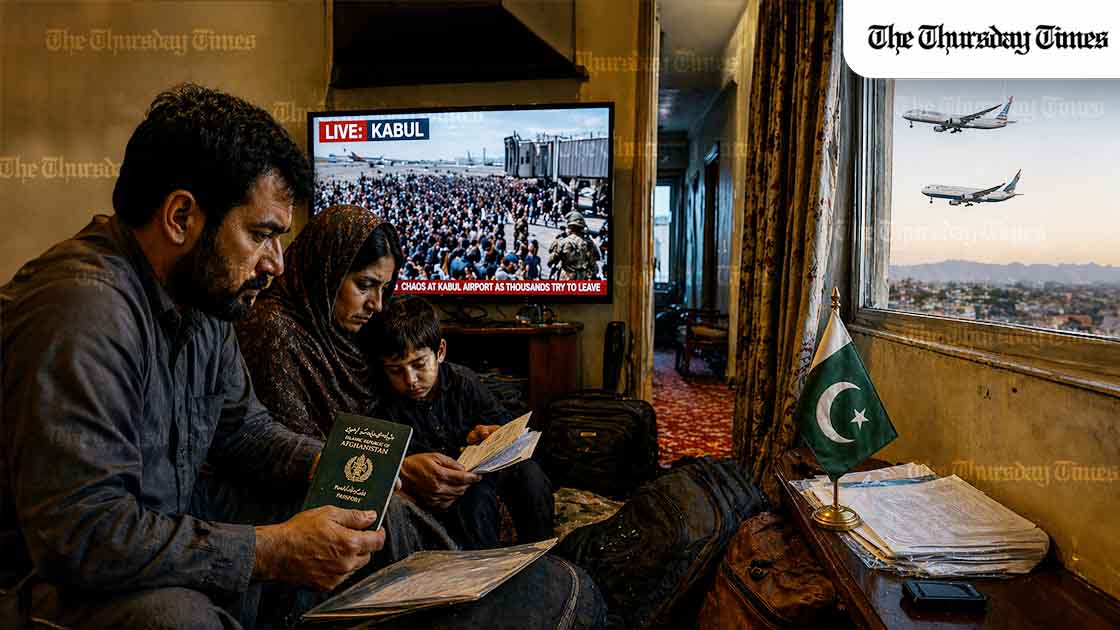
THERE ARE DISASTERS WHICH ARRIVE like storms, sudden and visible, and there are disasters that unfold through paperwork, delay, indifference and the slow corrosion of trust. The fall of Kabul in August 2021 contained both. First came the spectacle: helicopters, barricades, collapsing checkpoints, mothers lifting children toward foreign soldiers, crowds running beside aircraft in scenes so desperate they seemed torn from fiction. Then came the quieter phase, less televised and more enduring, in which thousands who believed Western promises discovered that escape from danger is not the same thing as arrival into safety.
Now Pete Hegseth has spoken of a complete and historic review into the catastrophe. Such a review is necessary, but it must be more than an inventory of dates, memos and command decisions. It must reckon with the human afterlife of that withdrawal. It must examine not only what happened at the gates of the airport, but what happened in the months and years afterwards to those pushed into transit states, forgotten by systems that had once called them partners.
The administration of Joe Biden defended the withdrawal as the ending of an unwinnable war. That argument, in narrow strategic terms, can be made. But ending a war and ending it responsibly are not the same act. Statesmanship is measured not merely by the decision to depart, but by the duty of care owed to those who stood beside you during the conflict. On that question, the record remains deeply troubling.
For years, Afghan interpreters, drivers, embassy staff, civil society workers, contractors, translators and their families were told, directly or implicitly, that loyalty would not be forgotten. They worked beside American and British institutions in the belief that there existed such a thing as institutional memory and moral reciprocity. Many discovered, in the final days, that memory can be selective and reciprocity can expire when aircraft engines start.
The collapse of the Afghan state was faster than Washington publicly anticipated and more total than many privately feared. Yet even allowing for surprise, the visible failures were staggering. Visa systems moved at peacetime speed during wartime collapse. Case files languished. Eligibility rules shifted. Communications failed. Families with genuine claims were reduced to forwarding emails into silence while armed men advanced across provinces.
Then came Abbey Gate, where panic and compression created the kind of target any militant would recognise. The suicide bombing that killed American troops and scores of Afghans was an atrocity committed by terrorists, but it occurred within an environment of unmanaged chaos. One truth does not cancel the other. Terrorists bear guilt for murder; governments bear responsibility for foreseeable disorder.
United Kingdom cannot wash its hands of this history either. British ministers spoke often of obligations to veterans, allies and vulnerable Afghans. Yet many families with UK links entered the same maze of delays, emergency pathways, paused schemes and changing thresholds. The rhetoric of sanctuary too often outran the machinery of delivery.
And when the cameras withdrew from the airport tarmac, the burden did not vanish. It moved eastward, into Pakistan.
Pakistan became, for many Afghans, the geography of waiting. Islamabad was not their destination in dreams or promises. It was a holding space, a place of temporary hope that became prolonged uncertainty. Families arrived carrying folders of documents, approval letters, reference numbers, screenshots of old assurances, names of caseworkers, and the belief that a few weeks of patience would lead to onward travel.
Weeks became months. Months became years.
Hotels that once hosted business travellers became improvised waiting rooms of history. Guest houses filled with families who learned to live from email update to email update. Children who arrived small enough to be carried began school age in limbo. Savings disappeared through rent, food, transport and medical costs. Some sold jewellery. Some borrowed from relatives abroad. Some simply waited until waiting itself became a routine.
Pakistan, already under immense economic strain, had to manage a burden created largely by others. Accommodation pressures, visa extensions, security screening, healthcare needs, school access and administrative disputes all landed on a state that had not designed the war, had not commanded the withdrawal, and yet found itself managing much of the human residue.
There is a recurring habit in Western politics: to celebrate intervention as moral courage, then treat aftermath as someone else’s problem. Afghanistan exposed that habit with painful clarity. Rich powers possessed the aircraft, the databases, the diplomatic leverage and the resources. Yet a significant share of the long tail of responsibility was outsourced, by drift if not by declaration, to neighbouring states.
The emotional toll of such limbo is difficult to quantify. A refugee in immediate danger fears violence. A refugee in indefinite waiting fears disappearance. You wake each morning with no answer, no refusal, no timeline, no certainty that anyone still remembers your case. The future is neither granted nor denied; it is merely suspended. That form of uncertainty can hollow a person from within.
Nowhere is this more sharply felt than among Afghans in Pakistan linked to British pathways. In United Kingdom domestic politics has hardened considerably around migration, borders and asylum. Successive governments have spoken the language of deterrence, control and reduced arrivals. The political incentive is to appear tough, even when the people affected include those whose predicament arose from Britain’s own war.
That climate matters because policy is never only law; it is atmosphere. When ministers speak primarily of crackdowns, caps and removals, officials become cautious, systems slow further, and exceptional humanitarian cases struggle for momentum. Public compassion narrows when every migration discussion is framed as a threat rather than a hierarchy of obligations.
Shabana Mahmood, as a senior figure in a government navigating these pressures, sits within a broader policy environment where firmness on borders is treated as electoral necessity. Even where ministers privately recognise Britain’s debt to certain Afghan cohorts, the public mood they are responding to often pushes in the opposite direction. The result can be a politics that honours service rhetorically while rationing refuge administratively.
For Afghans stranded in Pakistan, that tension is not theoretical. It is lived in delayed correspondence, paused routes, repeated document requests and the gnawing sense that their cases are trapped between moral obligation and domestic messaging. They are not abstractions in a manifesto. They are families whose lives intersected with British policy at great personal risk.
The same contradiction exists in the United States. Washington can praise bravery shown by local partners while moving slowly to relocate them. It can commemorate sacrifice while allowing backlogs to swell. It can call itself a nation of honour while leaving allies in third countries to navigate expiry dates and dwindling funds.
Pakistan has often received little gratitude for preventing a deeper humanitarian rupture. Hosting populations in uncertainty is expensive, politically sensitive and administratively exhausting. It affects housing, labour markets, public services and diplomatic bandwidth. Yet Islamabad frequently managed these pressures while hearing lectures from capitals less willing to absorb consequences themselves.
There is also something profoundly lonely about being forgotten in a transit city. Not fully settled, not fully deported, not fully accepted, not fully rejected. You exist in legal twilight. Your children ask when you are leaving. You no longer know how to answer.
Any serious review of Kabul’s fall must therefore widen its lens. It should ask how many people remained stranded years later. How many were routed through Pakistan on the understanding that onward movement would follow swiftly. How many suffered mental illness, poverty or family breakdown during prolonged uncertainty. How many promises dissolved not through formal cancellation but through bureaucratic fatigue.
It should ask whether the richest democracies have become too skilled at symbolic remorse and too poor at practical duty.
For Joe Biden, history will debate whether leaving Afghanistan was necessary. It will be harsher on the manner of leaving. Competence matters. Sequencing matters. Preparation matters. Most of all, people matter.
And for Britain’s current leadership, including figures such as Shabana Mahmood operating within a migration-hardened political landscape, the test is whether national obligations can survive domestic anxiety. If a country cannot distinguish between opportunistic migration and genuine debts owed to wartime partners, then something deeper than policy has been lost. ∎