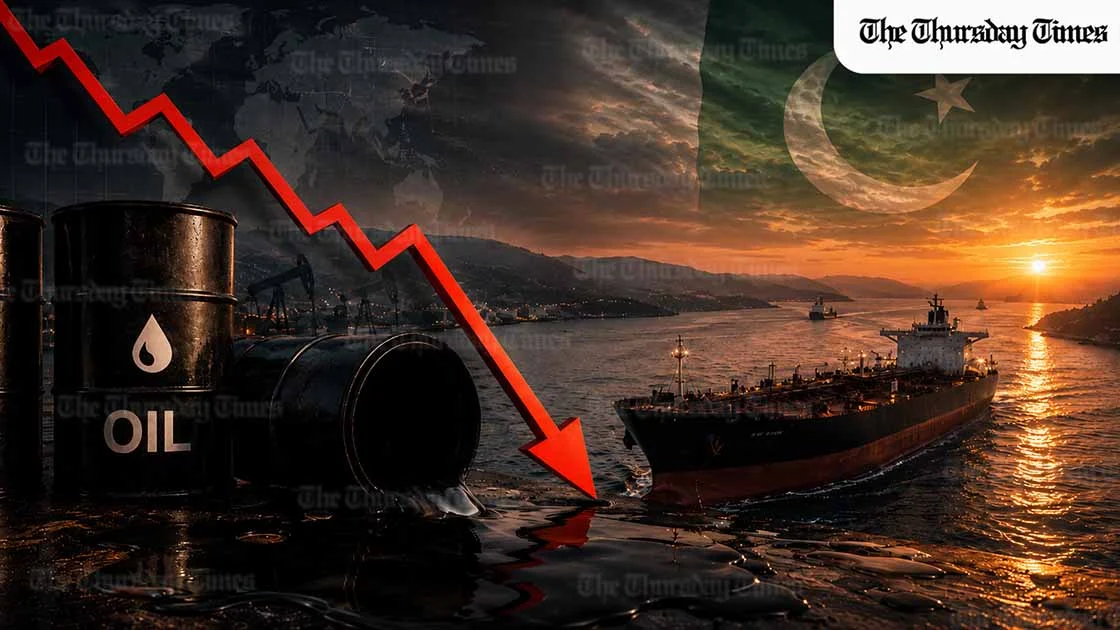
(The Thursday Times) — Oil prices fell sharply after Pakistan’s Prime Minister Shehbaz Sharif announced that the United States and Iran had reached a peace deal, with traders reacting to hopes that the Strait of Hormuz would reopen and fears of a wider regional supply shock would ease.
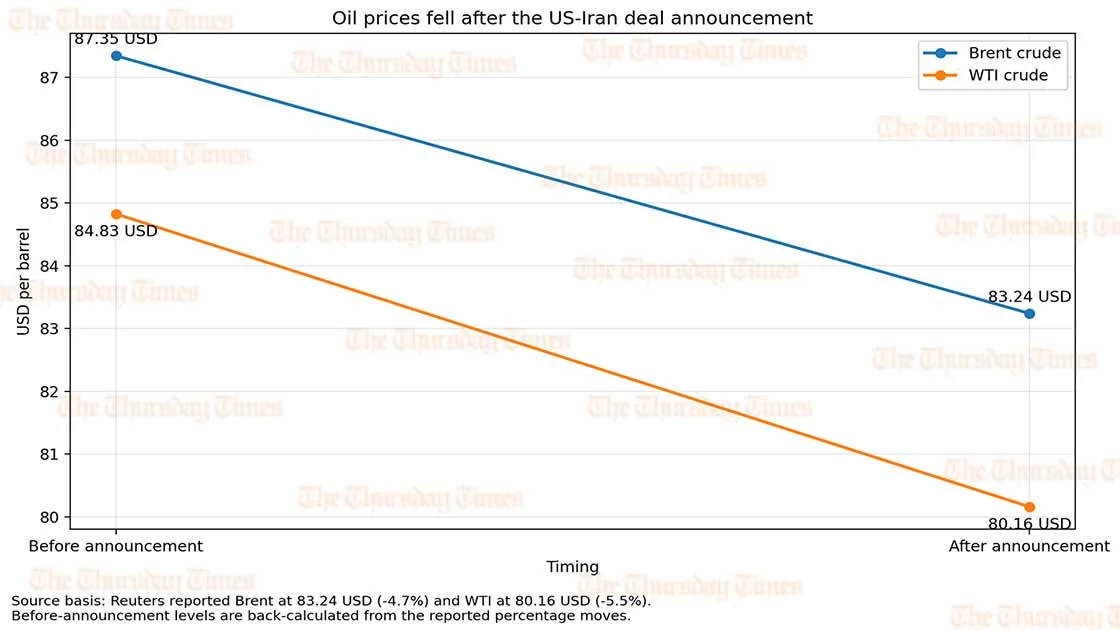
The move gave Pakistan’s mediation immediate economic weight. What had been a diplomatic process between Washington and Tehran became, within hours, a market-moving event. Reuters reported that Brent crude and US West Texas Intermediate both dropped more than four per cent as investors reassessed the risk premium that had built up around the Gulf.
Markets price in relief
Oil traders had been watching the Strait of Hormuz closely. The waterway is one of the world’s most important energy routes, and any threat to its movement can quickly lift prices because of its role in global crude and gas shipments.
Sharif’s announcement changed the immediate mood. Instead of pricing in escalation, markets began to price in the possibility of reopening, reduced military risk and a clearer path toward technical negotiations.
That does not mean uncertainty has disappeared. The agreement still has to be signed, implemented and tested. Questions around nuclear restrictions, sanctions, verification and regional security remain politically sensitive.
But for energy markets, the direction was clear enough. The prospect of a US-Iran agreement, backed by Pakistan’s mediation, was enough to send prices lower.
Pakistan’s diplomatic gain
For Islamabad, the market response adds another layer to the breakthrough.
Pakistan is no longer being discussed only as a mediator in political terms. Its role is now being linked to a measurable shift in global economic sentiment, after the EU formally commended Pakistan’s Iran mediation and Washington itself acknowledged Islamabad’s influence when Trump said he gave Iran a chance after Pakistan asked. Shehbaz Sharif carried the public announcement, while Field Marshal Asim Munir’s regional outreach, including his briefing to China’s Wang Yi that a US-Iran deal was close, formed part of the wider diplomatic architecture behind the process.
That mattered to markets. Oil fell because traders saw a lower risk of regional escalation, a possible reopening of the Strait of Hormuz and a stronger chance that diplomacy could hold.
A deal with global consequences
If the agreement is signed in Switzerland as planned, attention will turn quickly to implementation. The reopening of the Strait of Hormuz will be watched closely by energy traders, shipping companies, Gulf states and central banks already concerned about inflation.
For now, the market signal is unmistakable. Oil fell because the risk of war appeared to fall with it.
And at the centre of that shift stands Pakistan, whose mediation under Shehbaz Sharif and Field Marshal Asim Munir has helped turn a regional crisis into a possible diplomatic and economic reset.∎