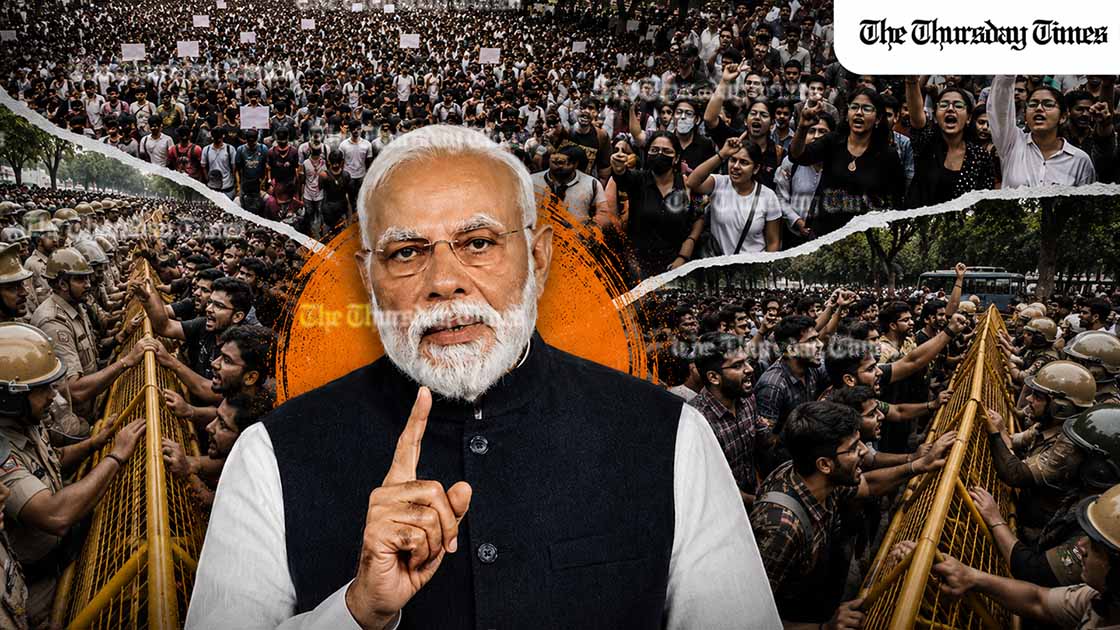
AN INDIAN CHIEF JUSTICE CALLED unemployed young people cockroaches. A medical entrance examination sat by 22 lakh students was leaked, and some of those students killed themselves. For two months afterwards, the government of the world’s largest democracy did not send a single minister, legislator or secretary to speak to the young people camped outside Parliament asking who was responsible. It sent police instead. Then it blamed Pakistan.
That sequence is the whole story of India’s summer, and none of it is in dispute. What is worth examining is why a government with a three-term mandate and no serious electoral threat responded to a group of teenagers with tear gas, and what it says that every instrument it reached for came off the same shelf it has used for a decade.
Begin with the silence, because the silence was a decision. The students had a single demand, the resignation of Union Education Minister Dharmendra Pradhan, and for two months the government declined to engage it, apparently calculating that a protest by exam candidates would dissolve into the admissions cycle. It was not an unreasonable bet. Indian student movements have short half-lives, because their participants have futures to protect and examinations to sit. What the calculation missed was that the examination was the grievance, and the futures had already been damaged.
The Cockroach Janata Party, formed on 16 May by a communications strategist named Abhijeet Dipke, took the Chief Justice’s insult and wore it. Within weeks it had more than 20 million followers on Instagram, exceeding the Bharatiya Janata Party and the Congress. On 20 July it put tens of thousands on the road to Parliament. Whatever else this is, it is not a movement that exhausted itself.
When waiting failed, the machinery moved to its second setting, which is delegitimisation by identity. This is the technique that has neutralised almost every mass mobilisation of the past decade. Those opposing the Citizenship Amendment Act were cast as Muslim unrest. The farmers who besieged Delhi’s borders became Khalistanis. Campus dissent has been anti-national or urban Naxal so routinely that the words now function as punctuation. The method converts a policy argument into a loyalty test, and loyalty tests are easier to win than arguments about governance.
It has not worked, and the reason is arithmetic rather than conscience. These students are the BJP’s own electorate: medical and engineering aspirants, job seekers, their parents, drawn from the aspirational middle across caste, religion and region, the exact demographic that delivered three national victories. There is no minority to isolate here, no border state to invoke, no foreign hand that does not implicate the voters themselves. The protesters have watched the attempt and named it. “The Indian government and media have no topic other than Muslims and Pakistan. Their only work is to declare people traitors,” one student at the site said. Another said simply: “In Narendra Modi’s eyes, we are anti-national.”
Where the machinery could not label, it tried force. Student organisations reported that attackers allegedly affiliated with the Rashtriya Swayamsevak Sangh attempted to break up an earlier stage of the protest by harassing and assaulting demonstrators, an incident condemned by the All India Students’ Federation and the All India Youth Federation. The crowd that arrived at Parliament afterwards was larger, not smaller. On 20 July the state used its own hands: barricades, tear gas, baton charges and mass detentions, sixteen Metro stations closed and internet access restricted around the protest site. Delhi Police then announced that none of it had happened, stating that “no such incident has taken place and protest is being handled professionally,” while footage of the same afternoon circulated on every Indian timeline. The force has spent the week issuing rebuttals of claims about its own conduct, an arrangement in which the accused is also the fact-checker.
The institutions that exist to absorb this kind of grievance have been conspicuous by their conduct. The Delhi High Court declined an urgent hearing sought by students over what their petitioners called disproportionate and excessive use of force. Delhi University, which had nothing to say while a leaked paper destroyed its students’ year, found its voice to warn them that demonstrating “may invite legal action” and could damage their “academic progress and professional opportunities,” and asked them to stay away. A university threatening its own students’ careers for attending a protest about their careers is not a neutral act, and it was received as none. Much of the national television media, meanwhile, has treated tens of thousands of people outside Parliament as a scheduling inconvenience.
With the courts unhelpful, the universities warning, the media averting its eyes and the police denying what the country could see, the government reached for the last item on the shelf. On Thursday Delhi Police announced it had identified and blocked 480 Pakistan-based social media handles which it accused of running “coordinated misinformation campaigns” around the protests, noting that the same accounts had been active during Operation Sindoor. No evidence was published. The timing was exact: the claim arrived at the moment of maximum domestic pressure, which is when such claims generally arrive. Its function does not depend on its truth. It reframes a domestic accountability crisis as a national security matter, in which Indian students demanding a minister’s resignation become the unwitting instruments of a hostile neighbour. It is the loyalty test again, administered from a different angle, and it required no thought whatsoever.
Only after all of this did the Prime Minister speak, and what he chose to say is more revealing than the two months of not saying it. In a self-recorded video posted late on Thursday night, Narendra Modi announced fast-track courts and a bill against paper leaks for Monday’s Parliament, and said he understood that leaks are painful for lakhs of families. He did not mention the protests. He did not mention the crackdown. He did not mention Dharmendra Pradhan. A Prime Minister addressing a student movement without acknowledging that a student movement exists is a considerable feat of message discipline, and the Congress called him “desperate and hassled-looking,” with Jairam Ramesh observing that his “lack of commitment to accountability is evident from his failure to even mention the student protests or the brutality unleashed on them by his police forces on 20th July.”
The offer, stripped of its packaging, is this: the government will punish the people who leaked the paper more efficiently than before, and will hear nothing about the people who presided over a system in which papers leak. The students asked a question about responsibility. They have been handed a procedure. Fast-track courts and stiffer sentences are not answers to the demand that someone in office own the failure; they are a way of being seen to act while conceding nothing that costs anything.
None of this means the movement wins. The BJP’s machine is intact, its resources vast, its media environment largely unwilling to press it, and the Cockroach Janata Party is leaderless by design with no electoral apparatus at all. Movements built on jokes have dissolved before, and this one may. But a marker has been set down that will outlast the summer. A government that has spent a decade instructing Indians on which of their neighbours to distrust has met a crowd it cannot name, and has been reduced, in full public view, to blaming a foreign country for the anger of its own children. That is not a government managing a narrative. It is a government that has reached the end of the only one it knows.