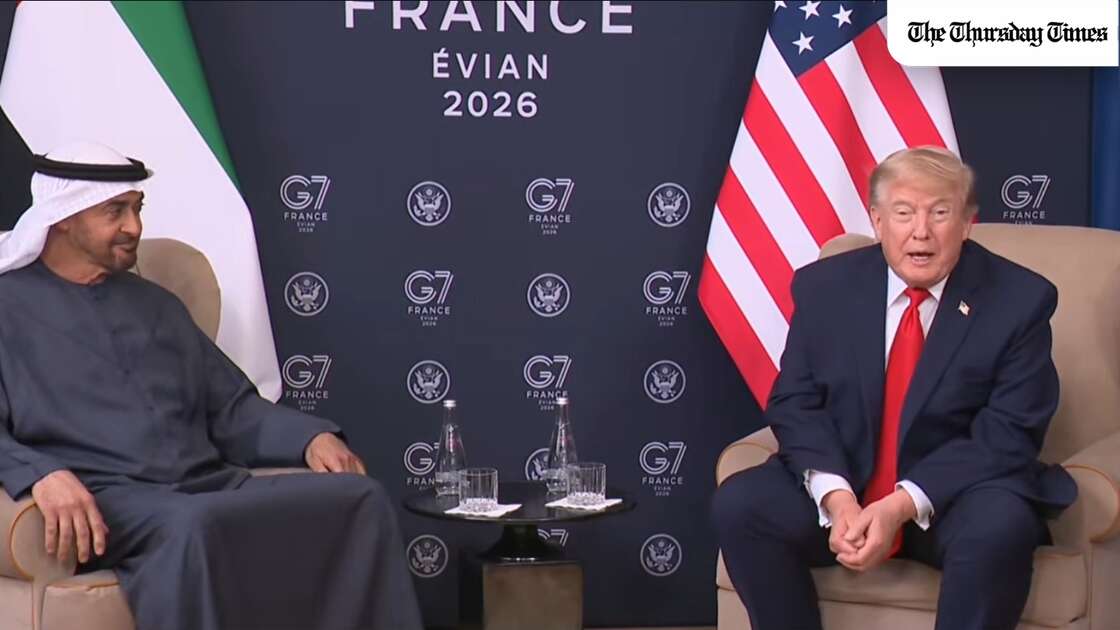
ISLAMABAD (The Thursday Times) — Donald Trump has said he will release the memorandum of understanding behind the newly announced US-Iran framework and may read it publicly at a press conference, as pressure grows for the White House to clarify the terms of a Pakistan-brokered agreement that has already reshaped diplomatic calculations across the Middle East.
Donald Trump says he expects to go through the US-Iran MOU with the media “in a couple of days.”
Trump said he may hold a press conference and read the document “word by word” so the press covers it accurately, calling it “a very important document.” pic.twitter.com/NU3ek5wHg0
— The Thursday Times (@thursday_times) June 16, 2026
Speaking as the deal moved from announcement to scrutiny, Trump said the document was important enough to be presented directly to the media so that it could be covered accurately. He framed the accord as a decisive break from the Obama-era Joint Comprehensive Plan of Action, arguing that his own framework blocks Iran’s route to a nuclear weapon rather than merely delaying it.
The comments came after US and Iranian officials said they had reached a preliminary framework to end hostilities, halt the US blockade of Iranian ports and reopen the Strait of Hormuz, one of the world’s most important energy corridors. The memorandum is expected to be formally signed in Switzerland on Friday, with detailed technical talks to follow.
Pakistan has emerged at the centre of the diplomatic breakthrough. Prime Minister Shehbaz Sharif announced that the United States and Iran had agreed to an immediate and permanent termination of military operations on all fronts, including Lebanon, after intensive mediation involving Islamabad and other regional partners.
Reuters reported that Trump posted that the deal with Iran was complete shortly after Sharif announced the breakthrough. The same report said the precise terms were not immediately known, but that the agreement would reopen the Strait of Hormuz and set up further negotiations on Iran’s nuclear programme, sanctions relief and the future of enriched uranium.
Trump’s latest remarks appear designed to answer a basic political problem: the agreement is being praised as a diplomatic breakthrough by supporters, but it remains vulnerable because the full text has not yet been published. His promise to release the MOU and go through it publicly suggests the administration wants to seize control of the narrative before critics define the deal as vague, risky or one-sided.
At the G7 summit in Évian-les-Bains, France, Trump defended the interim accord and said the central point was that Iran would not be allowed to develop a nuclear weapon. Reuters reported that he described the deal as a wall against a nuclear weapon, while contrasting it with the Obama-era nuclear agreement, which he has long denounced.
The 2015 JCPOA, negotiated under Barack Obama, offered sanctions relief in return for limits on Iran’s nuclear programme and international monitoring. Trump withdrew the United States from that agreement during his first term, arguing that it failed to protect US and regional security interests. Iran later expanded parts of its nuclear activity after the collapse of the agreement.
The new memorandum does not appear to resolve every nuclear question immediately. Officials and diplomats have described the framework as an opening document that creates a 60-day window for negotiations, including the handling of highly enriched uranium, inspection mechanisms, sanctions relief and the wider security architecture around the Gulf.
The Strait of Hormuz remains one of the agreement’s most sensitive points. Trump has said the waterway will be open and toll-free, while reports have pointed to continuing uncertainty over maritime fees, navigation rights and the role of any foreign naval presence. Energy markets reacted quickly to the announcement, with oil prices falling as investors priced in the possibility of restored shipping flows.
Lebanon is another fragile front. The agreement refers to a cessation of military operations, but Israel has distanced itself from parts of the process and has not presented itself as bound by US-Iran understandings. That leaves open the risk that continued Israeli-Hezbollah clashes could test the agreement before the Swiss signing even takes place.
For Pakistan, the agreement marks a striking diplomatic moment. Islamabad’s role gives Sharif’s government a rare opportunity to present Pakistan not only as a regional stakeholder, but as a mediator capable of convening adversaries whose conflict has affected global energy, Gulf security and wider Western diplomacy.
Still, the test now shifts from announcement to implementation. A published MOU may clarify what Washington, Tehran and the mediators have actually agreed, but it will not by itself settle the most difficult questions: how Iran’s nuclear commitments are verified, how sanctions relief is phased, how shipping is protected, and whether regional actors accept the terms.