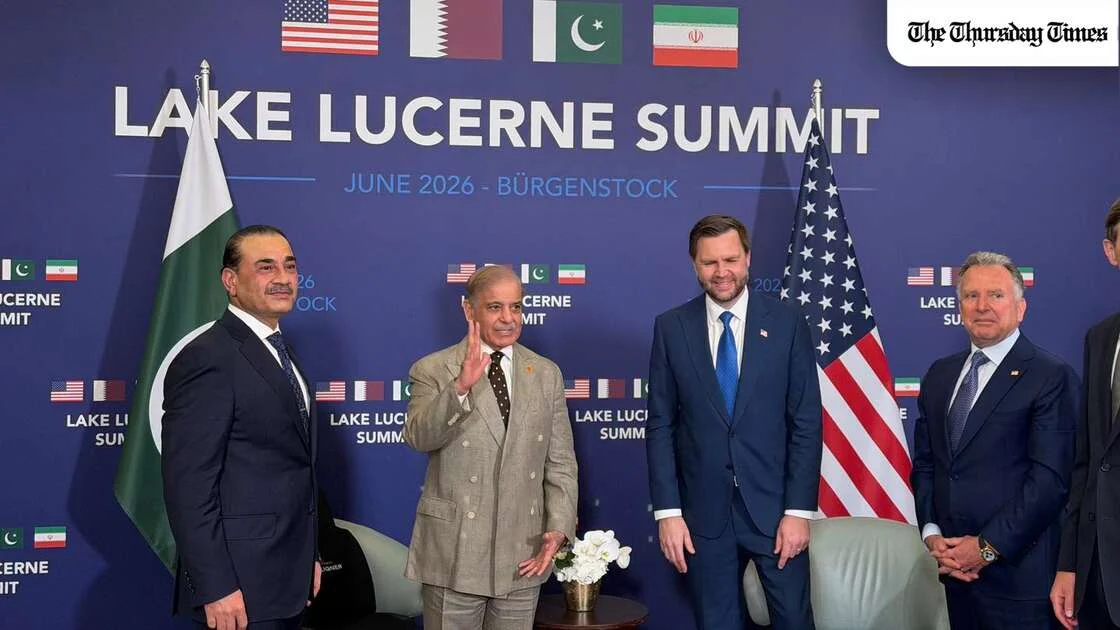
PAKISTAN DID NOT ARRIVE AT the Lake Lucerne Summit as a spectator. At Bürgenstock, Switzerland, Islamabad stood alongside Qatar as one of the two mediators trying to move the United States and Iran from open hostility towards a structured political process. For a country often discussed internationally through the language of crisis, this was a rare moment in which Pakistan was seen helping manage one.
The summit did not produce a final peace deal, and it would be wrong to pretend that it did. The issues between Washington and Tehran remain difficult, from nuclear restrictions and sanctions relief to Lebanon, the Strait of Hormuz and enforcement guarantees. Yet diplomacy is rarely settled in one room, on one afternoon. Its first success is often getting adversaries to stay in the same process. On that measure, Lake Lucerne mattered.
What the talks produced
High Level Committee plus further technical talks.
A structured path towards a final agreement.
Moves towards mechanisms for Strait of Hormuz and Lebanon.
The clearest result was the creation of a framework. The parties agreed to a High Level Committee, further technical talks and a 60-day roadmap towards a final agreement. They also moved towards practical channels on the Strait of Hormuz and Lebanon, two flashpoints where miscalculation could have carried consequences far beyond the region. That was not a small achievement.
For Pakistan, the summit gave international shape to the Islamabad Memorandum of Understanding. What began in Islamabad was carried into Switzerland and converted into a working diplomatic track. That is the success Pakistan can claim: not that it solved every problem, but that it helped turn an unstable ceasefire environment into a process with committees, deadlines and channels of communication.
Prime Minister Shehbaz Sharif’s role was central to that outcome. He gave the process political ownership and presented Pakistan as a state willing to invest diplomatic capital in de-escalation. His message after the talks was careful, not triumphalist. He spoke of dialogue, diplomacy and lasting peace, language that reflected both the promise of the moment and the fragility of what still lies ahead.
Qatar’s partnership was just as important. Doha brought its own record of mediation and its own access to the parties. The Pakistan-Qatar pairing worked because it combined different channels, different relationships and a shared interest in preventing the conflict from spreading. Lake Lucerne was therefore not a solo performance by any one country, but a coordinated mediation effort.
Within Pakistan’s delegation, Field Marshal Syed Asim Munir stood out for a different reason. His presence gave the process a security weight that ordinary diplomatic engagement alone may not have carried. The US-Iran track was not only about statements and communiqués. It involved nuclear concerns, regional militias, maritime movement and military de-confliction. In that setting, Munir’s role was naturally significant.
What made his conduct notable was not loudness, but steadiness. He appeared to operate as a serious back-channel figure, someone able to speak to security concerns while remaining within a wider political process led by the prime minister and supported by Pakistan’s foreign policy team. That balance matters. A military figure in diplomacy can easily overshadow the civilian frame. At Lake Lucerne, the stronger impression was of an institutional Pakistani effort.
The praise Munir received from JD Vance was unusually direct. It suggested that Washington saw him not simply as Pakistan’s army chief, but as someone who had helped keep the process alive through sustained engagement. Such remarks are politically useful for Pakistan, but they should also be read carefully. They were not the whole story of the summit. They were one part of a larger diplomatic picture in which Pakistan, Qatar, the United States and Iran all had to make the process work.
Still, Munir’s contribution should not be understated. Pakistan’s credibility in this mediation came partly from its ability to speak the language of security with seriousness. In a negotiation shaped by the risk of war, that credibility mattered. Munir helped give Pakistan’s diplomacy a hard edge without turning the summit into a military spectacle.
The larger success, then, belongs to Pakistan’s statecraft. Shehbaz Sharif gave the initiative political direction. Pakistan’s diplomatic machinery helped carry the Islamabad MoU into an international setting. Qatar strengthened the mediation track. Switzerland provided the setting. Munir added security credibility and continuity. Together, those elements allowed Pakistan to appear not as a country reacting to events, but as one helping shape them.
Lake Lucerne may still prove to be only an opening chapter. The 60-day roadmap will test whether the promises made in Switzerland can survive pressure from hardliners, battlefield incidents and competing regional interests. But for Pakistan, the summit has already delivered one important result: it showed that Islamabad can still matter in high-stakes diplomacy when it acts with discipline, coordination and purpose.∎