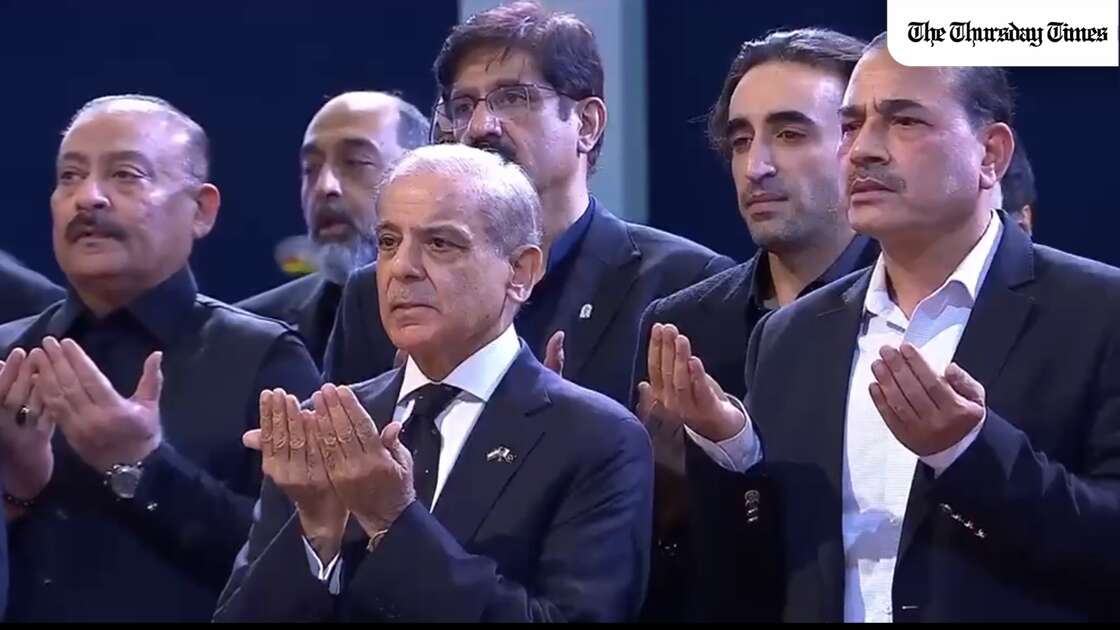
IN DIPLOMACY, ABSENCE SPEAKS, BUT presence sings. At the funeral of Ayatollah Ali Khamenei, Pakistan did not send a token, a message, or a ceremonial footnote. Pakistan sent its Prime Minister. It sent its Foreign Minister. It sent its Army Chief. It sent ministers, parliamentarians, and representatives of the federation. In that moment of grief for Iran, Pakistan did not stand at a polite distance. It stood close enough for its silence to be understood as solidarity.
Tehran: India was represented by only a small, low-level delegation at the funeral ceremonies, while Pakistan’s high-level delegation attended the event.
Pakistan's delegation included Prime Minister Shehbaz Sharif, Field Marshal Asim Munir, Deputy Prime Minister and Foreign… pic.twitter.com/Pkjfmuujye
— The Thursday Times (@thursday_times) July 3, 2026
India, by contrast, chose caution dressed as courtesy. New Delhi sent a governor and a minister of state, enough to show respect, but not enough to show embrace. It was a delegation of calculated protocol, not political feeling. India appeared at the funeral as a state managing a relationship. Pakistan appeared as a neighbour carrying a burden.
That difference matters. At funerals, nations reveal what they are unwilling to say in communiqués. A wreath can be diplomacy, but the presence of a prime minister is a verdict. Pakistan’s delegation told Iran that grief is not outsourced, brotherhood is not delegated downward, and strategic friendship is not measured only in trade corridors or carefully worded statements.
The symbolism becomes even sharper when one remembers that Tehran has often appeared more generous in its diplomatic warmth towards India than Pakistanis would like to admit. Iran has cultivated New Delhi, courted Indian access, and treated Narendra Modi with a seriousness that many in Pakistan have watched with discomfort. Even at this solemn hour, Modi was reportedly invited to attend. Yet Pakistan did not sulk, retreat, or reduce its own gesture in response.
Pakistan sent its Prime Minister. It was not a token, not a message, not a ceremonial footnote. At the funeral of Ayatollah Ali Khamenei, presence was understood as solidarity.
That is the quiet nobility of Pakistan’s position. It stood with Iran not because Iran always stood equally with Pakistan, but because some relationships are older than temporary grievances. Pakistan did not ask whether Tehran had favoured India. It asked what history, geography, faith, and neighbourliness demanded. The answer was simple: show up.
There is a moral grandeur in that choice. A lesser state would have measured its condolence by the warmth it had received in return. A smaller politics would have said, “Why should we go so far for a country that so often bends towards India?” Pakistan chose the opposite. It chose magnanimity over resentment. It chose memory over irritation. It chose civilisation over transaction.
And that is why the comparison with India is unavoidable. India may have diplomatic reach, commercial weight, and the confidence of a state that plays every table at once. But in Tehran, it sent a limited signal. Pakistan, poorer in resources but richer in emotional geography, sent a national signal. India acknowledged a death. Pakistan honoured a relationship.
There are moments when protocol becomes poetry. The sight of Pakistan’s civilian and military leadership standing together in Iran was one such moment. It was not merely a funeral delegation. It was a statement that Pakistan’s relationship with Iran is not held by one office, one party, one institution, or one government. It belongs to the state. It belongs to the street. It belongs to the border, the shrine, the memory, and the map.
Critics may say Pakistan should be more hard-headed, that Tehran’s flirtation with New Delhi should have taught Islamabad to be colder. But coldness is not strategy when the neighbourhood is on fire. Iran is not a distant file in a foreign ministry drawer. It is a neighbour, a civilisational partner, a border state, and a permanent fact of Pakistan’s security imagination. To abandon warmth because of diplomatic disappointment would be childish. To maintain warmth despite it is statecraft.
Pakistan’s gesture also carried a message beyond Iran. It told the region that Islamabad will not allow others to define the emotional limits of its foreign policy. It told Tehran that Pakistan’s hand remains extended even when the embrace has sometimes felt uneven. It told New Delhi that influence is not always measured by invitations and agreements. Sometimes it is measured by who comes when mourning calls.
This is where Pakistan’s diplomacy, at its best, has a rare human quality. It remembers that nations are not machines. They grieve, misjudge, forgive, and return to one another because geography does not permit permanent estrangement. Pakistan may have disagreements with Iran, and Iran may have disappointed Pakistan by leaning too warmly towards India at times. But neighbours who share borders must also share funerals.
In the long memory of nations, presence is the one gesture that cannot be forged. ∎