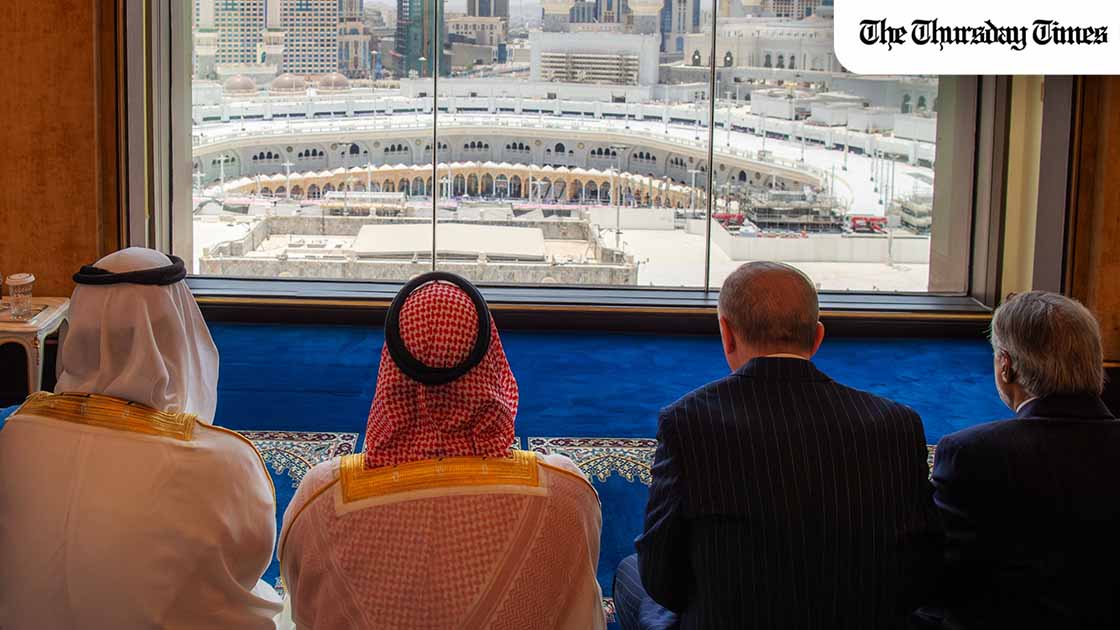
THERE IS A PARTICULAR KIND of sentence that states write only when they expect the words to be tested. An armed attack on Saudi Arabia, Turkey or Pakistan will be regarded as an attack on all three.
That single line, signed at Al-Safa Palace in Makkah on Friday, contains within it almost the entire meaning of the Makkah Joint Defence Agreement. It is easy to read past such language when it arrives amid ceremony, flags and declarations of brotherhood. It is harder, and more useful, to stop and consider what it actually asks of the countries whose names appear beneath it.
Begin with Pakistan.
States do not casually bind their security to countries whose judgment, endurance or reliability they doubt. The price of getting such a calculation wrong is not paid in diplomatic embarrassment. It is paid in soldiers, aircraft, ships and, in the worst circumstances, lives. Saudi Arabia and Turkey have therefore made a judgment about Pakistan that is more significant than the warmth of any communiqué. They have judged that when Pakistan gives its word, that word will still mean something when keeping it becomes costly.
For a country that has spent much of the past two decades being discussed in foreign capitals as a problem to be managed, a risk to be contained or a state forever expected to explain itself, that is no small reversal.
Nor did it happen by accident.
It followed a year in which Islamabad managed to place itself at the centre of conversations that more experienced diplomatic establishments had considered nearly impossible. Pakistan convened talks between Washington and Tehran at a moment when the distance between the two seemed measured not merely in policy but in war. The fact that those conversations happened at all altered how the region viewed Islamabad. What followed was telling. One Gulf government after another began arriving in search of understandings, arrangements and guarantees of its own.
The agreement signed in Makkah, however, is not merely a story about Pakistan’s return to strategic relevance. It is also the product of a deeper unease moving through the region.
For decades, Gulf security rested upon an American guarantee so familiar that few governments felt compelled to examine its foundations too closely. The United States would remain present. The sea lanes would remain open. The balance would somehow hold. Those assumptions were rarely written down because they scarcely seemed to require writing down.
The war between the United States and Iran has changed that.
The Strait of Hormuz can no longer be treated as an abstraction on a shipping map. The Red Sea has ceased to feel distant from the economies that depend upon it. States that once imagined themselves spectators to confrontation have discovered that geography does not always permit neutrality. Oil tankers, ports, airspace and trade routes have a way of pulling supposedly distant wars towards them.
And when a security guarantee that has underwritten your world for decades begins to look conditional, there are only two serious choices. You build alternatives, or you learn to live with exposure.
Saudi Arabia, Turkey, and Pakistan have chosen to build.
What gives their arrangement substance is that the three countries do not merely resemble one another. They complement one another.
Pakistan brings manpower, nuclear status and a military with extensive operational experience. Saudi Arabia brings capital, enormous diplomatic weight and a unique position in the Muslim world as the custodian of Islam’s two holiest cities. Turkey brings something different again: a defence industry that, within little more than a decade, has transformed itself from one heavily dependent on foreign suppliers into an exporter of drones, missiles, electronic systems and platforms that have altered the conduct of modern warfare.
Alliances between states that possess roughly the same things often become exercises in prestige. Alliances between states that possess different things can become instruments of capability. This is the latter kind. Yet seriousness requires something more than celebration, and Pakistanis are entitled to ask what precisely has been promised in their name.
A collective defence clause is not poetry. It is an obligation. At its most literal, it is a promise that Pakistani forces could be asked to defend Saudi or Turkish territory. That day may never come. The value of deterrence, after all, lies partly in preventing the promise from ever having to be fulfilled. But it could come, and perhaps at a moment Pakistan did not choose, in a conflict it did not begin, on a frontier it does not share. That is why Parliament should have more to say than it has so far.
Not because there is necessarily anything improper in the agreement, nor because every strategic commitment should be reduced to domestic political theatre, but because treaties of this weight endure crises only when the societies bound by them understand what has been undertaken. A public that first discovers the meaning of a defence pact on the morning its soldiers are being mobilised is a public that was informed too late.
Then there is Iran.
Ankara has already understood the sensitivity of the question. Turkish Foreign Minister Hakan Fidan has said explicitly that Iran is not the target of the alliance and that no country which refrains from aggression against the three members has reason to fear it. That is the correct assurance to give, and there is every reason to believe it reflects the intention of the agreement.
But intentions are only one part of diplomacy. Perceptions matter too.
Pakistan’s most valuable diplomatic asset over the past year has not been its geography or even its nuclear status. It has been the more elusive quality of being able to speak to opposing sides and still be heard by both. Tehran trusted Islamabad enough to sit across a table from Washington under Pakistani auspices. That sort of credibility takes years to acquire and can be narrowed surprisingly quickly. Formal alliances inevitably draw lines, even when those lines are described as defensive.
Pakistan will therefore have to work continuously to convince Iran that the Makkah agreement is a shield rather than a front. Reassurance cannot be delivered once and forgotten. It will have to become a permanent feature of Pakistani diplomacy, handled not as an afterthought but as a strategic priority.
There is another question the three governments will eventually have to answer, even if they prefer not to answer it in public: what, exactly, counts as an attack?
Deterrence depends upon belief. An adversary must believe not only that a treaty exists, but that its terms will be honoured. That requires clarity among the states themselves over thresholds, triggers and obligations.
Would a missile strike qualify? A naval attack? A cyberattack that disables critical infrastructure? An assault by a proxy force? What if responsibility is suspected but not immediately proven? What level of response would be automatic, and what would remain a matter for political judgment?
Ambiguity can be useful in a press statement. In the first hours of a real crisis, it can become dangerous. Those conversations are better held quietly now, across tables in Islamabad, Riyadh and Ankara, than improvised after the first explosion.
These are not objections to the treaty. They are the ordinary burdens that come with any serious one. And none of them diminishes what happened in Makkah.
The relationships formalised there are far older than the paper on which the agreement was written. Pakistan’s bond with Turkey reaches beyond the creation of Pakistan itself, back through the Khilafat Movement and through a political affection that survived the empire and circumstances that produced it. The relationship with Saudi Arabia has been sustained across eight decades by governments, soldiers, pilgrims and, perhaps most enduringly of all, by the millions of Pakistanis who made working lives in the Kingdom and sent home the remittances on which countless families, and at times the national economy itself, have depended.
Pakistanis have become accustomed to hearing their country described almost exclusively in the vocabulary of decline: fragile, isolated, dependent, unstable, forever one crisis away from irrelevance. Nations can internalise such descriptions if they hear them often enough.
It is therefore worth recognising the moments when the evidence points in another direction. Three states with substantial military, economic and political capabilities, three states with long memories and difficult neighbourhoods, have decided that their security is important enough to bind together. Pakistan is not observing that arrangement from the outside.
It is one of the three.
The satisfaction of that fact should last only a moment. The responsibility contained within it will last much longer. The task now is to remain worthy of the confidence. ∎