ISLAMABAD (The Thursday Times) — Pakistan has quietly begun mediating between Libya’s rival eastern and western power centres, two Pakistani sources told Reuters, in a previously unreported diplomatic effort that comes directly after Islamabad’s central role in brokering the Islamabad Memorandum of Understanding ending the US-Iran war. One of the Pakistani sources said the United States was “fully aware and involved” in Islamabad’s Libya role, suggesting Washington is once again relying on Pakistan as a trusted diplomatic channel in a complex multilateral conflict.
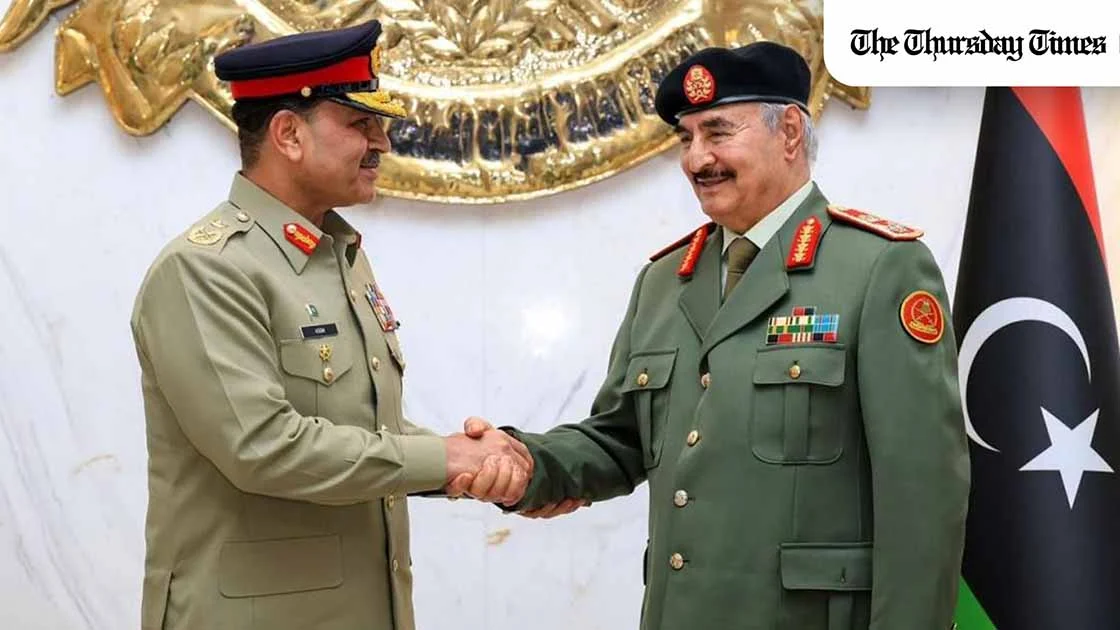
Pakistan has been quietly mediating between the eastern-based Libyan National Army, commanded by Field Marshal Khalifa Haftar, and the western-based UN-recognised Government of National Unity led by Prime Minister Abdulhamid Dbeibah, according to two Pakistani sources cited by Reuters. Qatar and Turkiye, one of the GNU’s biggest backers, were among the parties that encouraged Pakistan to get involved in the mediation effort, two Pakistani sources familiar with the matter told Reuters. Pakistan’s foreign ministry, its military media wing and the foreign ministries of Qatar, Turkiye, Saudi Arabia and the United States did not immediately respond to Reuters’ requests for comment.
A summary of a proposed Libya Reunification Plan, shared with Reuters, would set out a 36-month transitional power-sharing arrangement under a body called the Government of National Consensus and Presidential Council. The proposal would establish Dbeibah as prime minister and Saddam Haftar, deputy commander of the LNA and son of Khalifa Haftar, as chairman of the Presidential Council. The faction around Khalifa Haftar, the LNA commander-in-chief who controls many of Libya’s biggest oilfields and key infrastructure, would be handed authority over the budget under the proposed plan. A Pakistani source told Reuters that Pakistan would play “an active role in making sure this whole arrangement stays in play,” with details still being worked on.
While analysts view Pakistan as a secondary player in Libya, where the United States, the UAE, Turkiye and Egypt have wrestled for influence for years, Islamabad has maintained ties with both sides of Libya’s divide that other regional actors may be lacking. The rival western GNU also recently sought direct talks with Pakistan, according to an unreported document seen by Reuters. “The United States has been pushing hard in Libya,” Jalel Harchaoui, a contributor to Britain’s Royal United Services Institute, told Reuters, “but the format it is trying to impose is still loose and ill-defined.”
Pakistan’s army chief Field Marshal Asim Munir met Saddam Haftar in Rawalpindi last month, a meeting that was followed days later by Haftar’s visit to Washington where he met Secretary of State Marco Rubio. Pakistan signed a more than $4 billion defence agreement with the eastern LNA in December 2025, including 16 JF-17 Thunder multi-role fighter jets co-developed with China and 12 Super Mushshak basic trainer aircraft. The Thursday Times analysed the significance of that deal here. The agreement, one of Pakistan’s largest-ever weapons export agreements, also includes provisions for training, capacity building and potential joint manufacturing.
Pakistan’s Libya mediation effort comes directly after its central role in the US-Iran negotiations. President Trump said he gave Iran a chance because Pakistan asked him to, calling Field Marshal Munir and PM Shehbaz Sharif great. The EU formally commended Pakistan’s mediation role in a joint communiqué on 1 June. The trust Pakistan built with Washington during the Iran negotiations appears to be directly informing the US decision to involve Islamabad in Libya, with one Pakistani source confirming the US is “fully aware and involved” in the Libya effort.
Analysts caution there is no guarantee any deal that is signed will stick, pointing to previous failed attempts to reunify Libya. Tarek Megerisi, director of geopolitical advisory firm Informmi, told Reuters that the country’s prolonged conflict has repeatedly defied diplomatic solutions. Pakistan’s role remains unconfirmed by official sources on all sides. The Thursday Times will continue to monitor this story as it develops.
Sources: Reuters (primary source, two Pakistani sources); Middle East Online (confirming Reuters report). All quotes attributed to named analysts or anonymous sources as cited by Reuters. Pakistan’s foreign ministry has not confirmed the mediation role.∎