
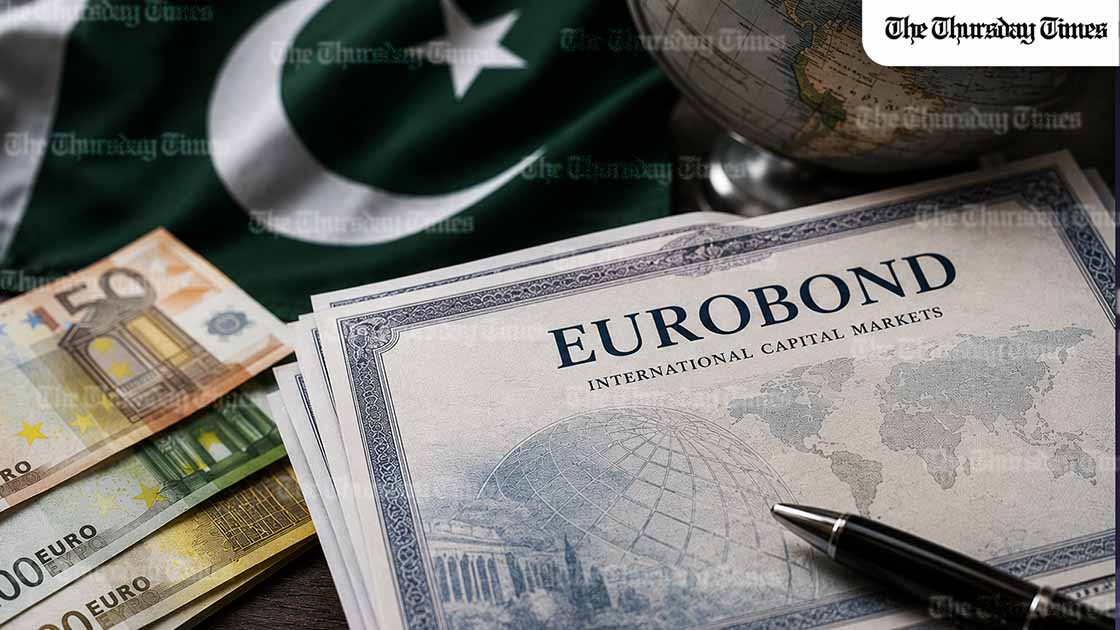
ISLAMABAD (The Thursday Times) — Pakistan has raised $3 billion through a dual-tranche Eurobond sale, its largest-ever single international bond transaction, drawing nearly $6 billion in orders from global investors, the Ministry of Finance said on Thursday.
The offering was split into two parts: $1.75 billion through a 5.5-year Eurobond carrying a coupon of 7.50 percent, and $1.25 billion through a 10-year Eurobond at 7.90 percent. Demand came in at almost double the amount on offer, from what the ministry described as a broad and diversified base of institutional investors across global markets. The finance ministry said strong interest extending to the 10-year tenor in particular demonstrated Pakistan’s ability to mobilise sizeable longer-term financing, calling it a sign that international investors are reassessing the country’s improving macroeconomic and credit fundamentals.
“Three years of rebuilding credibility, nearly $6bn of global investor demand, and a record $3bn issued in a single transaction, it is a landmark moment in Pakistan’s journey from economic stabilisation towards sustainable growth, and a stronger platform for the road ahead,” the ministry said in a statement.
The transaction marks the first issuance under Pakistan’s renewed Global Medium Term Note programme, following the country’s inaugural Panda Bond and a series of sovereign credit rating upgrades. It also extends Pakistan’s debt maturity profile well beyond the three-year tenor used in an earlier $500 million Eurobond issued in April, which was later upsized to $750 million through a green-shoe option after strong demand. That April bond carried a coupon of 6.975 percent and matures in 2029. Pakistan separately repaid a $1.4 billion Eurobond that matured in April, allowing the government to re-establish a pricing benchmark in international debt markets after years of leaning heavily on multilateral, bilateral, and commercial financing.
Citi, Deutsche Bank, Emirates NBD, MUFG, and Standard Chartered acted as joint bookrunners on the transaction, with Pakistan’s Debt Management Office leading execution. The government said its broader strategy goes beyond simply raising new debt, aiming to diversify funding sources, extend debt maturities, and reduce refinancing and rollover risk, including replacing shorter-term or more expensive obligations with longer-term financing where economically beneficial.
Pakistan’s last comparably priced Eurobond was issued more than a decade ago, during the PML-N government’s tenure, at a considerably higher coupon of 8.25 percent; that bond has since matured and been repaid. Proceeds from the new issuance are intended to help meet Pakistan’s external financing needs, including the repayment of older debt, according to Samaa’s reporting, a detail worth keeping alongside the finance ministry’s own framing of the sale as a confidence milestone rather than only that.