
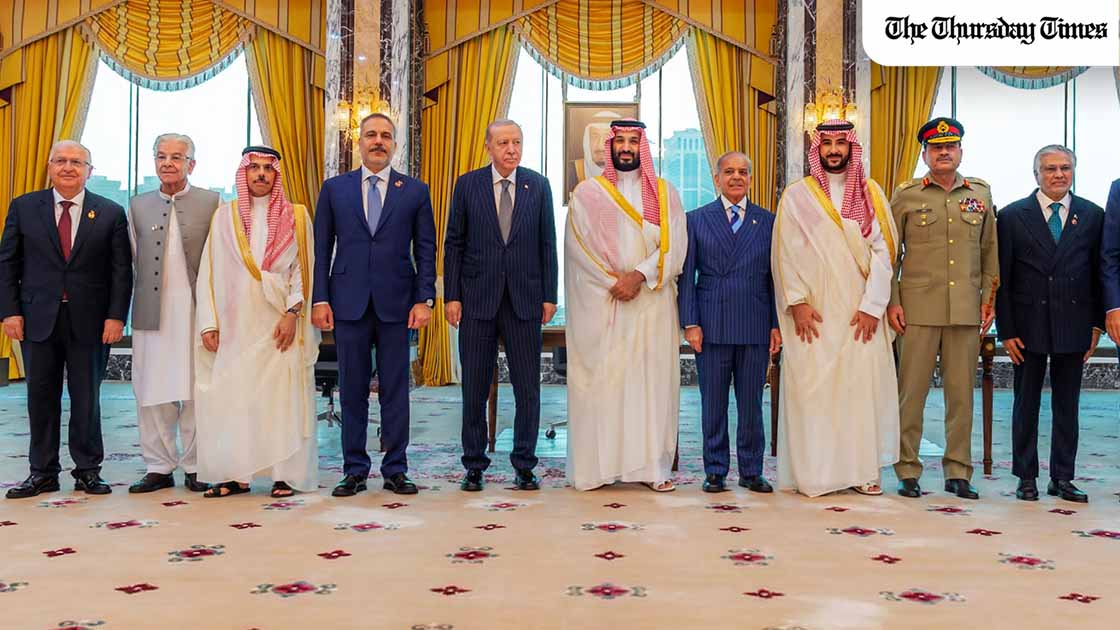
ISTANBUL (The Thursday Times) — Pakistan, Saudi Arabia and Türkiye convene the first session of the committee created under the Makkah Joint Defence Agreement in Istanbul on Monday, sending their foreign ministers, defence ministers and military chiefs to the earliest institutional step since the pact was signed three weeks ago.
Pakistan’s Foreign Office said the inaugural meeting of the Strategic Political and Defence Committee would be held in Istanbul, with Pakistan represented by Deputy Prime Minister and Foreign Minister Ishaq Dar, Defence Minister Khawaja Asif, and Field Marshal Syed Asim Munir in his combined capacity as Chief of Defence Forces and Chief of Army Staff. The Inter-Services Public Relations said Munir had arrived in Türkiye on an official visit.
Türkiye’s foreign ministry said Foreign Minister Hakan Fidan, National Defence Minister Yaşar Güler and Chief of the Turkish General Staff General Selçuk Bayraktaroğlu would attend. Saudi Arabia is sending its foreign and defence ministers along with its chief of general staff, offices held respectively by Prince Faisal bin Farhan Al Saud, Prince Khalid bin Salman and General Fayyadh bin Hamed Al-Ruwaili, who has chaired the Saudi general staff since February 2018. Riyadh had not formally published its delegation list by Monday morning.
Of the three officers in the room, Munir holds the most consolidated brief. Al-Ruwaili and Bayraktaroğlu each speak for a joint staff, but Munir arrives holding both service command and tri-service authority in a single office, which shortens the distance between what the committee agrees and what Pakistan’s forces can be directed to do. He is also the only chief present who was in the room for the arrangement this pact extends, having accompanied Prime Minister Shehbaz Sharif to Riyadh in September 2025 for the signing of the Strategic Mutual Defence Agreement between Pakistan and Saudi Arabia.
A Turkish foreign ministry source told Reuters that “International security issues will be on the agenda”, with discussions expected to cover defence capabilities and greater interoperability between the three armed forces. Anadolu Agency reported that the committee was envisaged to provide strategic direction for activities carried out under the pact. Pakistani outlets have additionally reported joint production as a likely item, which if confirmed would extend the arrangement from consultation into industry.
The agreement was signed in Makkah on 7 August by Sharif, Saudi Crown Prince Mohammed bin Salman and Turkish President Recep Tayyip Erdoğan. It provides that an armed attack against any one of the three shall be regarded as an attack against them all, a collective defence clause widely compared to Article 5 of the NATO treaty.
Islamabad has been precise about the scope. Dar has said that “The Makkah Accord is purely defensive in nature”, that it is not aimed at any country, that it does not abrogate or replace existing bilateral or multilateral commitments held by the three states, and that it rests on the right of individual and collective self defence under Article 51 of the UN Charter. Fidan has separately said the agreement is not directed against Iran.
The question of who else might join has followed the pact since the signing. Fidan said within two days that Egypt was among the countries that could potentially come in, and that Erdoğan wanted the alliance to expand. Bangladesh Foreign Minister Khalilur Rahman told parliament Dhaka would consider an invitation “positively”, and on Sunday Bangladesh’s state minister for foreign affairs said his government saw no risk in joining, describing talks as “progressing positively with all bilateral partners” while confirming that no formal invitation had been received.
India has followed the arrangement closely. The Ministry of External Affairs said on 7 August that it was monitoring the trilateral pact, and days later said New Delhi was examining the agreement from the perspective of national security and regional stability and would take “all necessary steps” to protect its interests. External Affairs Minister S Jaishankar has since questioned the pact’s immediate practical effect, asking “what has the Makkah pact done in response to that?” in reference to the military situations its signatories face, while adding that everything counts in New Delhi’s calculations.
Dar reached Istanbul on Sunday after concluding a visit to the United Kingdom and held talks with Fidan the same day. The two sides reviewed progress under the Pakistan-Türkiye High-Level Strategic Cooperation Council and agreed to convene its next session early, according to the Foreign Office. Fidan has also invited Dar to a Regional-4 meeting in Istanbul, a format that adds Egypt to the three pact members and which last met in Amman on 5 August.