
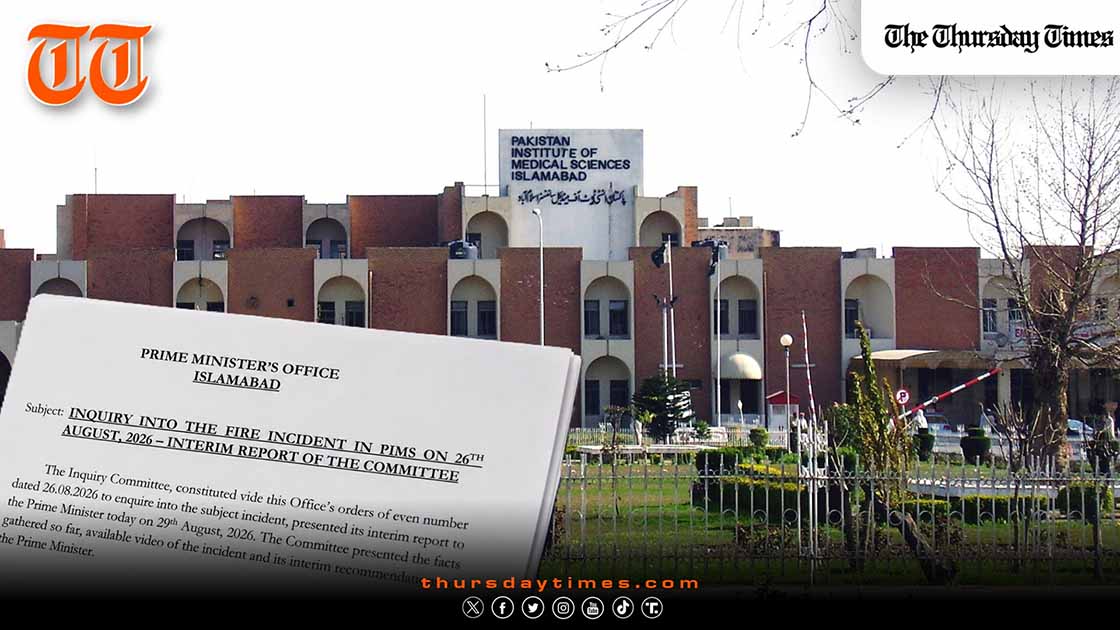
ISLAMABAD (The Thursday Times) — A CCTV timeline reconstructed by the interim inquiry into last week’s fire at PIMS Hospital shows the neonatal nursery went from the first sign of trouble to being fully engulfed in smoke in under two minutes, according to the committee’s report submitted to Prime Minister Shehbaz Sharif on August 29. The report also discloses that a separate inquiry into an earlier fire at the same hospital was still being sent back for revision just one day before the nursery fire broke out.
The interim report, dated August 28 and signed by committee chairman Shahid Khan, a former federal secretary, along with members Irfan Nawaz Memon, Barrister Nabeel Ahmed Awan, and Major General (Retired) Dr. Khurshid Uttra, reconstructs the morning of August 26 minute by minute using CCTV footage. Charge Nurse Nasreen is seen emerging from the nursery seeking help at 6:38:15am. She and Security Guard Maria enter at 6:38:35, by which point reflections of flames are already visible. Staff Nurse Razia enters at 6:38:56 and emerges eight seconds later carrying a baby, the nursery’s only survivor, before attempting to re-enter. Dr. Abdul Rehman emerges at 6:39:12. By 6:39:15, one camera’s view is substantially obscured by smoke; a second camera is obscured by 6:40:08. The committee found this evidence establishes that frontline staff made immediate rescue attempts, stating plainly that “the objective evidence therefore does not support generalized allegations that frontline medical and nursing staff simply abandoned the newborns.”
The precise cause of the fire remains technically unresolved. The committee said accounts variously attribute it to an air conditioning unit, an incubator or warmer, or an electrical short circuit or overloaded plug, and that utility company IESCO’s records show no external feeder fault, which shifts the inquiry toward PIMS’s internal wiring and equipment. Maintenance records show several incubators had recently been serviced, though the committee said this does not rule out an equipment-related origin, and it described identifying a specific cause at this stage as premature, pending forensic examination.
A more serious and still-unresolved question concerns how long it took to alert outside help. CCTV places the emergency at approximately 6:38am, but the Capital Emergency Service’s own records show it received its first call about 16 minutes later, at 6:54am, dispatching at 6:55am and arriving at 7:01am. The committee noted that other evidence reportedly refers to an earlier call, a contradiction it has not yet resolved, and said it is examining telephone records, PIMS control room logs, and CES call recordings to establish who first called, when an effective call actually reached emergency services, and whether an avoidable delay occurred. Notably, the report found CES’s own response, from receiving the call to arriving on scene, took only six to seven minutes, meaning the more material issue is not a slow response from CES after being notified, but the internal chain of detection, escalation, and notification that preceded that call. The committee found PIMS’s existing procedures did not clearly establish who was responsible for activating an alarm, summoning emergency services, assuming incident command, or unlocking emergency exits.
On evacuation infrastructure, the committee found PIMS had no approved, trained, or rehearsed fire and evacuation procedure specific to the nursery or neonatal patients, despite having a Security Department SOP dating to May 2023 that explicitly assigned the Assistant Director of Security responsibility for fire exits, firefighting equipment, and staff training. Personnel had even been nominated for fire safety training before the incident, leading the committee to frame the emerging question as whether assigned duties and training were ever translated into actual preparedness. The Capital Emergency Service independently reported that fire and life-safety arrangements were “inadequate and compromised,” that emergency exits were locked or obstructed, and that firefighters were forced to breach locked fire-exit doors to reach the scene, findings the committee called serious but said still require verification of each door’s exact status before individual responsibility can be assigned.
The report places particular weight on a fire that broke out at PIMS’s Female Nursing Hostel on July 6, only seven weeks before the nursery fire. That earlier inquiry had already identified an absence of adequate smoke detection, alarms, documented drills, and fire-safety inspection records, and had recommended a comprehensive fire-safety audit, working smoke detectors, emergency lighting, and annual electrical inspections. In one of the report’s most striking findings, the committee noted that on August 25, the day before the nursery fire, the July inquiry’s own report was still being returned for revision because it had not adequately addressed its terms of reference. The committee was careful to say this does not establish that finishing that inquiry would have prevented the nursery tragedy, but said it shows the institutional process for turning the July fire’s lessons into corrective action had not reached closure before a second, fatal fire occurred.
Based on these findings, the Prime Minister’s Office directed the immediate suspension of eight officials, with disciplinary proceedings launched under the Efficiency and Discipline Rules 2020 and criminal proceedings ordered against those found responsible. On the clinical side, the committee found fewer staff on duty than the roster required and recommended the suspension of Professor Dr. Sadia Riaz, head of the neonatology department, and Senior Registrar Dr. Nagham, holding the department head responsible for ensuring staff presence. On the administrative side, it recommended suspending PIMS Executive Director Professor Dr. Imran Sikandar, Joint Executive Director Dr. Mutahir Shah, Joint Executive Director (Non-Medical) Ch. Waris Ali Raza, and MCH Director Dr. Nosheela Amjad, finding the hospital’s administration failed to act on the lessons of the July fire. On external agencies, it recommended suspending Capital Emergency Service Director-General Dr. Abdul Rehman, finding CES itself failed to press PIMS for drills and protocols even after the July fire, and Assistant Director of Security Muhammad Usman specifically for absence from duty without leave and dereliction of duty. Separately, Charge Nurse Nasreen and Security Guard Maria were placed off-duty pending the committee’s final report, without prejudice either way, while Staff Nurse Razia, who rescued the fire’s only surviving infant, was awarded a cash reward of Rs 10 million and recommended for a civil honour.
The committee also examined the hospital’s private security contractor, M/s Belfort Security Services, finding its personnel had been deployed at the site and had taken part in rescue and firefighting efforts, with no evidence the company caused the fire or that its staff generally abandoned their posts. It nonetheless recommended PIMS verify whether Belfort’s contracted deployment, training, and equipment met its obligations, with any confirmed default to trigger contractual penalties and further action, and referred the matter of Belfort’s licence to the Interior and Narcotics Control Division.
On possible criminal liability, the committee identified two areas it considered potentially serious enough to warrant investigation: confirmed instances of locked or obstructed emergency exits, if the relevant doors are established as mandatory fire exits that specific individuals knowingly or negligently left unavailable, and any confirmed case where officials who received the July fire’s warnings had clear duty and opportunity to fix known hazards but failed to do so without justification. The committee stressed that administrative, contractual, and criminal processes must be kept separate, and that it is identifying circumstances for referral rather than pronouncing guilt itself, which remains a matter for investigating and judicial authorities.
Dr. Muhammad Salman, CEO of the National Institutes of Health, has been transferred to serve as PIMS’s acting executive director on deputation, retaining his NIH role in an additional capacity until a permanent arrangement is made. The Prime Minister’s Office has directed that the interim report be published on the website of the National Health Services, Regulations and Coordination Division.
The committee also ordered a set of immediate corrective measures it said could not wait for its final report. PIMS has been directed to carry out a hospital-wide fire, life-safety, and electrical audit using independent technical expertise, starting with the NICU and nursery, other ICUs, and operating theatres, with every smoke detector, alarm, extinguisher, hydrant, and designated fire exit to be physically inspected, tested, and documented, and any emergency exit found locked, obstructed, or incapable of immediate use rectified without delay. All incubators, warmers, air conditioning units, sockets, wiring, and other electrical systems in high-risk clinical areas are to undergo urgent technical inspection, with temporary fire-watch arrangements put in place wherever automatic detection remains inadequate, alongside practical fire and evacuation drills involving doctors, nurses, security, and engineering staff. The committee also ordered a clear, tested emergency-notification protocol under which a fire triggers a simultaneous internal alarm and direct notification to emergency services, rather than relying on the kind of informal, multi-layered communication chain the report found responsible for the delay in this incident, with a named responsible officer for each step. Every deficiency identified by the July inquiry, past inspections, and this report is to be tracked through a time-bound compliance system naming the responsible officer, the required action, a deadline, and independent verification that it was actually completed. The committee framed the reasoning behind this bluntly: “the July record demonstrates that identifying deficiencies without ensuring implementation does not provide effective institutional protection.”
Some findings remain open. The committee said further verification is needed on how many other staff were actually present in the nursery at the time versus the official roster, and said engineering, electrical, and biomedical personnel require further technical scrutiny before any responsibility can be attributed to them, cautioning that a fire being electrical in origin does not by itself justify blaming those staff. It also examined the corridor door visible on CCTV adjoining the nursery, which was closed until 6:39:45am, after rescue efforts had already begun through another access point, and noted that controlled access to a neonatal unit serves a legitimate security purpose, meaning a locked or restricted door is not by itself evidence of negligence unless it is confirmed as a required emergency exit that materially delayed the response.
The committee said its final report will fix individual responsibility only where the evidence establishes a complete chain connecting a person’s duty, their knowledge of a hazard, their omission, and the resulting harm.
Source:
Prime Minister’s Office directive and Inquiry Committee Interim Report, dated August 28-29, 2026