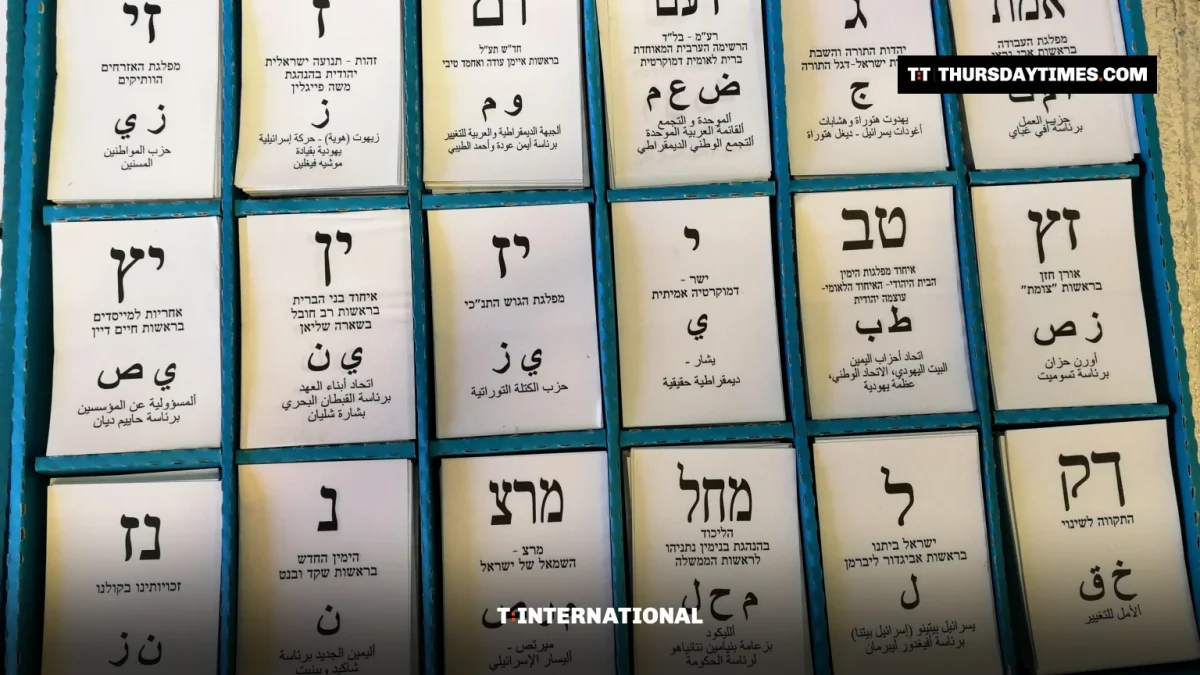
JERUSALEM (The Thursday Times) — Israelis are voting on Tuesday in a general election that puts Prime Minister Benjamin Netanyahu’s political survival on the line, with polls showing neither his right-wing bloc nor a rival alliance led by former army chief Gadi Eisenkot holding a clear path to power.
Polling stations opened at 7am and close at 10pm local time. According to the Central Election Committee, 7.3 million Israelis are eligible to vote, about 330,000 of them for the first time. Opinion polls have shown a tight race between Netanyahu’s Likud and its allies and Eisenkot’s alliance, which draws support from the right and the centre.
“My expectation is that we will have only a slight majority either way. No landslide,” Amotz Asa-El, a political analyst at the Shalom Hartman Institute, told Reuters.
Netanyahu’s pitch
Netanyahu, Israel’s longest-serving prime minister with 19 years in office, has campaigned on his wartime leadership and his close ties with US President Donald Trump, who has endorsed him. He is on trial on corruption charges, which he denies.
To form a government he may again need the far-right leaders Itamar Ben-Gvir and Bezalel Smotrich, both of whom have been sanctioned by several Western countries.
Eisenkot has accused Netanyahu of “relying on a campaign of fearmongering, lies and threats”, and said he was confident Trump would work “in full co-operation with any leader chosen by the people.” He says the next government must stop Iran from acquiring nuclear weapons, whether by force or through a US-backed diplomatic arrangement.
The coalition maths
A government needs the backing of at least 61 of the Knesset’s 120 members. Eisenkot has ruled out partnering with Arab parties, though analysts see a scenario in which they support a minority government led by him from outside. If no coalition can be formed, Netanyahu could stay on as caretaker prime minister until another election next year.
The vote is the first since the Hamas-led attack of October 7, 2023, which killed 1,200 people in Israel, and the war in Gaza that followed, in which Israeli attacks have killed 74,000 people according to Gaza’s health authorities. Israel has since also fought Hezbollah in Lebanon, carried out a 12-day air campaign against Iran’s nuclear sites in 2025 and joined the United States in a war with Iran this year.