DUBAI (The Thursday Times) — Dubai’s tourism industry has pulled itself out of a rough patch earlier this year, with the Department of Economy and Tourism (DET) reporting its strongest monthly visitor numbers since February as the emirate’s hotels filled back up through the summer.
The emirate welcomed roughly 6.97 million international overnight visitors between January and August, according to DET’s Tourism Performance Report, with August alone bringing in about 869,000 visitors — the best single month since the start of the year outside of the winter peak.
A steady climb back
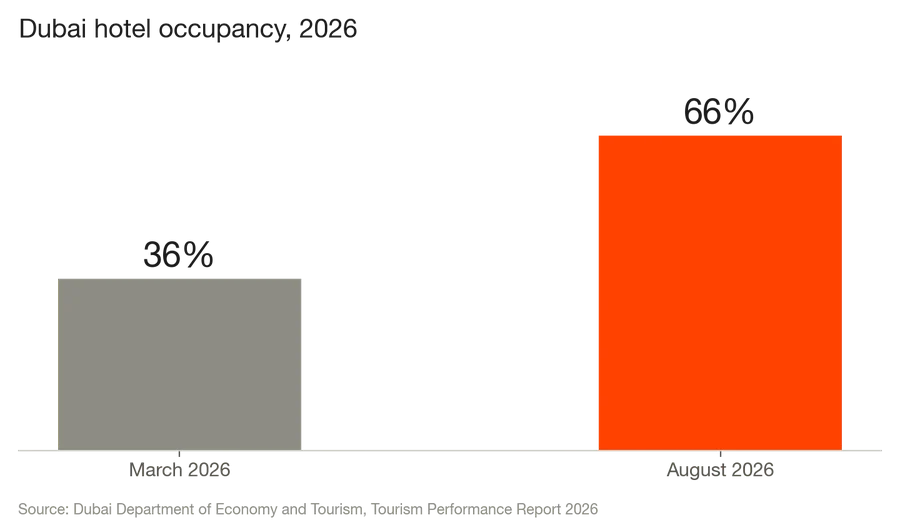
What stands out in the data is less the headline visitor count than the shape of the recovery underneath it. Hotel occupancy across Dubai sat at a subdued 36% in March; by August it had nearly doubled to 66%, as hoteliers reported rooms filling back up faster than new supply could be added. Room nights occupied for the January-to-August period totalled 21.61 million, against an inventory that has grown to roughly 149,000 rooms.
“Dubai’s tourism sector has recorded its highest visitor numbers since February,” the Department of Economy and Tourism said as Arabian Travel Market 2026 opened in the city.
The timing was useful for the emirate: the figures landed just as Arabian Travel Market, one of the industry’s biggest annual trade gatherings, opened its doors in Dubai, giving officials a strong set of numbers to put in front of an audience of airlines, hoteliers and tour operators deciding where to commit next year’s marketing budgets.
Where the visitors are coming from
Western Europe held its position as Dubai’s single largest source market for the January-to-August window, accounting for roughly a fifth of all international overnight visitors — a reminder that, for all the emirate’s efforts to diversify its traveller base toward Asia and the Gulf, European demand remains the backbone of its tourism economy.
Still short of the record
Officials have been careful not to oversell the numbers: this is a recovery, not yet a record. The 6.97 million figure for the first eight months of 2026 trails the comparable period in 2025, when the emirate was riding a stronger run of growth, and the January-2026 reading of around 2 million overnight visitors was itself only a modest 3% rise on the previous January.
But the trajectory through the middle of the year, and particularly the jump in hotel occupancy, is being read in the industry as evidence that the dip earlier in 2026 was cyclical rather than structural — and that Dubai’s long-running bet on tourism as a pillar of its post-oil economy is still paying off.∎