He was nearly a tailor. He gave India its song and Pakistan its idea, argued with God in front of a crowd, and was expected in Heidelberg at 10.23 p.m. The life of Allama Iqbal
Tehreer: Abdullah Esquire
50 minute ka mutala
Pakistan se
- پنجابی Punjabi
- سرائیکی Saraiki
- سنڌي Sindhi
- پښتو Pashto
- بلوچی Balochi
- ہندکو Hindko
- براہوئی Brahui
- کٲشُر Kashmiri
- بلتی Balti
Khitte se
- العربية Arabic
- فارسی Persian
- دری Dari
- हिन्दी Hindi
- मराठी Marathi
- ગુજરાતી Gujarati
- ਪੰਜਾਬੀ Punjabi (Gurmukhi)
- বাংলা Bengali
- தமிழ் Tamil
- తెలుగు Telugu
Duniya bhar se
Tarjuma: Thursday AI. Asal tehreer hi record hai.
Tarjuma ho raha hai… 0 / 51 Asal tehreer parhein
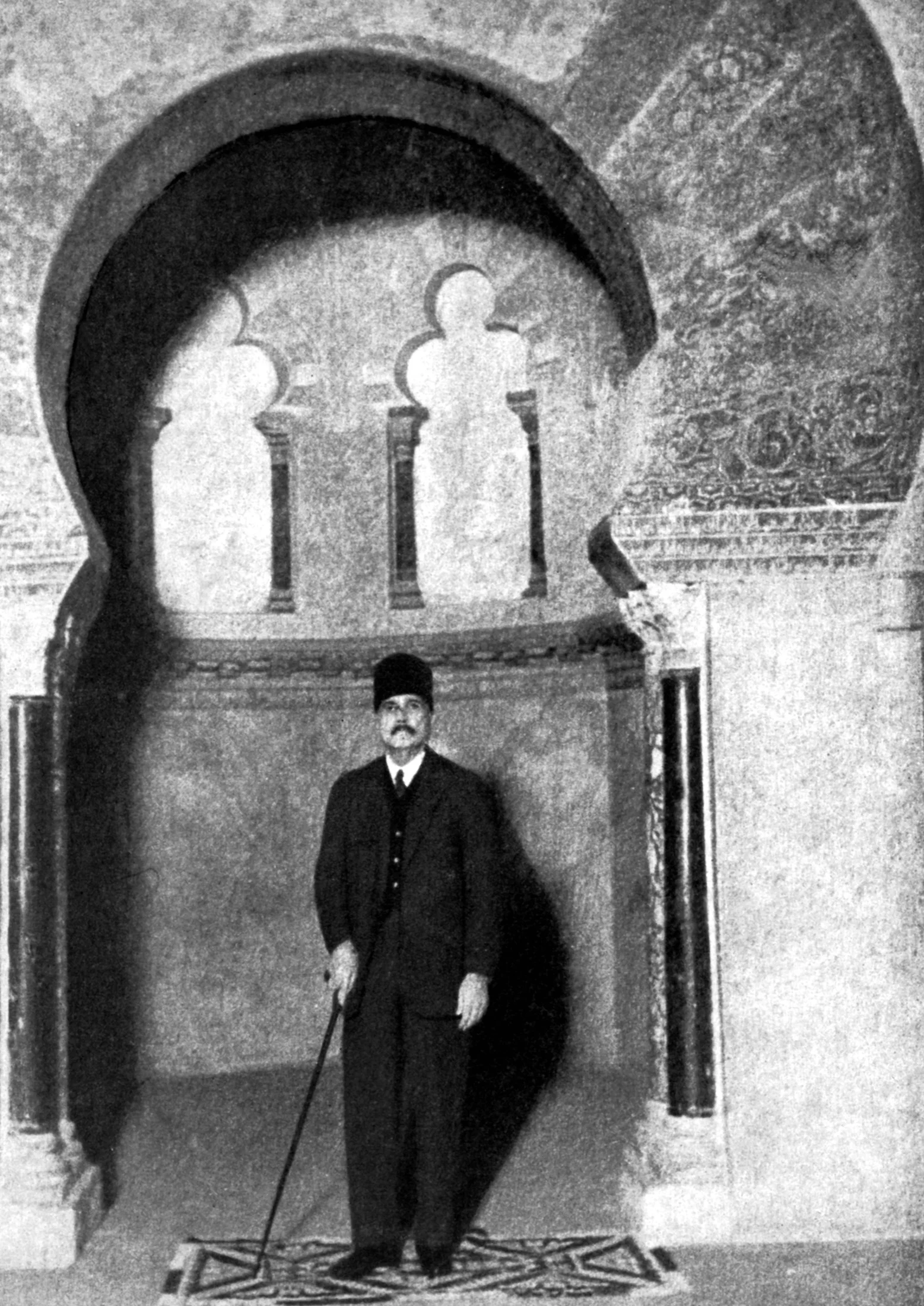
Cover: Allama Muhammad Iqbal stands in the mihrab of the great mosque of Cordoba, Spain, in January 1933. File photo. — IQBAL ACADEMY PAKISTAN/WIKIMEDIA COMMONS (PUBLIC DOMAIN)
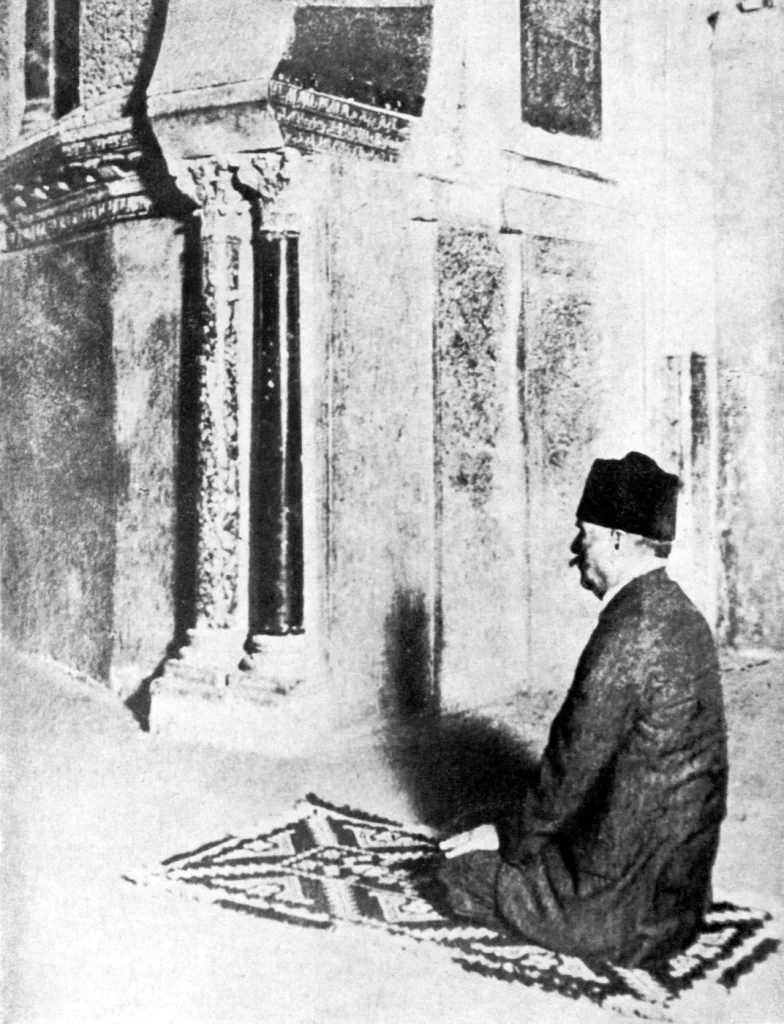
In January 1933, a 55-year-old lawyer from Lahore unrolled a small patterned rug on the floor of the cathedral of Cordoba, knelt down near the old prayer niche, and prayed.
The building had been a church since 1236, when a Castilian king took the city and had the great mosque consecrated. A cathedral had later been raised through the middle of its forest of columns. By most accounts the man on the rug was the first Muslim to pray there in more than four hundred years, and exactly how he managed it has been argued over ever since.
He said, once he was back in Lahore, that he had prayed “with the permission of the Director of Archaeology of Spain, while he was present there”. The journalist Abdul Majeed Salik heard that he had started while the guide was off asking a priest. Malcolm Darling, a British civil servant and an old friend, was told that priests came hurrying over, that Iqbal reminded them how the Prophet had hosted Christians in his own mosque, and that one of the priests ended up taking his picture. Somebody certainly had a camera. In one photograph he kneels with his back to us, in a dark suit and a tall fez. In another he stands inside the mihrabThe niche in a mosque wall that shows worshippers the direction of Makkah. with a walking stick, looking straight at the lens like a man who knows exactly what he is doing.
He sent his small son a postcard of the building. “I am grateful to God,” it said, “that he let me live long enough to see this mosque, which is better than all the mosques in the world.” To another correspondent he was less serene: “today a Muslim like me has to ask permission of others to pray in a mosque which was built by the Muslims.” Forty-two years later the son, a grown man by then, went to Cordoba and put his hand on the spot.
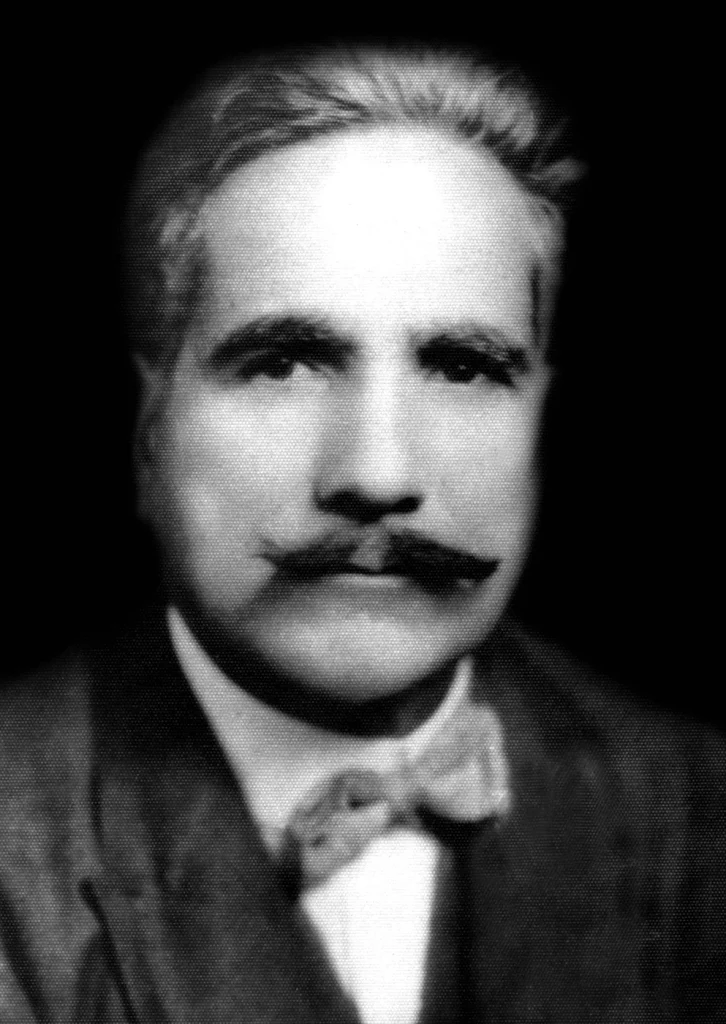
He was, in that January, Sir Muhammad Iqbal: a knight, a barrister of Lincoln’s Inn, a doctor of the University of Munich, and the son of a Sialkot tailor. He had written the song that Indian soldiers still march to. Two years earlier he had stood up in Allahabad and sketched the country that would become Pakistan. He had argued with God in verse before a crowd. Learned men had called him, in print, an atheist, a jackal, a donkey, a dog and Satan. His portrait hangs today on the walls of schools across Pakistan, looking a good deal calmer than he ever was.
He was also, that month, supposed to be somewhere else.
A few weeks before he knelt on that floor he had written from a London hotel to a woman in Germany whom he had not seen for a quarter of a century. He gave her the exact minute of his arrival. “According to my present programme,” he wrote, “I reach Heidelberg on 18 January 1933 at 10.23 p.m.” He named the hotel. He added: “The only object of my stay in Heidelberg is meeting you after so many years.”
The train came in. He was not on it.
To understand how a tailor’s son ended up on that floor, and why a schoolteacher in Germany was left waiting for a train, it helps to go back to a house in Sialkot, and to a needle.
A life in eight dates
The tailor’s son
Nobody, including the man himself, could agree on when he was born. Pakistan celebrates November 9, 1877. The register at Cambridge says he was “born in the month of Muharram 1876”. A German archive offers “10th of July 1876”. The curriculum vitae he submitted at Munich gave a date in the Islamic calendar that works out at November 1877, and then added 1876 in brackets, which is the mark of a great philosopher who has got his sums wrong and is hoping nobody will check. One later biographer argued for 1873. The national holiday has settled the matter by not asking.
His father, Sheikh Noor Muhammad, made clothes. The family were Kashmiris who had come down to the Punjab, and they were not rich. Noor Muhammad had little formal schooling, but he kept a circle of friends who met at the house to read the Sufi classics, and the scholars and mystics who came to know him took to calling him the “unlettered philosopher”. Iqbal’s mother, Imam Bibi, could not read at all. She gave money to poor women without telling anybody, and she was the person the neighbours went to when they fell out. When she died, her famous son wrote: “my urge for worldly progress was due only to her presence.”
The family had a story, of the kind families of famous men tend to acquire afterwards. Before the boy was born, Noor Muhammad dreamt of a bird of brilliant plumage flying low in the air, which dropped into his lap of its own accord. Versions differ as to the bird. All of them agree about what it meant.
The first thing that actually happened to him was bad. When he was about two, according to the chronology kept by the Iqbal Academy, leeches were applied to him as a home remedy and he lost the use of his right eye. He would go through life seeing the world from one side. Twenty-odd years later, that eye would cost him a government job.
What came next could have cost us the poet. Noor Muhammad had a trade and a son, and he drew the obvious conclusion. A ceremony was proposed to start the boy at the needle. It did not go ahead, because a man named Syed Mir Hasan objected.
Mir Hasan taught Arabic and Persian at the Scotch Mission College in Sialkot, and he is the first of the people in this story who saw it coming. When the boy was in about his fourth year of primary school his father thought of taking him out of the Mission School and sending him to the mosque instead. Mir Hasan intervened. The boy, he said, was for “the School, not the Mosque”.
So the first two lives that were planned for Muhammad Iqbal, as a tailor and as a mullah, were cancelled by the same schoolteacher.
Sialkot, about 1877. A boy is born to a tailor, on a date nobody will ever agree about.
A ceremony is proposed to start him at the needle. A schoolteacher stops it.
His father thinks of moving him to the mosque. The same teacher stops that too.
Noor Muhammad had one more thing to give, and it is the story his son would tell for the rest of his life. He noticed the boy reciting the Quran one morning and asked what he was doing. The boy, puzzled, pointed out that he did this every day. His father told him to read it as though it were being revealed to him personally, because there was no other way to understand it. Whether the exchange took place in those words nobody can now say. The idea certainly stayed. Much of what Iqbal later wrote about religion assumes that a text is something that happens to you.
Mir Hasan gave him the rest: Persian, Arabic, the whole inheritance of Muslim letters, walked through at the pace of a man who enjoyed it. The boy was writing verse young enough to send his ghazalsThe classical love lyric of Urdu and Persian: self-contained couplets on a single rhyme. by post to Daagh Dehlvi, the most celebrated Urdu poet of the age, for correction. Daagh, according to an old friend of Iqbal’s, was later proud to count him among those whose work he had marked.
In 1893, when he was fifteen or sixteen, he was married. News that he had passed his matriculation arrived in the middle of the wedding. The bride was Karim Bibi, three years older than he was, and the daughter of the civil surgeon at Gujrat, a match in which Mir Hasan once again turned out to be involved. “It is not every humble tailor’s son,” his biographer Iqbal Singh observed drily, “who gets married to a civil surgeon’s daughter.” Years later, writing to a clever woman he was trying to impress, Iqbal claimed that he had protested against the marriage at the time. Singh calls this an afterthought. Others find signs that he meant it. What is certain is that it was a disaster, that there were a daughter and a son, and that he supported Karim Bibi for the rest of his life while wishing, in writing, that he could run away.
Near the end of that life, by which time he had forgotten very little, the tailor’s son put a needle into a couplet.
وہ پرانے چاک جن کو عقل سی سکتی نہیںعشق سیتا ہے انھیں بے سوزن و تارِ رفو
Those old rents that reason cannot mend,
love stitches, with no needle and no thread.
Armaghan-e-Hijaz
In 1895 he left for Lahore: a married man of about eighteen, with one good eye, a teacher’s blessing, and an elder brother who was paying the bills. Keep an eye on the brother.
The song India still sings
Lahore gave him Room No. 1 in the quadrangle hostel of Government College, and then the rest of the city. From 1899 he lived inside Bhati Gate, in a lane called Koocha Jalootian, in the part of the walled city where poets and wrestlers and singers lived on top of each other.
He took his BA in 1897, and in 1898 he sat for a law degree and failed Jurisprudence. He took his MA in philosophy in 1899, and the accounts of how well he did are instructive. One says he came first in the Punjab. Another, in the Academy’s own chronology, records a Third Division and a medal, on the apparent grounds that he was the only candidate. He got a job at 74 rupees and 14 annas a month. In 1901 the government turned him down for public service, on account of the eye. The British Raj, in other words, declined him twice before it made him a knight.
The professor who taught that class of one was Thomas Arnold, an orientalist who had come to Lahore from Aligarh. Arnold was the second person to see it coming. He took the young man through European philosophy, treated him as a colleague and started pushing him towards the West.
The city, meanwhile, had found him on its own. In November 1896, at a mushairaA public gathering at which poets recite their work, often to a loud and opinionated crowd. in the Bazar-e-Hakeeman, a student nobody had heard of read a ghazal with a couplet about the drops of sweat on a sinner’s ashamed forehead, which Divine Grace gathers up as though they were pearls. An old master present, Mirza Arshad of Gurgaon, burst into praise. People came to hear the student again. Soon they were coming in numbers that embarrassed the Anjuman Himayat-e-Islam, the charity that ran schools and orphanages for Muslims and held its annual fundraiser in Lahore. Around the turn of the century he read them a poem called The Orphan’s Lament. Many people wept, we are told, and when the meeting ended his admirers nearly mobbed him. Printed copies sold at a premium for the orphans. Singh, reading it a lifetime later, thinks it is not much of a poem. That is hardly the point. He had discovered that verse could move a Punjabi crowd to tears and rupees, and he was never to forget it.
He composed in bursts. His friend Sir Abdul Qadir once asked him for a poem at nightfall and sat down with a pencil: “He went on dictating the whole night.” Thereafter he kept a notebook and a pencil by the bed. He smoked a hookah and read in bed. When an earthquake struck during those years, his servant Ali Bakhsh ran up and down the building in terror. Iqbal looked up from his book. “Go and stand under the stairs,” he said, and went on reading. Keep an eye on Ali Bakhsh as well. He would be there at the end.
Lahore also gave him the first of the disasters of his heart. In 1903 or 1904 he fell for a singing girl from the old city named Ameer Begum, and by one account “loved her to distraction”. Her mother is said to have ended it. And in the summer of 1903 the brother who had paid for his schooling, Ata Muhammad, was arrested at Quetta on charges of financial corruption. The promising young professor went there, in the words of the Academy’s chronology, “to clear him out”. The brother who had carried him now had to be carried.
Through all of this he was writing for children, for orphans, for mountains. Himala, addressed to the Himalayas, opened his first collection. He wrote a child’s prayer, marked in his collection as an adaptation, which begins with a wish that life should be like a candle.
لب پہ آتی ہے دعا بن کے تمنا میریزندگی شمع کی صورت ہو خدایا میری
My longing comes to my lips as a prayer:
may my life, O God, be like a candle.
Bachche ki Dua, from Bang-e-Dara
It is still recited at morning assembly in schools across Pakistan, by children who have no idea that the poet was a one-eyed lecturer behind on his sleep. And then, on August 16, 1904, a weekly called Ittehad printed a short poem he had called Tarana-e-Hindi, the song of India.
سارے جہاں سے اچھا ہندوستاں ہماراہم بلبلیں ہیں اس کی، یہ گلستاں ہمارا
Better than all the world is our Hindustan.
We are its nightingales; this is our garden.
Tarana-e-Hindi, 1904
The poem got away from him almost immediately and has never been brought back.
A Lahore weekly prints a short poem by a lecturer aged twenty-six.
Gandhi, it is said, sings it more than a hundred times in Yerawada jail.
Ravi Shankar sets it to a new tune. The Indian armed forces take it up as a quick march.
India’s first astronaut is asked from orbit how his country looks. He answers with Iqbal’s first line.
The massed bands of the Indian military play it at Beating the Retreat.
There can be few stranger facts in the culture of the subcontinent. A republic that has gone to war with Pakistan again and again still marches to the words of the man Pakistan regards as its ideological founder, and it has never found a way of stopping.
When he wrote it he was twenty-six and in love with the whole idea of Hindustan. He was also restless. He first thought of going to America. Arnold had gone home to England in 1904, and Iqbal wrote him a farewell poem that ends with something close to a threat: “I’ll break the bonds of Punjab, and then run straight to you.”
In September 1905 he did. The man who came back three years later would no longer believe a word of that song.
Three years in Europe
On the way to the ship he stopped at Delhi, where on September 2 he visited the shrine of Nizamuddin Auliya and the tomb of Ghalib, the two presiding spirits of what he was leaving. He left the next day. He reached Dover on the 24th, with a Punjabi’s suspicion of the weather and Arnold’s letters of introduction.
Cambridge put him in a first-floor flat at 17 Portugal Place, in the shadow of Trinity, where a plaque records it today. His teachers were John McTaggart and James Ward. McTaggart did not spare him. Iqbal wrote a thesis on the reality of time, and when McTaggart criticised it bitterly, he tore it up. On November 6, 1905, he was admitted to Lincoln’s Inn. He took his Cambridge degree in 1906.
Then he decided to stop writing poetry.
The evidence is unusually good, because the friend he told set it down in the preface to his first Urdu collection. “One day, Shaikh Muhammad Iqbal said to me that he had firmly decided to give up poetry,” Sir Abdul Qadir recorded. He thought there were better uses for the time. Qadir answered that his poetry “was not of a type that ought to be abandoned”. Unable to settle it, they took the question to Arnold. “Arnold Sahib agreed with my point of view.” It took a British professor to tell the greatest poet of modern Urdu to keep going. Had Arnold said the other thing, as a later writer remarked, “no-one today would have heard of Iqbal’s name.” Shortly afterwards somebody at a party asked him for something in Persian. He went back to his lodgings and by morning he had two complete poems. He had found the language that would carry him out of India.
And then came 1907.
On April 1 he went to a party at the house of a Miss Beck in London. Among the guests was Atiya Fyzee, a brilliant young woman from a great Bombay family, who was travelling through Europe collecting famous men and writing them up. She found a professor who announced that he was “two personalities in one”. Her verdict was instantly recorded: “fond of his own opinion – a bad sign, I said to myself!” Two weeks later she had him to tea. He recited comic verses, and when she started writing them down he stopped her. “These expressions are meant only for this particular occasion,” he said, “and their mission has ended the moment they are uttered.” She had met her match. Over the next few years he would write her some of the most unguarded letters of his life.
Arnold told him to go to Germany, saying that the pupil would surpass his teacher. By July he was in Heidelberg, learning the language at a pension on the Neckar in the company of three young women teachers. Atiya, who turned up to inspect the arrangement, named them as “Frauleins Wegenast, Senechal and Schat”. She reported that he looked at first “sarcastic and almost sinister”, until “a sharp rejoinder” brought him round. And then the sinister Punjabi professor, she tells us, danced to a German folk tune and sang aloud.
September 24, 1905. Three weeks out of Delhi.
A first-floor flat at 17 Portugal Place. McTaggart savages his thesis on time, and he tears it up.
Lincoln’s Inn, and a tea party with Atiya Fyzee.
July 1907. A pension on the Neckar, and Fraulein Wegenast.
November 4, 1907, five in the afternoon. A First in Arabic. A Third in philosophy.
Emma Wegenast was twenty-seven. He read Goethe with her, and walked with her along the river. He stayed for three months or perhaps six, depending on whom you believe, and it is the only period of his life in which he sounds purely happy. He called Munich an “Isle of Bliss, bathed in the sea of imagination”. On the bank of the Neckar he wrote a poem about a night so quiet that the moonlight itself had stopped speaking.
خاموش ہے چاندنی قمر کیشاخیں ہیں خموش ہر شجر کی
The moon’s own light has fallen silent.
The branches of every tree are silent.
Ek Shaam, on the bank of the Neckar, from Bang-e-Dara
The letters he wrote her afterwards survive: 27 of them are known, and those who first saw them recalled more than 40. They are very strange letters. He addresses her throughout with the formal “Sie”, never the intimate “Du”. He apologises for his “schlechte Deutsch”. And then, in that bad and correct German, he tells her: “My body is here, my thoughts are in Germany.” Back in India he wrote that he had lost all of his German, “excepting a single word: Emma!” A family story has her wanting to follow him to India, and a brother forbidding it. She appears never to have married: every one of his letters is addressed to “Fraulein”.
He still had to get a degree. He paid his 260 marks at Munich on July 22, and on Monday November 4, 1907, at five in the afternoon, he went into the Senate Chamber to be examined. It is here that his career as a philosopher comes up against the record. Fritz Hommel, the orientalist who oversaw the examination, had written to a colleague about the candidate’s thesis on Persian metaphysics, “but I know nothing about Islam myself”. The marks survive. He got a First in Arabic, a Second in English and a Third in philosophy, and the degree was awarded cum laude. The most famous philosopher in the history of the Muslim subcontinent had taken a doctorate that was, as one of his biographers cheerfully concedes, technically a PhD in Arabic.
Something much larger had also shifted. Iqbal had come to Europe as an admirer of its libraries and its energy. Its nation-states, armed and competing, began to look to him like a form of idolatry. In March 1907, seven years before the guns of August 1914, he wrote a poem that reads now as a prophecy.
تمھاری تہذیب اپنے خنجر سے آپ ہی خود کشی کرے گیجو شاخِ نازک پہ آشیانہ بنے گا، ناپائدار ہو گا
Your civilisation will take its own life with its own dagger.
A nest built on a slender branch cannot last.
March 1907, from Bang-e-Dara
He said what he meant by it in a couplet that has been quoted against him and for him ever since.
ان تازہ خداؤں میں بڑا سب سے وطن ہےجو پیرہن اس کا ہے، وہ مذہب کا کفن ہے
Of these new gods the greatest is the homeland.
Its robe is the shroud of religion.
Wataniyat, from Bang-e-Dara
He taught for a few months at the University of London, sent his resignation to Government College in January 1908, and was called to the bar on July 1. He talked of going back to Heidelberg before he sailed. He did not. There was some business in Paris instead, about which nobody knows anything. Reaching Lahore in late July, he was dined by his friends outside Bhati Gate and fêted at Sialkot, and he described it all, in German, to Emma.
In 1910 he took the metre and the rhyme of Tarana-e-Hindi and wrote it again, as Tarana-e-Milli, the song of the community. The nightingale of Hindustan now belonged to everywhere.
چین و عرب ہمارا، ہندوستاں ہمارامسلم ہیں ہم، وطن ہے سارا جہاں ہمارا
China and Arabia are ours; Hindustan is ours.
We are Muslims, and the whole world is our homeland.
Tarana-e-Milli, 1910
He had left as a Punjabi patriot. He had come home with three qualifications from two countries, a mistrust of the idea of a country, and a wife he did not want. Now he had to earn a living.
The rooms in Anarkali
The rooms he took in Anarkali had previously housed Fazl-i-Husain and then Muhammad Shafi, two men who would run Punjab’s Muslim politics between them. They stood over the premises of a bookseller named Attar Chand Kapoor, they came with a pigeon loft on the roof, and Iqbal stayed for fourteen years.
He went to court in a black suit and a Turkish cap, sometimes with a monocle over the good eye, and he drove himself there in his own gig. Government College paid him Rs 500 a month to teach philosophy until, at the end of 1910, he gave it up for the law. As a lawyer he was the despair of everybody who loved him. Each month, Singh records, he estimated what the household needed and “made it a point not to accept any more briefs than would cover his monthly expenses”. When he had earned enough, he stopped. In May 1910 he kept a paying client sitting outside while poets recited in the next room, on the grounds that a man who had come for his name would not run away. He would go on practising, in this way, for a quarter of a century, with more than a hundred reported judgments to his name. When Alwar State offered him a secretaryship at Rs 600, he wrote back with a list of his dependants, a pensioned brother, two wives and two children, and explained that it was not enough.
Two wives. We will come to that.
Princes found him difficult. In Lahore, around 1909, the Maharaja of Kashmir, Pratap Singh, had him brought to Kashmir House and was told he was a doctor. The Maharaja, who pronounced it “dak-dar”, took this to mean a man from the post office. He asked what he did. Told that he made bait, couplets, the Maharaja understood him to make canes. Then he ordered him to sing. Iqbal murmured that he would if his friends agreed to wear ankle-bells.
Better company was available. On Jail Road lived Princess Bamba, a granddaughter of Maharaja Ranjit Singh, the great Sikh ruler of the Punjab, who was then living in Lahore. One afternoon in 1912 she ordered her driver to fill a hookah and carried it over and set it down in front of the son of a Sialkot tailor with her own hands. Iqbal could not get over it. Ranjit Singh’s granddaughter, he told his friend Mirza Jalal-ud-Din, has served me hookah. The same princess had a picnic at Shalimar that produced two rather unexpected poems in Bang-e-Dara, one about a flower and one about a cat sitting in a lap, which he later smuggled into the section of the book where he kept the European ones.
None of this was what he was thinking about. What he was thinking about was his marriage, and on this we have an unusually full account, because his own son, a judge, sat down in old age and wrote it out.
He had been looking for a way out of the Karim Bibi arrangement since his return. He would tell Atiya he had thought of fleeing the country. By 1910 a second marriage had been arranged, with an orphan of about nineteen named Sardar Begum, the sister of a carpet dealer. There are three versions of how she was found: through a friend’s proposal, through a barber’s wife who led his mother to the house, or by means of a photograph obtained on a pretext. The nikahThe Muslim marriage contract, which can be signed well before the bride moves to her husband’s house. was held. And then two or three anonymous letters arrived, casting doubt on her, and he stopped.
For three years, nothing happened. She remained his wife on paper in her brother’s house. Early in 1913 he married a third time, Mukhtar Begum of Ludhiana. And then his friends traced the letters. They had been written by a lawyer who wanted the girl for his own son.
Sardar Begum, meanwhile, had sent him a message. She would stay unmarried, she said, and on the Day of Judgement she would take hold of the hem of his garment. Mukhtar Begum, when she heard all this, wept.
He brought her home. Because he had privately resolved on divorce during those years, a second nikah was held in the late summer of 1913, to be certain. He could not leave a woman who had suffered for three years, he wrote on October 26, and he wished he had known before the other marriage. The house then contained two wives, a sister and various nieces. There were evenings of cards and ludo and pigeons, Karim Bibi came for a brief, unimaginable visit, and the greatest mind in Muslim India returned to his hookah.
That is the private life. In the middle of it, on an April night in 1911, he had done the most dangerous thing a poet in Lahore had ever done.
A complaint to God
The Anjuman was holding its annual session in the courtyard of the Riwaz Hostel at Islamia College. Iqbal was at dinner at Mirza Jalal-ud-Din’s when the panting secretary arrived to fetch him. He went as he was, in a shalwar, short coat and Turkish cap. The poem is often dated to 1909; the better evidence, including Iqbal’s own remark a year later that it was last year’s poem, says April 1911.
He began with a jab, a couplet saying that he knew no trick of selling the nation, and that in Punjab one could not find a teacher of that art. The crowd demanded that he sing it. Then he turned from the politicians, and addressed God directly, with a complaint.
Muslims had carried your name across the world, the poem said. They had prostrated themselves in the middle of battle. They had carried it over desert and sea and broken the idols. And what had they got for it? Wealth and power had gone to the unbelievers, and the faithful had been left with poverty and promises. Few people had spoken to God like this in Urdu, and none of them in front of the Anjuman’s donors.
کیوں زیاں کار بنوں، سود فراموش رہوںفکرِ فردا نہ کروں، محوِ غمِ دوش رہوں
Why should I go on losing and forget what might be gained?
Why give no thought to tomorrow, and brood on yesterday?
Shikwa, 1911
People threw flowers. His father wept. Khwaja Abdul Samad Kakru got up and put a shawl round his shoulders. Iqbal took it off and gave it to the Anjuman, which auctioned it on the spot.
A storm followed. Traditionalists were appalled by the tone. Letters arrived in thousands. A year later, in front of a crowd put at around ten thousand, he remarked that Shikwa had evidently displeased God. Then he refused to sing.
It is commonly said that he was declared an infidel for the poem. That is not quite what the record shows. His son’s biography records objections to its tone. The formal fatwa came much later, in 1925, from Maulvi Didar Ali, the preacher of the Wazir Khan Mosque, and over something else entirely. But a poet who has told God off in front of ten thousand people has not finished the conversation.
Six months after Shikwa, the news from Tripoli got worse. Italy had invaded the Ottoman province in the autumn of 1911, and Iqbal went to the Badshahi Mosque after prayers and stood in front of a crowd with a poem in which he has been to Paradise and is asked by the Prophet what gift he has brought. He has brought a cup, he says. “It contains the blood of the martyrs of Tripoli.” A year later the Balkans were on fire as well, and at a public meeting in the garden outside Mochi Gate, on what seems to have been November 30, 1912, he delivered the reply.
جرأت آموز مری تابِ سخن ہے مجھ کو
شکوہ اللہ سے، خاکم بدہن، ہے مجھ کو
The force of speech has taught me to be bold. May dust fill my mouth: my complaint is against God.
دل سے جو بات نکلتی ہے اثر رکھتی ہے
پر نہیں، طاقتِ پرواز مگر رکھتی ہے
What comes from the heart carries power. It has no wings, yet it has the strength to fly.
اے خدا! شکوۂ اربابِ وفا بھی سن لے
خوگرِ حمد سے تھوڑا سا گلا بھی سن لے
O God, hear a complaint from the faithful too. From one so used to praising, hear a little blame.
کی محمدؐ سے وفا تو نے تو ہم تیرے ہیں
یہ جہاں چیز ہے کیا، لوح و قلم تیرے ہیں
Be faithful to Muhammad and We are yours. What is this world? The Tablet and the Pen are yours.
Jawab-e-Shikwa is God’s answer, and God is not sentimental. The promise was never broken, the poem says; it is you who stopped keeping your side of it. Each verse was auctioned as he read it, for the Balkan fund, and the sums were, his son says, heavy. In the last couplet the promise is renewed. Generations of Pakistanis have learned the two poems as a pair. Iqbal had made it possible to doubt out loud and return.
He had made it possible to doubt out loud and return.
Two years later, he found out what doubt was for. On November 9, 1914, by the commonly accepted date on his own birthday, his mother died. Eight days after that, his daughter Meraj Bano died as well. The elegy he wrote for his mother is long, and in it the philosopher of Heidelberg admits that he has no argument against grief. It ends with a couplet now cut into gravestones across the Urdu-speaking world.
آسماں تیری لحد پر شبنم افشانی کرےسبزۂ نورستہ اس گھر کی نگہبانی کرے
May the sky scatter dew upon your grave,
and fresh green grass stand guard over this house.
In Memory of My Late Mother, from Bang-e-Dara
He was thirty-seven, and he had lost the woman who, by his own account, had been the reason for all of it. He went back to his desk and began work on the book that would make the word for “conceit” the most important word in the language.
The word he made his own
Asrar-i-Khudi, the Secrets of the Self, came out in 1915. It is a long masnaviA long narrative or teaching poem in rhyming couplets, the form Rumi used. in Persian, and he chose Persian with care: Urdu would have stopped at the edge of India, and Persian could still reach Kabul, Tehran and the educated Muslims of Central Asia. At the heart of the book is a single word.
In ordinary Urdu, the word meant conceit.
Iqbal took the insult and built a philosophy on it.
خودی کو کر بلند اتنا کہ ہر تقدیر سے پہلے
خدا بندے سے خود پوچھے، بتا تیری رضا کیا ہے
Raise your self so high that, before each decree of fate, God Himself should ask of man: tell me, what is your wish?
KhudiLiterally “selfhood”. In ordinary Urdu it can mean conceit; Iqbal used it for the human ego as a creative force. had always been a slightly disreputable term. Mystics taught that the self was the veil between man and God, and that the highest spiritual state was its dissolution. Iqbal looked at the Muslims of his time, a colonised people with beautiful manners, and concluded that this teaching had done them enormous harm. He argued that the self is the most real thing we have. It is made stronger by love, by effort and by refusing to beg, and weaker by anything that teaches it to accept its situation.
پیکرِ ہستی ز آثارِ خودی استہر چہ می بینی ز اسرارِ خودی است
The form of all existence is the work of the self.
Whatever you see is one of the self’s secrets.
Asrar-i-Khudi, 1915
To make the point, he told the story of a lump of coal who meets a diamond in a mine. They are, the coal complains, made of the same stuff. Why should one be burned for warmth and the other set in the crowns of kings? The diamond answers that dark earth becomes a jewel by hardening. It is the sort of parable a tailor’s son might tell.
فارغ از خوف و غم و وسواس باشپختہ مثلِ سنگ شو، الماس باش
Be free of fear, of grief, of doubt.
Be hard as stone. Be a diamond.
Asrar-i-Khudi, 1915
God, in this account, does not want man to disappear. God wants a collaborator.
What followed was one of the great literary brawls of the century in India. The first edition contained a passage attacking Hafiz, the best loved of all Persian poets, as a seductive influence on a people who needed waking up. Hafiz was revered in Sufi circles as something close to a saint. Khwaja Hasan Nizami of Delhi rushed out Urdu renderings of Iqbal’s Persian that added meanings not to be found in it. The elderly satirist Akbar Allahabadi joined the attack, by the account of Iqbal’s son without having read the poem. Opponents called him the names listed at the beginning of this story. One of them published a riposte entitled Asrar-i-Bekhudi, the Secrets of Selflessness. Iqbal fought for a while, and then wrote the most effective sentence of the whole affair: “I have omitted in this edition lines written on Hafiz.”
In 1917 he published Rumuz-i-Bekhudi, a companion poem about how the strengthened self must then give itself to a community. Then, in 1920, something happened that no Punjabi poet had arranged for. Reynold Nicholson, the great translator of Rumi, brought out an English version as The Secrets of the Self, and London sat up.
E.M. Forster reviewed it for the Athenaeum. He was struck that “Iqbal has won his vast kingdom without help from the West”, and then remarked of the poem’s doctrine: “The drawback of being a Superman is that your neighbors observe your efforts.” The Cambridge don Lowes Dickinson, in the Nation, found something alarming: “Not the star of Bethlehem, but this blood-red planet.” Iqbal wrote to Nicholson in exasperation about “the old European idea of a blood-thirsty Islam”. Nietzsche, whom he had read and argued with, was constantly brought up. He was now famous among people who could not read him.
Fame brought the Punjab’s British governor to the door, and on January 1, 1923, Muhammad Iqbal became a knight. Lahore’s poets, who had been waiting for this, responded at once. The wit Abdul Majeed Salik published a line that went round the city: “Sirkar ki dehleez pay Sir ho gaye Iqbal!” At the government’s doorstep, Iqbal has become Sir. Salik later found it hard to look him in the face. Iqbal, who knew a good line when he heard one, had it recited to him again and again.
Here the story takes the turn that every schoolchild in Pakistan knows. Iqbal is supposed to have said he would accept only if his old teacher, Mir Hasan, was honoured too. The governor objected that Mir Hasan had written no books. Iqbal replied that he himself was Mir Hasan’s book. It is a beautiful story, and it would be pleasant to report that there is a document behind it. None has been found. What is on the record is that the old schoolmaster from Sialkot, who had twice stopped a boy being taken out of his hands, did become Shams-ul-Ulama, the Sun of Scholars.
The poems kept coming. Payam-e-Mashriq, the same year, was his answer to Goethe’s West-East Divan, a century late and from the other side of the conversation, with a dedication to King Amanullah of Afghanistan that included a good deal of advice the king had not asked for. A son was born in 1924. He named him Javid, which means eternal. And now, in his late forties, a poet with a knighthood and a monocle decided to go into politics.
The principle of movement
He ran for the Punjab Legislative Council in 1926, and the campaign is the funniest thing in his life.
His opponent in the Muslim seat for Lahore was Malik Muhammad Din, allegedly put up by a senior judge who disliked him. Turbaned squads marched through the wards. Supporters went about in red caps with his name chalked on them. Kashmiri newspapers called him a liar and a Wahhabi. One voter, greeted respectfully by the candidate in the street, replied by lifting his dhoti. The poet Hafeez Jalandhari, who was walking alongside, observed that the nation had now shown what it had. Iqbal laughed.
On polling days, November 23 and 24, there was a stabbing at Mochi Gate, and arrests for forged voting slips that included his opponent’s brother. When the count came in, he had 5,675 votes to 2,698. A victory parade went through the walled city with bhangra dancers and the young critic M.D. Taseer dancing among them, and it halted near Bhati Gate for the sunset prayer. He had won. It cost him the friendship of Fazl-i-Husain, the most powerful Muslim in the province.
He was not a natural. A High Court judgeship he wanted had already gone elsewhere, partly, as Fazl-i-Husain’s son would later write, because “Dr Iqbal alienated the sympathies of officials by unrestrained criticism of the Government”. In May 1927 communal riots broke out in Lahore. At half past midnight on the night of May 3 he was at Haveli Kabuli Mai, in the thick of it. The riots shook him. “Doubts have crept in my mind,” he told a newspaper, “whether we are at all capable to take charge of political institutions.”
Poetry was only half of what he was doing. In January 1929 he travelled south to give a series of lectures, and the tour became one of those events that can happen only to a certain kind of Indian celebrity. In Madras he spoke at Gokhale Hall, under the patronage of a merchant, Seth Jamal Muhammad, who gave him a cheque and Kashmiri shawls, one of which went to Ali Bakhsh. A gathering of Muslim women in purdah presented him with an address from behind a screen, and demanded a poem on women’s freedom. It is hard to say which party was the more surprised.
On January 11 he went to the tomb of Tipu Sultan at Srirangapatna, who had died fighting the British in 1799. He asked to be left alone there and stayed a long time with his eyes shut. A court singer named Ali Jan had been brought along, and when he saw Iqbal weeping he stopped. Iqbal told him to go on. Asked afterwards what message the tomb had given him, he replied with a Persian couplet about dying like a man.
The lectures, delivered in Madras, Hyderabad and Aligarh and published in Lahore in 1930 and by Oxford University Press in 1934 as The Reconstruction of Religious Thought in Islam, are among the most intellectually ambitious things any Muslim wrote in that century. Their central claim is that Islam was not designed to stand still. The chapter that has caused the most trouble is called The Principle of Movement in the Structure of Islam, and its subject is ijtihadIndependent reasoning applied to questions of Islamic law..
For centuries the law was held to be complete, every line in its place.
Iqbal called for reasoning that never stops. He called it the principle of movement.
The gates of legal reasoning, he said, had been closed by frightened men in a frightening century, after the Mongols burned Baghdad, and they had to be opened again. He went further, suggesting that in the modern age this authority might pass from individual scholars to an elected Muslim legislature. Many clerics have never accepted that sentence. It had already cost him something. In 1925 Maulvi Didar Ali, the preacher at the Wazir Khan Mosque, had formally declared him an unbeliever; among the causes given are his translation of a Hindu prayer into Urdu and a paper on ijtihad delivered in Lahore the previous December.
There was a son at home who was now old enough to be puzzled by all this, and he was the reason for the strangest book Iqbal ever wrote. Javid Nama, published in 1932, is a journey through the heavens in the manner of Dante. Rumi is the guide. They pass through the spheres of the moon and of Mercury, and meet, among others, Tolstoy, Nietzsche, and a pair of Muslim traitors in the depths. The traveller’s name is given by Rumi in a joke.
تند سیر اندر فراخائے وجودمن ز شوخی گویم او را زندہ رود
He moves fast across the breadth of being.
In jest I call him Zinda Rud, the Living Stream.
Javid Nama, 1932
A living stream: that was how the man who had once decided to give up poetry saw himself. He had one more thing to do first. He had to go to Allahabad.
The country he did not name
The All-India Muslim League had a problem in 1930, which was that nobody much wanted to come to its annual session. The council chose Lucknow, and the arrangement was fixed on August 17, the day Iqbal’s father died in Sialkot. The session was postponed, allegedly through the manoeuvres of his old friend Fazl-i-Husain. Benares and Ajmer were tried. In the end it was held in Allahabad, in what one Iqbal scholar calls “a forlorn haveli”, at the end of December.
The official proceedings are merciless. There was an “audience of about 600 persons, a large majority was formed by local people”. Around 25 delegates turned up for the Subjects Committee. A League politician, Muhammad Yakub, had to summarise the president’s English in Urdu, for the benefit of those who could not follow it. The next day attendance fell “below the requisite quorum” of 75, Iqbal left in the middle of the debate, and the whole thing ended a day early.
Critics of Pakistan like to bring this up. They have it the wrong way round. On December 29, 1930, in a half-empty house, in front of a few hundred people who had mostly come in from the neighbourhood, a tired poet stood up and read out the future.
India, he said, was a continent of human groups belonging to different races and speaking different languages, and its communal question could not be resolved by pretending otherwise. Then came the sentence: “I would like to see the Punjab, North-West Frontier Province, Sind and Baluchistan amalgamated into a single state.” Self-government, he went on, “within the British Empire, or without the British Empire”, appeared to him the final destiny of the Muslims, at least of North-West India.
“I would like to see the Punjab, North-West Frontier Province, Sind and Baluchistan amalgamated into a single state.”
Historians have argued for almost a century over how far he meant that to go. In public, in the years of negotiation that followed, the knight who was writing to British newspapers was careful about it. In private, as we will see, he was not. He never used the word Pakistan. That was left to somebody else.
In January 1933, a student at Cambridge sat down with the names of the Muslim homelands of the north-west.
He took a letter from each, and the end of the last.
One more letter was added soon afterwards, to make it easier to say.
The student was Choudhry Rahmat Ali, and the pamphlet was called Now or Never. It is dated January 28, 1933. That was the month Iqbal knelt on his rug at Cordoba, a thousand miles from the young men who were busily naming his idea.
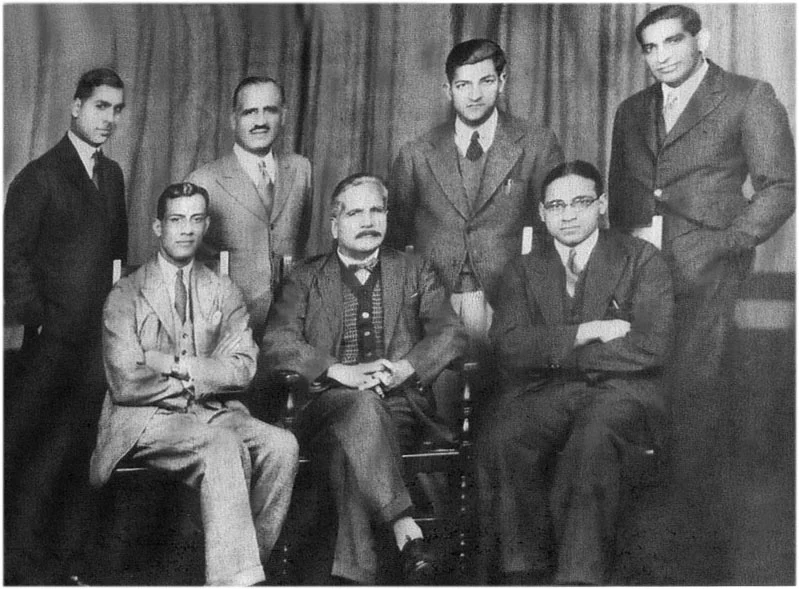
What matters more is whom he persuaded. Muhammad Ali Jinnah had given up on Indian politics and gone to live in London. By the mid-1930s he was back, rebuilding the League, and Iqbal’s letters began to arrive at his desk. They are the letters of a dying man who has one thing left to say. “The problem of bread is becoming more and more acute,” he wrote on May 28, 1937, and the sentence would not look out of place in a political speech today. On June 21, with his health collapsing, he called for a separate federation of Muslim provinces and told Jinnah why he kept writing. “You are the only Muslim in India today,” he said, “to whom the community has a right to look up for safe guidance through the storm which is coming to North-West India and, perhaps, to the whole of India.”
Jinnah would later describe him as “a personal friend, philosopher and guide and as such the main source of my inspiration and spiritual support”. The Lahore Resolution was passed in March 1940, less than two years after Iqbal’s death, in a park that now bears his name. Two days afterwards, in a tribute to the dead poet, Jinnah said that if he lived to see a Muslim state, and was offered a choice between the works of Iqbal and the rule of that state: “I would prefer the former.”
The floor at Cordoba
Now we can go back to the rug.
He had gone to London in 1931 for the second Round Table Conference, on the future of India, as one of the Muslim delegates. It did not go well. Alone among them he wanted out of the Federal Structure Committee, and he resigned and left on November 21. Fazl-i-Husain, who had been considering him for a public appointment, dropped the idea, and confided his reasons to his diary: “had this silly fellow not announced telegraphically that he had resigned from the Round Table Conference. No other member did that.”
He went home by way of the most interesting people he could find. In Rome, on November 27, he spent about forty minutes with Benito Mussolini, and there are three accounts of what was said. In one the Duce offers him a paid trip to Libya. In another, given by Iqbal’s friend Faqir Waheeduddin, Iqbal told him about the Prophet’s policy of limiting the population of Madinah, and Mussolini “thumped the desk with his two hands”. To Italian reporters he said: “Your Il Duce is another Luther, but is without a Bible.” He wrote a poem admiring the dictator’s energy. Later, after the invasion of Ethiopia, he wrote another in which Mussolini turns on his European critics and asks what exactly he has done that they did not do first. It is a sharper poem, but it does not quite retract the first. The prophet of the self could be dazzled by men who had a great deal of it.
In the same city, invited to a reception by a Countess Carnevale, he agreed on condition that she ask the most beautiful women in Rome. In Cairo an old Sufi, Abu al-Azayim, called at his hotel as a religious duty, and after the old man had gone Iqbal burst into tears. “My God time has come that people look upon so ‘sinful’ man like me,” he said. In Jerusalem, in December, the Grand Mufti met him at the station, and he sat through the Muslim World Congress. Palestinian orphans staged a pageant for the guests on the conquest of Andalusia. Iqbal stood up and answered them with Persian verses on Tariq, burning his boats on the Spanish shore. The idea was growing.
His small son wrote to him during that journey, in the first letter he had ever written by himself, and asked him to bring home a gramophone. Iqbal sent him a poem instead. It tells him to make his own place in the country of love, and to create a new age with its own mornings and evenings. Few boys have received so magnificent a refusal.
مرا طریق امیری نہیں، فقیری ہےخودی نہ بیچ، غریبی میں نام پیدا کر!
My way is not riches, but poverty.
Do not sell your self. Make your name in poverty.
To Javed, from Bal-e-Jibril
He came back for the third conference at the end of 1932. On one of those crossings between Paris and London some card-sharps tried to fleece him, lost £20, and were then threatened with the police.
And in a London hotel, he sat down and wrote to Fraulein Wegenast.
They had kept up a thin correspondence through the decades. There had been a gap for the First World War, after which he wrote to say he was sorry for the time of trial Germany now faced. And now, from Queen Anne’s Mansions in St James’s Park, in December 1932, he gave her the train. “I am leaving London on Friday, 30 December,” he wrote. “According to my present programme I reach Heidelberg on 18 January 1933 at 10.23 p.m.” He gave the name of the hotel. “The only object of my stay in Heidelberg is meeting you after so many years. I am looking forward to meeting you with great pleasure.”
He left London when he said he would. In Paris there was Henri Bergson. The greatest living philosopher of time was by then in a wheelchair. A Sikh friend, Sardar Umrao Singh, arranged the meeting and interpreted, and they talked for two hours. Iqbal, who had once torn up a thesis on time because McTaggart hated it, had been waiting for this conversation all his life. By one account he quoted a saying of the Prophet, do not abuse time, for God says, I am time, and Bergson kept asking whether it was authentic. Iqbal told William Rothenstein what happened to the record of this meeting between two of the great minds of the century: “the friend who was with us recorded the conversation, but afterwards could not read his own handwriting.”
Then he went on to Spain, travelling with an English secretary who, he reported to Atiya Fyzee with some satisfaction, had come to see in him a “divine personality”. “I can say negatively,” he added, “that I am not a fool.” The Spanish papers took her for his daughter. On January 24 he lectured in Madrid, with the great Arabist Asin Palacios in the chair. Granada left him cold: “Al-Hamra did not leave much of an impression on me,” he wrote. Cordoba did not.
We have been in that mosque already. It remains to say what came out of it.
سلسلۂ روز و شب، نقش گرِ حادثاتسلسلۂ روز و شب، اصلِ حیات و ممات
The chain of day and night is the painter of all that happens.
The chain of day and night is the root of life and death.
Masjid-e-Qurtuba, from Bal-e-Jibril
Masjid-e-Qurtuba is one of the great poems of the Urdu language. It begins by saying that day and night, the chain of ordinary time, are the artist of all that happens and the origin of life and death, that every work of art is on its way to being erased. Then it says that one thing is not. A thing made in love, the poem goes on, can outlast the chain. All around him were eleven centuries of stone arguing the case. He had finally found his answer to McTaggart.
He sent his apologies to Heidelberg from Madrid.
There is no record of what she said. His biographer Iqbal Singh’s explanation is unsentimental. In 1907 he had been little known outside the Punjab, and she had taught him German. He was now, Singh says, one of the great poets of Asia, a knight, a man with a lingering ambition to lead the Muslims of India, and hence the importance of a photograph at prayer in Cordoba. She was “a humble and middle-aged teacher”. Perhaps. It is at least as likely that he could not face it. He had once written that all his German had gone, except for a single word. He was fifty-five, his kidneys were troubling him, and he got no closer to that word than Madrid. It would have been a strange meeting on that platform: a famous man who could no longer be the person she remembered, and a woman who had kept all his letters.
Back in Bombay, he told reporters: “if Palestine is a promised land for the Jews, Spain is likewise a promised land for the Arabs.” He had a couplet for it.
ہے خاکِ فلسطیں پہ یہودی کا اگر حقہسپانیہ پر حق نہیں کیوں اہلِ عرب کا
If the Jew has a right to the soil of Palestine,
why should the Arab have no right to Spain?
Sham o Falastin, from Zarb-i-Kalim
In October of that year he went to Kabul with his friends Ross Masood and Sulaiman Nadvi, at the invitation of King Nadir Shah. He presented the king with a Quran bound in green velvet, in tears: “this is all that I possess. I am a Faqir.” He stood at Babur’s tomb from five to seven on the evening of October 29 and went to Ghazni the next day to the graves of Mahmud and the poet Sanai. He reached home on November 5. On November 8, Nadir Shah was shot dead.
It was the last great journey. A few weeks later, at Eid, he lost his voice.
The rent on the 21st
The accounts of how it happened are the sort that families have. In one he ate vermicelli on Eid in January 1934 and had a chill; his doctor blamed “exposure to cold during the prayer in Shahi Mosque”. A German woman in the household was told it was carrot halwa with yoghurt. Whatever the cause, it took the voice that had held Mochi Gate, and it never came back. By the end he could speak only in a whisper. His sight was going as well.
He gave up the law because he could no longer plead. His income, over his last four years, went up and down between Rs 4,609 and Rs 16,065. He asked for help, through Ross Masood, and the Nawab of Bhopal gave him a pension of Rs 500 for life, in return for which he was supposed to write a new theology. He went repeatedly to Bhopal for electrical treatment, and stayed at the Shish Mahal, where most of Zarb-i-Kalim was written. Oxford invited him to give the Rhodes lectures. He had to refuse. When a cheque for Rs 1,000 arrived from Hyderabad, from the prime minister or perhaps from the Nizam’s treasury, he sent it back with some verses.
There was a house to be built. Sardar Begum had saved money and sold her bridal jewellery to buy the plot on Mayo Road, and in May 1935 the family moved in. He named it Javid Manzil. And then he did a very strange thing. The house had been built in his son’s name. Iqbal drew up a document on stamp paper renting three front rooms from the boy, who was then ten, for fifty rupees a month. The rent was paid regularly, and receipts were obtained. Doris Ahmad, who would come to know the household as well as anybody, recorded that it was paid on the 21st of every month, in advance.
Fifty rupees, on the 21st of every month, in advance. The landlord was ten years old.
A receipt was obtained every time.
April 20, 1938. His doctor comes at eleven. Friends stay late.
By about five in the morning, only Ali Bakhsh is left at the bedside.
“Allah! Here I feel pain.”
Within days of moving in, Sardar Begum was dead at the age of 37. She had waited three years to be taken home to one house, and had lived a few days in the other. By the account of the woman who now came to look after the children, he entered the women’s quarters only once after that.
That woman was Doris Ahmad, a German, and she is the best witness we have to his last years. Her memoir is one of the most touching things in the literature. She records that the household ran on Rs 150 a month, and that Ali Bakhsh got Rs 25. She records that this great champion of Muslim tradition wore shalwar qamees perhaps twice in her time there. When his brother sent a burqa for little Munira, aged seven, Doris refused to make her wear it, and he backed her. She knitted the girl a red sweater and showed it to him, by now nearly blind. “Now I can see the colour from a distance,” he said, “and recognize my Babbi when she returns from school.”
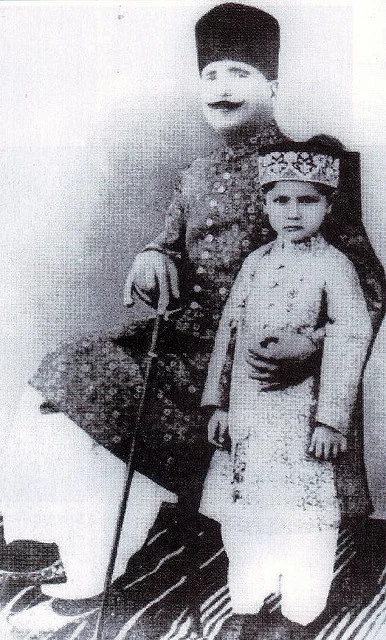
He drew up a will, naming guardians for the children. He had a creed for it: “I follow the path of early Muslims. I don’t believe in Taqlid.” Toward the end visions came. He spoke to Rumi and Ghalib, and once sent Ali Bakhsh to fetch Rumi back. Two weeks before the end, his sister Zainab brought in a practitioner of the old arts, and at half past four in the morning Ali Bakhsh carried a live black cock through the sickroom “with his hand over its beak”.
Early in 1938 Jawaharlal Nehru came to see him at eight in the evening and sat on the floor. Iqbal asked how many members of the Congress shared Nehru’s socialism. About six, said Nehru. Mian Iftikharuddin, who was present, urged Iqbal to take over from Jinnah as the leader of the Muslims. By one account Iqbal’s reply was: “I am one of his foot soldiers.”
He kept working. On March 28 he made his peace in print with a great Deobandi scholar, Maulana Husain Ahmad Madani, who had argued that nationhood followed homeland: “I no longer have any right to criticize him.” On April 7 he wrote, of the pilgrimage he had always meant to make: “Apparently, there is no chance to go to Hejaz.” At five in the afternoon on April 20, the last outside visitor was shown in, a German baron named von Veltheim, who had come to pay his respects. “I am not afraid of death,” Iqbal told him. “I am a Muslim and shall welcome death with a smiling countenance.”
His doctor, Colonel Amir Chand, came at eleven. Barely half an hour before the end, by one account, he recited a Persian quatrain that would appear later that year in his final book, Armaghan-e-Hijaz. It has been read as his epitaph ever since.
سرودِ رفتہ باز آید کہ نایدنسیمے از حجاز آید کہ نایدسرآمد روزگارِ ایں فقیرےدگر دانائے راز آید کہ ناید
The song that has gone may come again, or may not.
A breeze from the Hijaz may come again, or may not.
The days of this faqir have reached their end.
Another who knows the secret may come, or may not.
Armaghan-e-Hijaz, 1938
At about five in the morning, only Ali Bakhsh, who had stood under the stairs thirty years before, remained at his bedside. Iqbal said he had a pain in his chest and put his hand over his heart. “Allah!” he said, by Ali Bakhsh’s account. “Here I feel pain.” His head dropped forward, and as Ali Bakhsh reached for his pulse, he died. It was around 5:15 on the morning of April 21, 1938, though Doris Ahmad thought it was 4:30.
It was the 21st. The rent was due.
It was the 21st. The rent was due.
Javid, thirteen years old, was woken at dawn and stood at the door. He did not cry, he remembered, because he thought his father would have disapproved. In the confusion of the following hours relatives broke the lock on the dead man’s belongings. “Since that day,” Doris Ahmad wrote, “I have never been able to stand the smell of camphor.”
The city came to the house. The High Court, the colleges and the shops shut. Permission for the grave came through the Governor by noon. The bier went from Mayo Road along Railway Road to the Islamia College ground, then by way of Circular Road, Chowk Wazir Khan and the Kashmiri Bazar. Muslims, Hindus and Sikhs walked with it. Counts of the crowd run from 20,000 to 70,000. The last prayers ended at about eight in the evening, and he was buried at about ten, in Hazuri Bagh, at the steps of the Badshahi Mosque, in the space between the mosque and Lahore Fort.
Rabindranath Tagore said he had left “a void in our literature that, like mortal wound, would take a very long time to heal up”. Jinnah, in Calcutta, said he had “stood single-handed as a rock”. Ali Bakhsh stayed on with the family; when Javid came to start his law practice years later, the old servant offered him Rs 5,000. He died in 1967.
Another age
Nine years after Iqbal died, the country he had sketched at Allahabad came into being and made him its national poet. It named a university, Lahore’s airport and a public holiday after him. His falcon, the shaheenThe falcon, Iqbal’s favourite image of the free and self-reliant spirit., went on to school crests and the sides of trucks.
نہیں تیرا نشیمن قصرِ سلطانی کے گنبد پرتو شاہیں ہے، بسیرا کر پہاڑوں کی چٹانوں میں
Your nest is not on the dome of a royal palace.
You are a falcon. Make your home on the mountain rocks.
To a Young Man, from Bal-e-Jibril
The tomb took thirteen years, slowed by the difficulty of bringing red stone across a new border from Jaipur. Eight designs were rejected. The committee that built it refused money from princes and governments, and poor residents of the walled city raised the fund door to door. Its lapis tombstone is said to have been a gift from the people of Afghanistan.
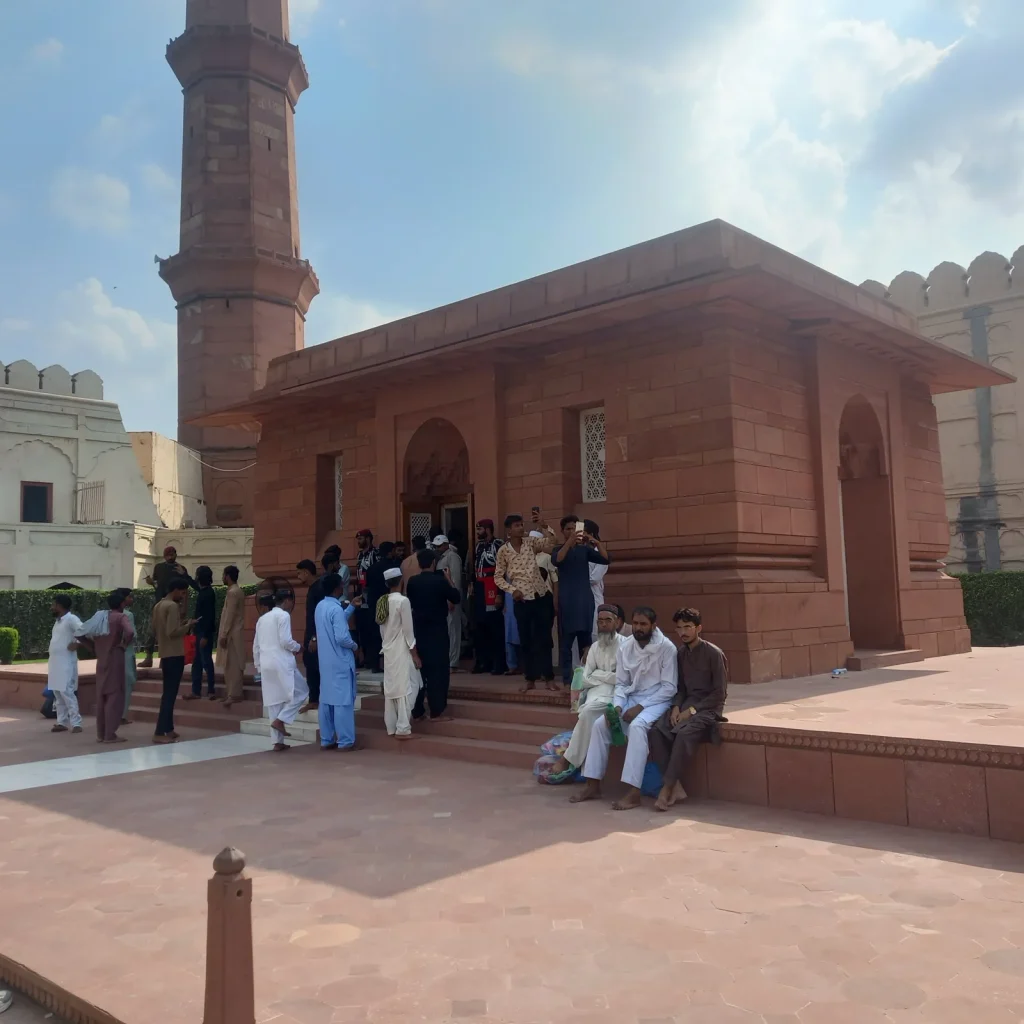
The boy who rented out his rooms grew up to be chief justice of the Lahore High Court. “He did not love me the way other fathers do,” Javid Iqbal said of his father in old age. He lost an election to Zulfikar Ali Bhutto in 1970 and died in 2015. His son, Walid Iqbal, became a senator for the PTI. The house on Mayo Road was sold to the state in 1977 for Rs 3.5 million and turned into a museum. A public holiday was cancelled by a government circular in 2015 and restored in 2022.
He has travelled a long way further than that. In Iran, where they call him Iqbal Lahori, he is read as a Persian poet of the first rank, and Tehran University held an international congress in his honour in the 1980s. In Konya a cenotaph carved with that same name stands in the Mevlana Museum, near the master he took as his guide. In Heidelberg a plaque went up on September 16, 1966, and a stretch of the new riverside road was named the Iqbal Ufer. In India, the bands go on playing the song, even as a council of Delhi University voted in May 2023 to take him out of the political science syllabus. He would have had something to say about that.
Fame of that kind has its price. A poet who told people to stop waiting for permission is now heard mostly on one day a year, in speeches. He knew it might come to this. He said he had hope all the same.
نہیں ہے نا امید اقبال اپنی کشتِ ویراں سےذرا نم ہو تو یہ مٹی بہت زرخیز ہے ساقی
Iqbal does not despair of his ruined field.
With a little moisture, Saki, this soil is very fertile.
Bal-e-Jibril
And he had always insisted that the thing was not finished.
ستاروں سے آگے جہاں اور بھی ہیں
There are other worlds beyond the stars.
ابھی عشق کے امتحاں اور بھی ہیں
There are more tests of love to come.
Cordoba is the place to leave him. Near the end of the poem he wrote there, after stanzas on love and time and stone, he turns to the river that runs below the mosque, the Guadalquivir, whose name comes from the Arabic for the Great River. He had spent his life looking at what had gone. In the same breath he turns towards what had not yet come.
آبِ روانِ کبیر! تیرے کنارے کوئیدیکھ رہا ہے کسی اور زمانے کا خوابعالمِ نو ہے ابھی پردۂ تقدیر میںمیری نگاہوں میں ہے اس کی سحر بے حجاب
O flowing waters of the Great River! On your bank
someone is watching a dream of another age.
A new world still lies behind the curtain of fate.
Before my eyes its dawn stands unveiled.
Masjid-e-Qurtuba, from Bal-e-Jibril
Far to the north, beyond the Pyrenees and the Rhine, a train had come in and gone out again. He was 55, a long way from Sialkot, with five years left to live. He rolled up the rug, took his stick and went home to Lahore to get on with it.