PESHAWAR (THE THURSDAY TIMES) — Pakistan’s military has sounded the alarm over a resurgence of terrorism in Khyber Pakhtunkhwa, linking the renewed wave of violence to Afghan safe havens, local facilitators, and incomplete implementation of key national security measures.
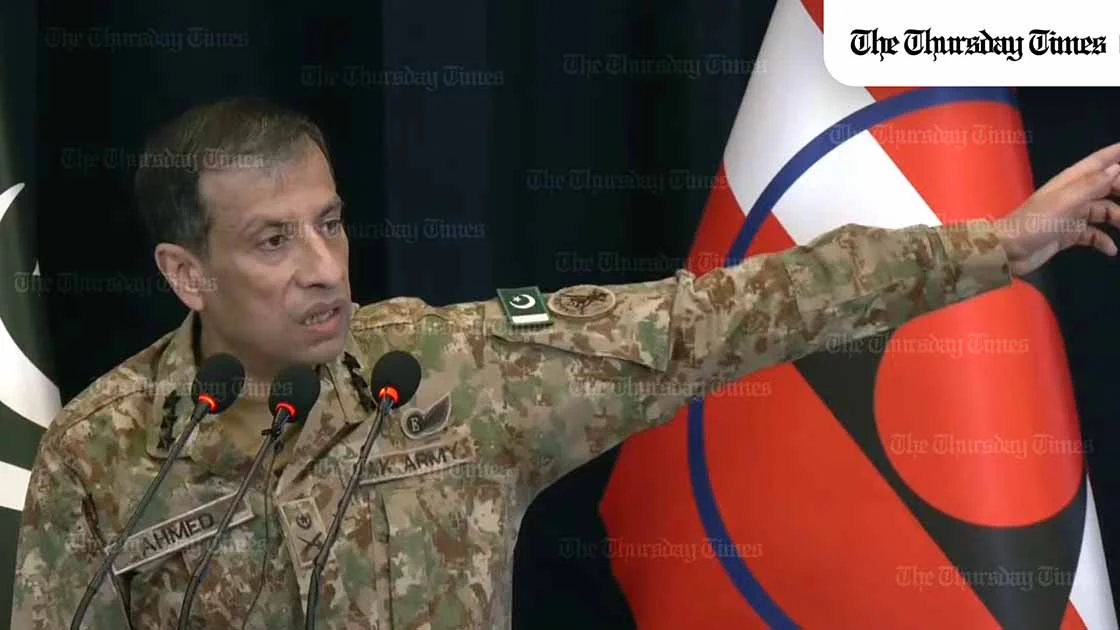
Speaking at a press conference at the Peshawar Corps Headquarters, Lieutenant General Ahmed Sharif Chaudhry, Director General of Inter-Services Public Relations (ISPR), paid tribute to the “brave and resilient people” of the province and the security forces battling extremism on the front lines. He said the purpose of his visit was to sit among the people and acknowledge their sacrifices in the country’s long fight against terrorism.
General Chaudhry revealed that around forty counterterrorism operations are being conducted every day across the province. He said that so far, 917 militants have been neutralised, while 516 Pakistanis have laid down their lives, including 311 army officers and soldiers, 73 police personnel, and 132 civilians. “Our officers lead from the front, we fight together, and we sacrifice together,” he said.
Root causes and political confusion
The military spokesperson attributed the continuity of terrorism to five main factors: the incomplete and uneven implementation of the National Action Plan (NAP), political exploitation of the security issue, the use of Afghan soil against Pakistan with Indian support, the availability of modern weapons and safe havens to militants in Afghanistan, and local political patronage networks shielding extremist and criminal elements.
He recalled that following the 2014 Army Public School massacre, the entire nation had agreed on the NAP as a comprehensive framework to end terrorism. “If terrorism is raising its head again, it is because many of its points remain unfulfilled,” he said, adding that no terrorist should be spared and that every perpetrator must be brought to justice. He emphasised that national consensus, media responsibility, and political will were all essential to building a unified national narrative, reminding that “not every conflict is resolved through talks; sometimes decisive action is necessary.”
Judicial delays and governance challenges
General Chaudhry expressed concern over delays in terrorism-related trials in Khyber Pakhtunkhwa, warning that the absence of timely justice weakens peace efforts. He said when law enforcement accelerates operations, certain political and local networks become active to protect militant elements, undermining the rule of law.
He urged courts and political leaders to act with urgency and unity, saying peace cannot prevail while extremists continue to exploit institutional gaps.
Disinformation and public responsibility
The military spokesperson warned that “false and confusing narratives” are being spread through major social media platforms as part of an organised disinformation campaign. He accused certain political and criminal alliances of fuelling unrest in Khyber Pakhtunkhwa while attempting to dishonour the sacrifices of the armed forces and martyrs. “It is time for citizens to stand united against lies, divisive politics, and manipulative propaganda,” he said.
National security and the Afghan connection
General Chaudhry made it clear that Pakistan’s national security “cannot be mortgaged to any other country, least of all Afghanistan.” He said the state, its armed forces, and law enforcement agencies are solely responsible for protecting the people. “No individual or political group will be allowed to gamble with the lives, property, and dignity of the proud people of Khyber Pakhtunkhwa,” he added.
The ISPR chief said facilitators of terrorism face only three choices: hand over the militants to the state, join the fight against them, or face full legal consequences. He said evidence exists of cross-border involvement in recent attacks and that Pakistan would continue to take “necessary defensive measures” to protect its citizens.
According to him, terrorist organisations such as ISIS, ETIM, and Indian-backed networks continue to operate in Afghanistan under various banners. “These extremists have neither faith nor loyalty; they are mercenaries for hire and a threat to global peace,” he said.
Institutional neutrality and freedom of speech
General Chaudhry reaffirmed that the army is a non-political state institution. “All political leaders and parties are respected, but no politics is greater than the state. The path to progress lies in the Constitution and democracy. Our sacrifices are for the nation, not for any individual,” he said.
He stressed that Article 19 of Pakistan’s Constitution guarantees freedom of expression, but within reasonable legal limits. “When those limits are enforced, some view it as a threat,” he said, noting that in many countries, even a single social media post can lead to years of imprisonment.
Internal accountability and rule of law
Responding to questions about the court-martial of a former intelligence chief, General Chaudhry said the matter is proceeding on the basis of solid evidence. “The army’s internal accountability system does not act on claims but on facts. Every legal requirement is being met, and there is no haste in decision-making,” he said.
He dismissed the perception that the military holds power without accepting responsibility. “The Constitution defines Pakistan as a federation. The army is part of the state, not above it. Decisions are made collectively, and their burden cannot be shifted onto a single institution,” he said.
India’s proxy strategy and the May 9 riots
The DG ISPR accused India of intensifying its proxy operations after repeated failures to destabilise Pakistan directly. He said the state is responding with coordinated intelligence and border security measures.
On the violent protests of 9 May 2023, he said the issue “is not the army’s case but the people’s case.” He insisted that all planners and perpetrators would face justice and that escaping punishment would not be possible.
Truth will prevail
Concluding his address, General Chaudhry said, “We do not care about those who spread lies from two miles away. We stand on truth, and falsehood always perishes before it. The struggle is difficult, but in the end, truth will triumph.”∎