
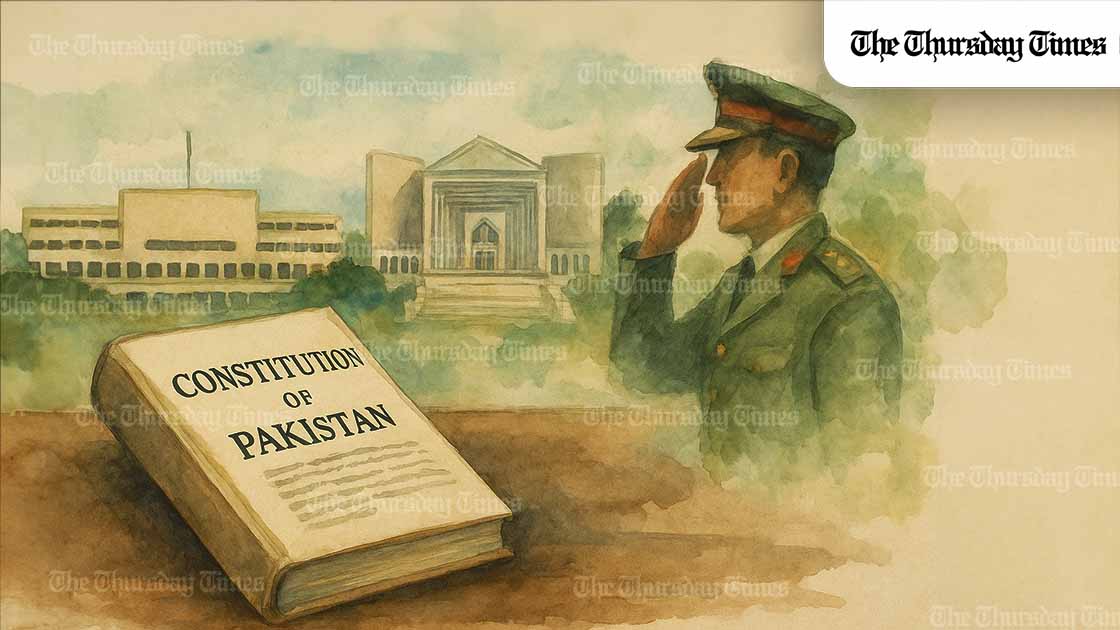

The Twenty Seventh Amendment Bill has been received with cries of alarm, yet from a strictly legal vantage point it reads not as a coup against the Constitution, but as a disciplined act of constitutional housekeeping. For decades, Pakistan has lived in a grey zone where real authority has floated above or around the text. This Bill does something jurists have long claimed to want: it drags power out of the shadows and pins it to language, procedure and office. If we truly believe in constitutionalism, then we should have the courage to constitutionalise the realities we expect to govern us.
The decision to consolidate military command under a Chief of Defence Forces is a textbook exercise in legal clarity. The diffuse arrangement, with a Chairman Joint Chiefs of Staff Committee and a separate Chief of Army Staff, created precisely the kind of institutional ambiguity that constitutional lawyers warn against, a structure that allowed influence without clear responsibility. By uniting command functions in a single, text defined office, the amendment replaces atmospherics with attribution. There is now an identifiable, justiciable locus of command, an official who is not a rumour, but a creature of the Constitution.
Mobility of judges, when entrusted to an institution such as the Judicial Commission rather than to informal executive pressure, is a safeguard against fiefdoms and capture at High Court level.
Recognition of five star rank and its associated protections has been caricatured as feudal indulgence. In truth, it is the opposite. Pakistan already elevates its senior commanders to an informal pantheon, without defined safeguards, thresholds or retirement contours. The Bill interrupts that culture of wink and nod exceptionalism and replaces it with rule bound privilege. Lifetime rank and calibrated protections are not a moral reward; they are a legal cage. Once written, they can be interpreted, limited, and, if ever necessary, amended. What is unwritten lives in impunity. What is written is constrained by words.
Similarly, the creation of a Commander for National Strategic Command is not a militaristic flourish, but a badly needed doctrinal anchor. Nuclear and strategic assets have, for years, been enveloped in an aura of mystique, somewhere between the civilian executive, the services, and opaque command committees. By vesting oversight in a constitutional office, with appointment mechanisms and defined responsibility, the amendment moves strategic command from whispered understandings to enforceable architecture. The law gains a handle on the most dangerous portfolio in the state.
What is unwritten lives in impunity. What is written is constrained by words.
The Federal Constitutional Court is, perhaps, the most misunderstood element of the package. Far from being an instrument to weaken judicial review, it formalises a sophisticated distinction that many mature systems embrace: one apex jurisdiction for constitutional questions of statecraft, another for the mass of civil and criminal appeals. Pakistan’s Supreme Court has been asked to be a trial court, a human rights forum, a federal umpire and a political theatre, all at once. It is legally sound, and institutionally sane, to relieve it of that schizophrenia and assign constitutional interpretation to a specialised, text focused court.
Critics recoil at the textual primacy of the Federal Constitutional Court over the Supreme Court, but this is precisely the structuring honesty that Pakistani constitutionalism has lacked. If we accept that constitutional adjudication is qualitatively different from appellate correction, then it is doctrinally coherent to place the court of the basic law at the summit of protocol and jurisdictional dignity. To do otherwise, to pretend all apex roles are identical, is to persist with the fiction that has enabled both populist theatrics and selective contempt for the bench.
There is intellectual honesty in spelling out when, how and by whom the highest offices may be questioned, instead of outsourcing that decision to the mood of the moment.
The provisions on judicial appointments and transfers have been denounced as tools of coercion. A jurist reading more carefully should see something else: an overdue assertion that judicial office belongs to the constitutional system, not to a judge’s personal comfort zone. Mobility of judges, when entrusted to an institution such as the Judicial Commission rather than to informal executive pressure, is a safeguard against fiefdoms and capture at High Court level. Independence is not the right to be immovable; it is the right to decide without fear, within a framework that treats all judges as officers of one integrated judicial service. Earlier yesterday, Nadeem F. Paracha was right to point this out.
On immunities and protections, the outrage is loud but doctrinally thin. Constitutional design has always recognised that certain offices require insulation from frivolous or politically timed proceedings, not to moralise their occupants, but to preserve the continuity and autonomy of the state. The Bill’s structured protections for specified offices and ranks are preferable to the current selective, opportunistic practice where accountability is often retrofitted as vengeance. There is intellectual honesty in spelling out when, how and by whom the highest offices may be questioned, instead of outsourcing that decision to the mood of the moment.
The so called sweeteners on provincial cabinets and symbolic federal gestures are not tawdry bribes; they are mechanisms that restore a measure of negotiated federalism to a constitutional transformation. Constitutional law is not written in a vacuum. It is written in a federation of egos, electorates and elites. Folding provincial interests into the amendment is precisely how one translates raw political consent into a lawful, supermajority based settlement. From a legal perspective, this is not contamination; it is the practical method by which a rigid constitution is legitimately altered.
One may prefer slower gestation, but the Constitution does not enshrine a right to leisurely politics.
Much noise has been made about speed and secrecy. Yet the controlling fact, for a lawyer, is simpler: if the Bill secures the requisite two thirds majorities, passed through both Houses in accordance with Article 239, then it is not a furtive coup, it is the lawful expression of constituent power within the existing constitutional order. One may prefer slower gestation, but the Constitution does not enshrine a right to leisurely politics. It enshrines procedures. Either those procedures have been met, in which case jurists must acknowledge their authority, or they have not, in which case the challenge is justiciable within the new framework itself.
What truly unsettles many critics is that the amendment codifies what has long been denied, that the military and the higher judiciary are not marginal actors, but central organs in the balance of the state. By constitutionalising their roles, the Bill reduces the profitable ambiguity of the so called hybrid order. It narrows the space for unspoken understandings and replaces them with offices that carry traceable authority and, in principle, legal accountability. Whether one likes the distribution or not, this is better constitutionalism than the pious lie that text and practice inhabit different planets.
For once, Pakistan has chosen not to hide its power map in the footnotes. Lawyers who claim to revere transparency and textual fidelity should recognise the virtue in that choice. The Twenty Seventh Amendment is not flawless, but it is defensible as a serious, internally coherent attempt to reconcile constitutional form with institutional reality. To reject it outright is to prefer sanctimonious abstraction over legal candour. The Constitution is not a museum piece; it is an instrument, and this Bill treats it as such, sharpening it to reflect the state that actually exists, rather than the state that only exists in speeches.


