
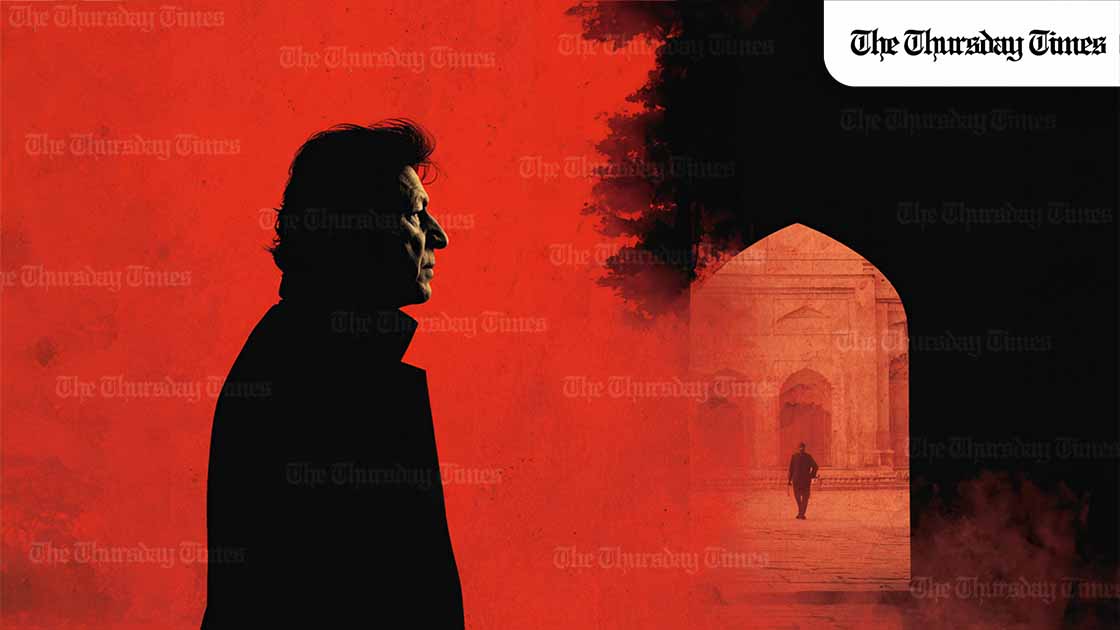

IT BEGINS, AS GRIEF SO often does, in our most silent moments.
A television hums in the corner of a Lahore living room, recycling the same grainy clips of marches, speeches, and container-top proclamations. An uncle in Faisalabad scrolls through his phone before Fajr, thumbs hovering over yet another thread about the cipher, the conspiracy, the betrayal. A student in London checks X before checking his exam timetable, because somewhere in the back of his mind he believes that nothing in Pakistan truly moves unless one man has spoken about it overnight.
Every country, like every person, has a heartbreak it takes too long to get over. Imran Khan is Pakistan’s. For years he has lived not just in our institutions and our headlines, but in our nervous systems. He has become that figure everyone insists they are “done with” yet cannot stop bringing up at every family dinner. The name that turns every ordinary conversation into an argument.
Grief, the therapists tell us, is not only about losing someone. It is about losing the version of ourselves that believed in them. That is why it lingers. That is why, even four bruising years after his ouster, the country still flinches at the sound of his initials. We are not only mourning a leader who failed. We are mourning the promise of a “Naya Pakistan” that never came and the part of ourselves that bought the story.
There is an old truth about heartbreak that Pakistan needs to hear. One day, in one year, two years, three years, or four, you will wake up and realise that it has been years since you even thought about them. That is not betrayal. That is healing. The only way to truly move past someone is to forget them in the ordinary sense of the word, to stop checking their profile, to stop replaying the last fight in your head, to stop letting them script your mornings.
We have tried everything else. We tried adoration and got a personality cult. We tried rage and got permanent street agitation. We tried endless argument and ended up with a politics that circles one name like a moth around a flame. Hatred, unfortunately, is still a form of devotion. It still keeps him at the centre of the room.
Look at what that devotion cost. Take, for example, the economy he inherited and then treated as a backdrop to rallies rather than a patient in intensive care. His government entered a 39 month, 6 billion dollar IMF programme in 2019, meant to stabilise reserves and restore credibility, then veered on and off its commitments whenever domestic politics demanded a shortcut. Analysts noted how fiscal consolidation was repeatedly diluted, reforms delayed and price controls used for quick popularity, until Pakistan slid back toward crisis and the programme stalled.
By 2022, investors were openly speaking about default. As talks with the IMF dragged on and subsidy policies zigzagged, Pakistan’s risk premiums soared, reserves thinned and the word “bankruptcy” entered ordinary political speech. International outlets reported that without a renewed IMF bailout, Pakistan could face a second sovereign default in its history, and even the eventual loan was framed as a last minute effort to avert an imminent crash.
Now look at where we stand. After his fall, the country had to crawl back through the glass he left on the floor. A standby arrangement in 2023, followed by a larger 7 billion dollar programme in 2024 and subsequent reviews, has inched Pakistan away from the precipice, lifting reserves, pulling inflation down from record highs and slowly restoring investor confidence. Growth is still anaemic, closer to containment than true recovery, but the language has shifted from “default tomorrow” to “if we keep our nerve, we might just make it”.
Foreign policy tells the same story of promise turned into avoidable humiliation. The prime minister who liked to cast himself as a fearless truth-teller abroad presided over a period in which the new American president did not call for months, a silence that became a running joke in the diplomatic community and a symbol of diluted clout. Analysts read the missing phone call as shorthand for a relationship that had cooled, not because Pakistan had found some brilliant new strategic independence, but because Washington no longer felt obliged to flatter Islamabad’s ego.
With Saudi Arabia, too, the relationship lurched from rhetorical warmth to quiet frost. A long-standing partnership frayed amid disagreements over Kashmir and broader regional alignments. By the time a “reset” was declared in 2021, it was clear that years had been wasted on posturing rather than careful statecraft, and that Riyadh’s new intimacy with New Delhi would not easily be reversed.
None of this was abstract. It filtered down into the lives of ordinary Pakistanis in the form of fuel price shocks, import restrictions, collapsing purchasing power and a creeping sense that the country had become a permanent emergency. That is the true ledger of the Khan years, not the slogans painted on billboards.
Yet even now, you can see how the drama of one man continues to colonise the national mind. Since his ouster through a constitutional vote of no confidence in April 2022, his party has treated every setback as proof that the entire system is illegitimate unless it crowns him again. There have been marches, sit-ins, calls for “Black Days” and rolling campaigns of agitation. Each time, Pakistan’s fragile governance cycle is yanked away from budgets, reforms and diplomacy, and dragged back onto the question of how loudly one man’s supporters can shout in the streets.
This is where the grief metaphor matters. A country cannot truly rebuild its institutions while it stays locked in a state of perpetual emotional negotiation with its last bad relationship. At some point, you have to stop composing long speeches to the ex in your head. You have to stop checking if they have posted. You have to accept that what is broken will not be repaired by re-enacting the breakup every weekend.
For his supporters, Imran Khan is not just a former prime minister but a moral project. That is precisely the trap. When politics is fused with personal salvation, every legal case becomes persecution, every election loss becomes proof of conspiracy, and every critic becomes a sinner. There is no ordinary disagreement left, only betrayal. That is why Pakistan’s public sphere feels so airless. It is not a conversation. It is a courtroom drama in which millions have been cast as unpaid extras.
And yet you cannot defeat a cult of personality by feeding the personality more oxygen. You do not dismantle a one man show by giving him the prime-time slot every night. The harsh truth is this: in order to truly combat him, you must forget him. Not legally or historically, but emotionally and narratively. You must refuse to let him be the main character of your political story.
That means court cases proceed with the dull rhythm of ordinary justice, not the breathless pace of cable countdowns. He appears in legal reports, not breaking news chyrons. Verdicts are discussed in terms of evidence and precedent, not astrology and martyrdom. The rule of law cannot be rebuilt on the schedule of a fan base.
It also means the media must break its own addiction. Endless talk shows framed as “Imran Khan versus the state” are not a public service. They are a ratings strategy that locks the country in a loop. Journalism in the public interest would ask different questions. How many children have gone back to school since the last budget. Which tax reform actually passed. Why climate resilience plans are still stuck in PowerPoint while floods come every season.
There is a generational cruelty in this obsession. Millions of young Pakistanis have been taught that politics begins and ends with one man, that reform is impossible without his return and that everyone else is inherently corrupt. Their political energy is real and powerful, yet it is being squandered on replaying the same fall from power in ever more dramatic ways. The world is debating artificial intelligence, green industrial policy, digital currency, climate migration. Pakistan’s youth are being told their main duty is to trend the same hashtag every few weeks until he is freed.
Imagine something different. Imagine if the same passion that fills the streets for him filled the streets for education reform, or for transparent local government, or for climate mitigation in Sindh and Balochistan. Imagine an opposition that fights over competing proposals for tax codes and industrial policy rather than competing narratives of who betrayed whom. That is what it would look like for a country to move from heartbreak to adulthood.
Moving on from Imran Khan means erasing him from the record. It means placing him where every former leader belongs, in a chapter of a history book rather than in the opening line of every news bulletin. His government came to power, governed, faltered and fell. That story has been tested against reality. It is no longer a promise. It is a case study.
Pakistan now stands in a narrow corridor where stabilisation is just about possible, but not guaranteed. IMF reviews are being passed, reserves have stopped bleeding, inflation has dipped from its terrifying peak, and external partners speak again of “macroeconomic stability” rather than “near term default”. This progress is fragile. It will not survive if every quarter of political calm is sacrificed to another round of high drama for one man’s benefit.
There is a line the country needs to repeat to itself, like a prayer made of common sense. A republic is not a fan club. It is not supposed to be arranged around the emotional needs of a single leader. The dignity of 240 million citizens cannot be reduced to whether they clap or boo one man on a prison video link.
So the work now is psychological as much as it is economic or constitutional. It is the work of collective forgetting in the healthy sense, of allowing one man’s shadow to fade from the centre of the frame. One day, in one year, two years, three years, or four, Pakistan must be able to wake up and realise that it has gone weeks without his name dictating the news cycle, months without its blood pressure rising at the mention of his initials.
That will be the day the country has truly started to heal. Not when he is jailed or freed, not when a particular case ends, but when his presence no longer decides what is politically possible. When budgets, not bail hearings, lead the headlines. When foreign delegations land in Islamabad to talk about trade and technology, not to ask nervously who really runs the country.
In personal grief, acceptance is the quiet stage in which you can remember without collapsing. Pakistan deserves that stage. It deserves to remember the Khan years as a lesson rather than a destiny, as a warning rather than a prophecy. The work of this decade is to rebuild institutions, not resurrect illusions.
Being done with Imran Khan is not an act of revenge. It is an act of national self-respect. It is the decision of a people who finally understand that they cannot drive into the future while staring only at the rear-view mirror, replaying the same crash in slow motion. To combat him, we must forget him. To save our democracy, we must put him back where he belongs, not at the centre of our lives, but at the edge of our memories.


