

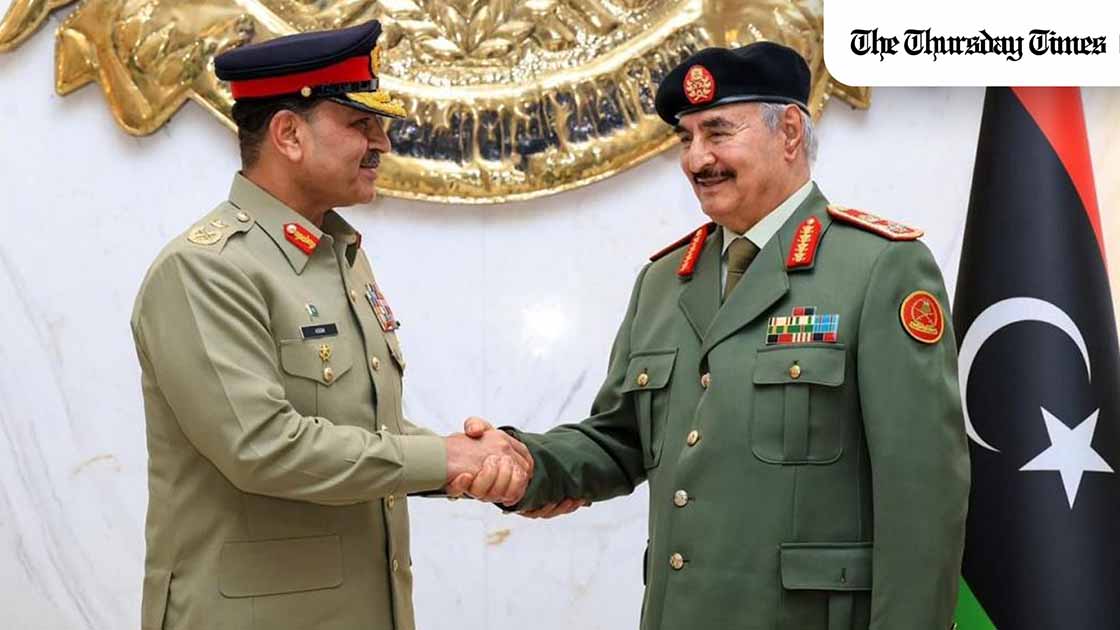
ISLAMABAD (The Thursday Times) — The world is increasingly viewing Pakistan not only as a capable military power, but as a credible defence partner whose armed forces have been shaped by operational experience and battlefield readiness. That shift in perception is now being used in Islamabad to frame a new agreement with Libya as something larger than a routine transaction, and more like a marker of Pakistan’s expanding footprint in defence exports.
Pakistan’s defence industry has long argued that indigenously produced military hardware is not just a symbol of self-reliance, but a practical contributor to the economy. Defence exports bring foreign exchange, yet their value runs deeper. They can stimulate manufacturing, support skills development, accelerate technology transfer, and create jobs in sectors that sit upstream and downstream of production. For Pakistan, the defence economy has always carried a second function as well: strengthening diplomatic leverage by turning industrial capability into sustained partnerships.
Under Prime Minister Shehbaz Sharif, the government has repeatedly presented export growth as a core route to economic stabilisation and recovery. Officials say Pakistan has widened its ambitions beyond traditional export lines, highlighting progress in areas such as information technology, mining and minerals, crypto-related services and trends, and agricultural products. Within that broader export drive, Pakistan’s defence production industry is now being positioned as a major pillar, increasingly expected to carry weight alongside civilian sectors and to open fresh channels of international engagement.
Pakistani officials also describe the global mood towards the country as more receptive after what they call the historic success of Maarka-e-Haq. The claim, repeated in official circles, is that friendly countries are showing heightened interest in Pakistani defence equipment, and that this interest is not limited to sales alone. It is being portrayed as the start of longer-term cooperation, including technical collaboration and shared security priorities in an unsettled region.
The Libya agreement is being characterised in Islamabad as financially significant and strategically meaningful. Senior figures present it as the outcome of sustained military diplomacy led by Field Marshal Syed Asim Munir, which they say has helped project Pakistan’s defence industry into wider markets and reinforced trust-based defence relationships with partner states.
Libya’s procurement environment remains complicated by international restrictions. The United Nations framework affecting arms transfers to Libya has been in place for years, and any defence-related arrangements are typically treated as part of a regulated international process. Pakistani officials argue that Libya continues to engage broadly, including with Western countries, to acquire military hardware, and they present the Pakistan arrangement as consistent with that wider pattern of engagement.
For Islamabad, the deal is being used to underline a larger message: that defence production, military diplomacy, and economic policy can work as a single strategy when aligned. The agreement with Libya is being held up as evidence that Pakistan is trying to convert capability into credibility, and credibility into economic momentum. If that momentum holds, officials believe defence exports could become a stronger and more durable pillar of national income, while also lifting Pakistan’s influence through partnerships that extend beyond commerce.


