
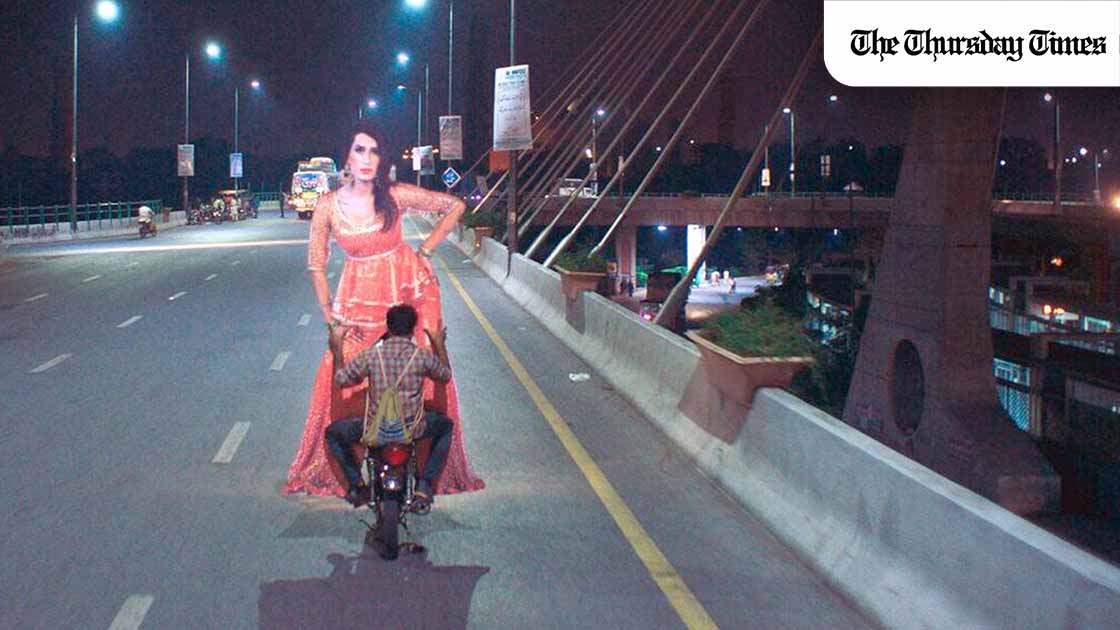

JOYLAND, PERHAPS PAKISTAN’S GREATEST ARTISTIC feat to date, returns to me like a bruise you keep pressing: not because you enjoy pain, but because it’s the only honest proof that something happened. It isn’t a film that “unfolds” so much as it exhales, slowly, into the room: a domestic air thick with expectation, a family home that doubles as a courtroom, a city that hums with unsaid rules. You come out the other side quieter, not from shock, but from recognition.
Marriyum Aurangzeb, then Pakistan’s federal Minister for Information & Broadcasting, became one of the most visible state faces attached to Joyland’s whiplash censorship saga. In mid-November 2022, the Ministry moved to revoke/withdraw the film’s censor clearance and announced a nationwide ban on the grounds of “highly objectionable material,” citing complaints and framing the decision as a response to perceived moral/social concerns. In other words: a film that had already passed the formal gates was suddenly treated like contraband, because a loud enough crowd, many of whom hadn’t watched it, demanded the door be slammed.
Why that’s poisonous for artists everywhere is precisely because it isn’t “just Pakistan” and it isn’t “just one film.” When a state can retroactively punish a work that complied with the process, because the work triggers a pressure campaign, every artist learns the same lesson: approval is provisional, legality is negotiable, and safety lies in self-censorship. The chilling effect travels fast: producers pre-trim scripts, financiers avoid anything that might attract clerical/political outrage, and the public sphere shrinks until only sanitised stories survive. Joyland’s case became a global cautionary tale of how easily “community complaints” can be weaponised into policy, turning art into a hostage and artists into liabilities.
There are stories that critique patriarchy by pointing at it, and then there are stories that critique it by showing you how it lives, how it breathes in the corners, how it asks for tea, how it smiles while it corners you. Joyland belongs to the latter. It is not interested in grand speeches or clean villains. It is interested in the banal machinery of “normal,” the way it turns men into little soldiers of performance and women into furniture that learns to speak.
The film’s Lahore feels like a place where tenderness is always late, always stuck in traffic. Everyone is moving, but nothing is progressing. The streets are bright, the rooms are dim, and the bodies inside them learn to shrink to fit the available mercy. It is a city of partitions: curtains, doorframes, stairwells, thresholds you hover at because crossing them would mean admitting you want something you’re not allowed to want.
At the centre is Haider, a man shaped less by desire than by the fear of being seen without armour. He is not the brute of cautionary tales; he is softer, more porous, more tragically reachable. That’s what makes the film sting. Hyper-masculinity here isn’t solely aggression: it is the constant rehearsal of adequacy. Haider is asked to be a son, a husband, a provider, a continuation of a surname, and it all sits on him like borrowed clothing that never quite fits.
And then there is Mumtaz: a character so alive you can almost hear her pulse under the dialogue. If Haider is a question whispered into a pillow, Mumtaz is the answer that society keeps interrupting. She moves with a kind of clarity that makes the world around her look even more confused. She wants joy in the most ordinary sense: room to breathe, room to be, room to choose without having to turn it into a negotiation.
Joyland is ruthless in how it depicts the home: not as sanctuary, but as the primary stage where gender is performed under fluorescent lights. The father’s authority isn’t cartoonish; it’s managerial. He oversees masculinity like an institution. The siblings orbit around duty. Even the walls feel enlisted. You understand, watching, how an entire family can love each other and still participate in each other’s disappearance.
What the film does so deftly is bring disposition to the fore: mood, temperament, and the weather of a person. It makes you watch fear not as a moment, but as a lifestyle. It makes repression visible as posture: the way someone sits, the way they lower their eyes, the way they laugh too quickly to end a conversation before it risks sincerity. The film demands eye contact. It won’t let you look away, not because it’s loud, but because it’s intimate.
Into this intimacy walks Biba, and the film’s temperature changes. She arrives not as a symbol, but as an overbearing and unignorable presence: glamorous, hungry, tired, radiant, and human in the way that refuses easy consumption. Her world, the theatre, the choreography, and the spotlight, could have been framed as escapism, but Joyland understands performance as survival. Onstage, Biba is allowed to be large. Offstage, she is forced to negotiate the violence of being perceived.
Haider’s attraction is not painted as simple liberation; it is painted as collision. Desire here is a kind of disobedience, but also a kind of exposure. When Haider begins to move toward Biba, it isn’t framed like a heroic awakening. It’s messy, tentative, equal parts yearning and terror. The film understands that in a rigid gender economy, wanting can feel like treason even when it’s tender.
And yet Joyland is never naïve about tenderness. Warmth, in this film, is not the antidote to oppression; it is what oppression targets first. The warmth between characters is real, but it exists under surveillance: by family, by neighbours, by the invisible civic force of “log kya kahenge,” that omnipresent chorus that turns personal life into public property. Every soft moment feels like it might be confiscated.
The greatest cruelty of hyper-masculine norms is that they don’t just police men. They recruit them. The film shows how patriarchy makes accomplices out of the frightened, how it turns vulnerability into a debt that must be repaid with control. You see this in the microgestures: the casual entitlement, the inherited authority, the way shame gets passed down like an heirloom. The men in Joyland aren’t monsters; they’re trained. And training is always someone’s choice, repeated until it becomes a reflex.
What lingers most is how Joyland treats women not as plot devices but as worlds. Mumtaz’s sadness is not decorative; it is consequential. Her joy is not secondary; it is central. The film refuses to make her the “good wife” or the “angry wife” or the “tragic wife.” She is simply a person in a system designed to make personhood expensive. And the cost is paid daily, in small installments: swallowed words, delayed dreams, a body that learns to apologise for taking up space.
Biba, too, is granted complexity without being turned into a moral lesson. The film doesn’t ask her to be flawless to be worthy. It doesn’t ask her to be saintly to be safe. It lets her be sharp, demanding, wounded, playful—alive. That aliveness is what threatens the echo chamber most: not her identity as an abstract controversy, but her refusal to be reduced to one.
There is a particular kind of tragedy Joyland understands: the tragedy of almost. Almost saying the truth. Almost choosing courage. Almost making room for the people you love. The film is full of almosts, and they are devastating because they mirror reality. In a society that confuses conformity with virtue, people don’t usually implode in one dramatic choice. They erode. They compromise themselves in increments until they no longer recognise the outline of the life they wanted.
Looking back on Joyland now, what feels “divine” about it isn’t that it offers transcendence, but that it offers honesty with grace. It takes a place thick with inherited masculinity and dares to foreground the things it tries hardest to smother: disposition, fear, repressed warmth. It is a film that doesn’t shout at Punjab’s echo chamber; it invites it to listen to its own heartbeat and realise it has been calling that sound weakness.
And maybe that’s why it hits so hard on rewatch. Because you notice the tenderness sooner. You notice the way everyone is pleading in their own dialect of silence. You notice how love, in this world, is often expressed as control because no one was taught a safer language. Joyland doesn’t excuse it. It simply shows you the human cost of confusing domination for care.
The current Punjab set-up has, in some areas, taken steps that treat trans folk as people with ordinary needs and long horizons, rather than as a talking point. Under the incumbent Chief Minister, the province has backed PSDF’s Pehchan programme, which routes trans participants into vocational and technical training with the stated aim of employability and income. It’s a straightforward intervention: skills, certification, and a path that is at least meant to lead somewhere more stable than informal work and constant scrutiny. I have met and discussed such with people who did undertake the training provided. They are over the moon about it.
None of this fixes the deeper violence or the daily discrimination, but it does count as institutional acknowledgement, which is often the first thing missing.
When the credits arrive, you don’t feel finished. You feel implicated. You feel like you’ve been staring at something you were told not to name, and now the naming has already happened inside you. Joyland leaves you with that uncomfortable, necessary intimacy, where you can’t avoid eye contact even if you wanted to, because it knows the real theatre isn’t on a stage.
It is in the home, on the street, and in the quiet violence of expectation—and in the fragile, stubborn insistence of people who keep trying to feel anyway.


