

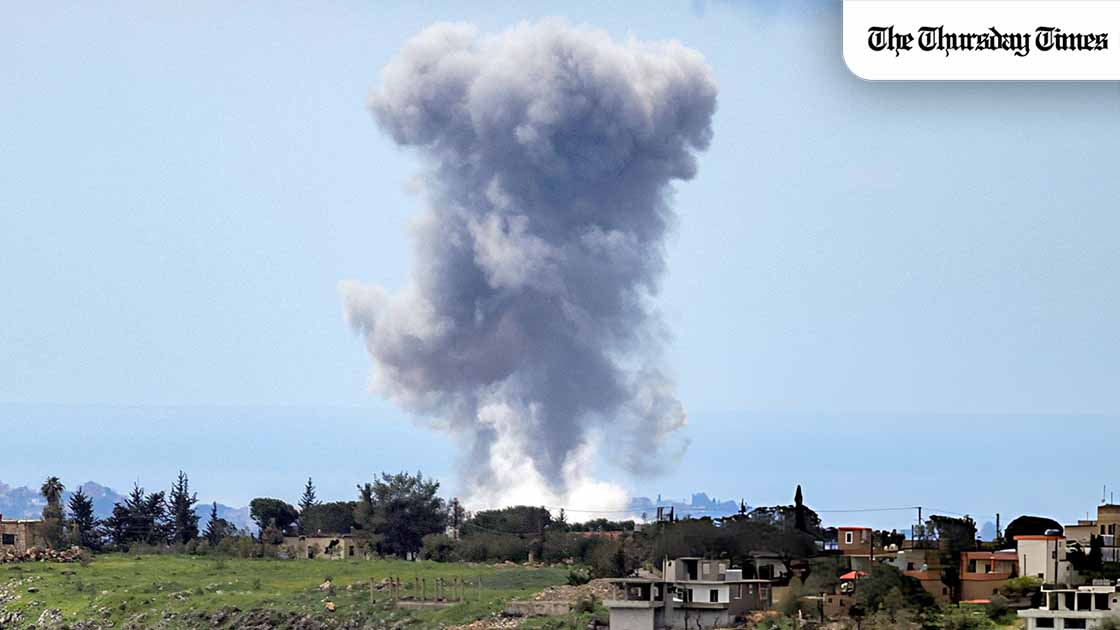
TEHRAN/RIYADH/ISLAMABAD (The Thursday Times) — Saudi Arabia’s confrontation with Iran entered a more dangerous phase on Tuesday after Iranian state-linked reporting said a petrochemical complex in Jubail had been attacked, a claim that followed Saudi statements that its forces had intercepted seven ballistic missiles aimed at the Kingdom’s Eastern Region, with debris falling near energy facilities. The sequence of events marked one of the sharpest escalations yet in a war that has already spilled far beyond Iran’s borders.
For Riyadh, the significance of the latest strike lies not only in the immediate security threat but in what it represents: an assault reaching into the infrastructure that underpins Saudi economic stability. Jubail is not just another industrial site. It is one of the nerve centres of the Kingdom’s energy and petrochemical economy, making any attack there politically sensitive, strategically consequential and symbolically explosive.
The Saudi government has in recent days paired military interception with official restraint, even as the security environment has visibly worsened. According to Saudi and international reporting, missile debris caused a fire near energy facilities, though no injuries were immediately reported. At the same time, companies in Riyadh and other business hubs have shifted staff to remote work because of fears of further Iranian retaliation, a sign that the threat is no longer being treated as theoretical.
That tension is now colliding with a broader diplomatic effort in which Pakistan has tried to position itself as a channel for de-escalation between Washington and Tehran. Pakistan’s role has been noted across recent reporting on ceasefire proposals and wider regional mediation, even as the talks remain fragile and heavily contested. Iran on Tuesday rejected a U.S.-backed ceasefire proposal and instead pushed for a more permanent framework, underscoring how narrow the diplomatic opening had already become before the strike on Saudi territory.
The attack therefore lands at the worst possible moment for any state trying to keep diplomacy alive. If Pakistan had been seeking to sell itself as a credible bridge between rival camps, a strike on Saudi energy infrastructure risks hardening positions in Riyadh, embarrassing intermediaries and empowering those across the region who argue that military pressure, not negotiation, will define the next phase of the crisis. That is an inference from the timing and the diplomatic backdrop, but it fits the direction in which events are moving.
Pakistan moved quickly to condemn the attacks, calling them a serious violation of Saudi sovereignty and territorial integrity and a dangerous escalation that undermines regional peace and stability. The wording of Islamabad’s statement was notable for its clarity: at a moment when Pakistan has tried to preserve room for mediation, it chose not to blur the line over an attack on the Kingdom.
The broader regional context makes the danger even clearer. Since late February, Gulf states have faced repeated Iranian attacks on infrastructure, while threats around the Strait of Hormuz have shaken energy markets and pushed governments and businesses into emergency planning. Reuters has reported that the closure of Hormuz has already disrupted roughly a fifth of global oil and liquefied natural gas flows, sending prices sharply higher and exposing the vulnerability of even those producers with alternative export routes.
That is why the Saudi dimension cannot be dismissed as peripheral to the Iran crisis. An attack on the Kingdom’s eastern energy belt is not simply another theatre in a widening conflict. It risks dragging a central Arab power deeper into direct confrontation, raising the cost of restraint for its leadership and increasing the chances that regional diplomacy will be overtaken by deterrence logic.
There is also a political consequence for Pakistan. Islamabad has spent the past several days trying to present itself as a serious, useful actor in a crisis involving Iran, the Gulf and the United States. But mediation depends not only on access; it depends on outcomes, or at least on the ability to prevent things from getting worse. If attacks continue against Saudi targets while Pakistan is visibly associated with peace efforts, its diplomatic wager becomes harder to defend. That is again an inference, but it follows from Pakistan’s own public investment in the process and from the timing of its condemnation.
Still, the events of Tuesday do not make diplomacy irrelevant. They make it urgent. Even now, the most consequential question is whether the latest attack becomes the point at which Saudi patience gives way to direct retaliation, or whether outside intermediaries can still keep the crisis from tipping into a full regional war. Pakistan, having publicly backed Saudi Arabia while also trying to preserve a negotiating channel, may now find itself under greater pressure than before to prove that mediation can still deliver something more than statements.


