
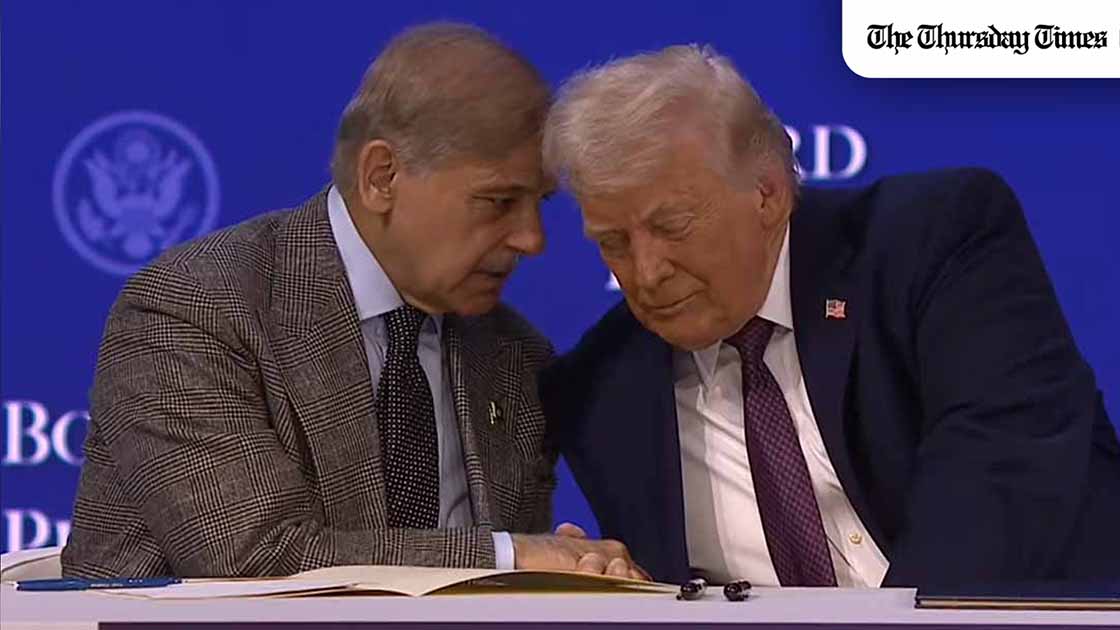
WASHINGTON (The Thursday Times) — US President Donald Trump has signalled that Pakistan could become the centrepiece of a renewed diplomatic push between the United States and Iran, openly praising Islamabad’s role and suggesting he may personally travel there if a deal is finalised.
In remarks reflecting growing confidence in Pakistan’s mediation efforts, President Trump said that if an agreement is signed in Islamabad, “I may go there,” adding that Pakistan has “been great” throughout the process.
Donald Trump: If the deal is signed in Islamabad, I may go. Pakistan has played a remarkable role, with Field Marshal Asim Munir and Prime Minister Shehbaz Sharif both making a major impact. pic.twitter.com/4Ml6EyXZsc
— The Thursday Times (@thursday_times) April 16, 2026
Trump pointed directly to Islamabad as a potential venue for concluding talks, suggesting that the city is emerging as a neutral ground capable of hosting both sides. “Let’s get the other side in Islamabad,” he said, indicating that momentum may be building toward another round of negotiations that could culminate in a formal agreement on Pakistani soil.
The US president also offered rare and explicit praise for Pakistan’s leadership, highlighting both military and civilian figures at the forefront of the mediation effort. He described Field Marshal Asim Munir as having “been great,” crediting him with playing an exceptional role in facilitating communication and maintaining stability throughout the process. Similarly, Prime Minister Shehbaz Sharif was described as “really great,” with Trump acknowledging his effectiveness in supporting diplomatic engagement during a volatile period.
The emphasis on Pakistan’s leadership reflects a broader shift that has been quietly taking shape in recent weeks. Islamabad is no longer simply hosting discussions. It is actively shaping them. From enabling backchannel communication to sustaining direct and indirect contact between the two adversaries, Pakistan’s role has evolved into that of a central mediator trusted by both sides.
Trump’s suggestion that he may travel to Pakistan if a deal is signed adds a new dimension to this dynamic. While framed cautiously as a possibility rather than a certainty, the prospect of a presidential visit tied to a US–Iran agreement carries significant symbolic weight. It would mark not only a diplomatic breakthrough but also a clear endorsement of Pakistan’s role as a credible intermediary in one of the world’s most sensitive geopolitical disputes.
For Pakistan, the implications extend well beyond the immediate negotiations. Trump’s public endorsement strengthens Islamabad’s international standing at a time when it is actively repositioning itself as a hub for diplomacy, mediation, and regional stability rather than conflict.
As discussions around a possible next round of talks gather pace, Pakistan’s role appears increasingly institutionalised. What began as facilitation has evolved into structured diplomacy, with Islamabad firmly at its core.