
LONDON (The Thursday Times) — It began with a suit, but quickly became something larger.
When Derek Guy, the menswear writer behind the influential @dieworkwear account and a contributor to The New York Times, highlighted the tailoring of Pakistan’s Prime Minister Shehbaz Sharif, he was making a familiar point in an unfamiliar arena: that some of the finest examples of classic Western dress are now often found outside the modern West.
Interesting to me that when you see men on the global stage, beautiful Western-style tailoring is often worn by men from non-Western countries. Pictured here is Shehbaz Sharif (Pakistan), Akinwumi Adesina (Nigeria), and Naruhito (Japan). https://t.co/rdwsIrXazX pic.twitter.com/QzwoawMPh8
— derek guy (@dieworkwear) April 19, 2026
“Interesting to me that when you see men on the global stage, beautiful Western-style tailoring is often worn by men from non-Western countries,” Guy wrote, pairing Sharif with other figures known for polished formal dress.
The observation travelled quickly. In Pakistan, where political conversation is rarely short of intensity, the response was notably light-hearted and proud. Social media users called it “real soft power,” while others treated the endorsement as a form of international validation. The novelist Bina Shah joked that Sharif’s “aura tripled.”
Yet beneath the humour sat a sharper point about image, symbolism and changing standards of public presentation.
The return of structure
The suits that drew attention were not loud or experimental. They were traditional.
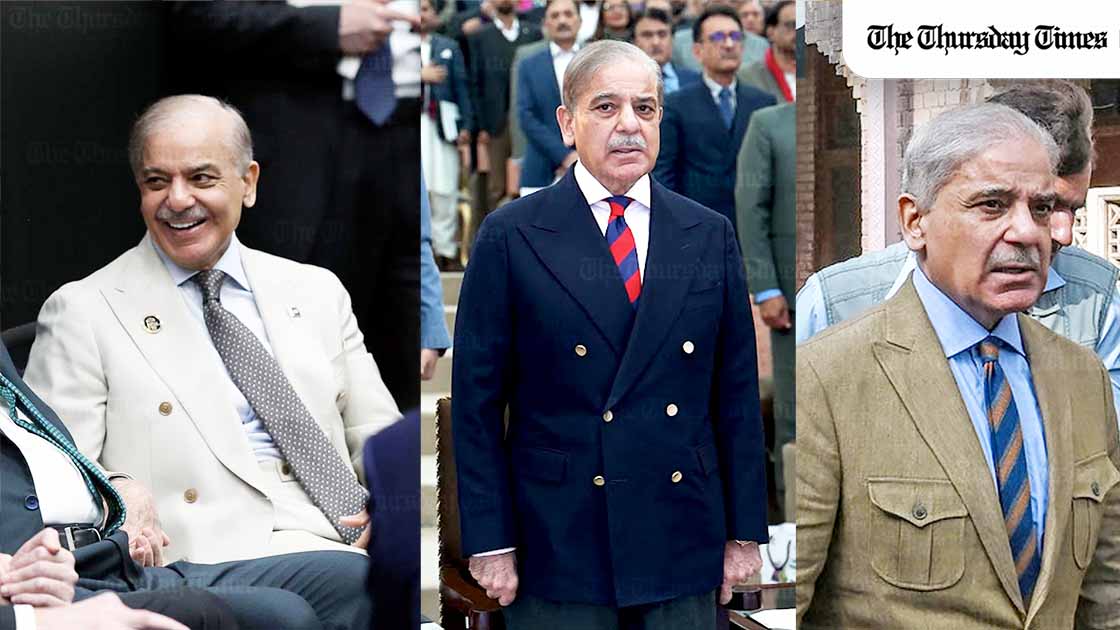
One image showed Sharif in a cream double-breasted suit with broad lapels, structured shoulders and softly draped trousers. Another captured him in a navy double-breasted jacket cut with similar confidence. To many viewers, they looked simply elegant. To tailoring enthusiasts, they signalled something more exacting: proportion, cloth quality and an understanding of fit.
For decades, much Western political dress has moved in the opposite direction. Slimmer cuts, shorter jackets, narrower lapels and a more casual attitude have become common. Formality, once seen as part of office, state and ceremony, has often been treated as stiffness to be escaped.
Guy and others in the menswear world have long argued that this shift has sometimes come at the expense of beauty.
Sharif’s appearance did not emerge from nowhere. His clothes have drawn notice before, both as part of his political image and as a reflection of a recognisable personal style. Over the years, discussion around his wardrobe has ranged from his more utilitarian public looks to his preference, in higher-profile settings, for sharply cut power suits and carefully composed formalwear.
What is different now is the frame.
Earlier commentary tended to treat his clothing as a domestic matter of presentation, personality or political optics. Derek Guy’s post shifted that conversation outward. Sharif was no longer being discussed merely as a politician who dresses well, but as evidence in a broader international argument: that some non-Western leaders now carry the language of classic tailoring with greater confidence than many of their Western counterparts.
Sharif’s moment landed because clothing on the global stage still carries meaning.
Leaders are photographed before they are heard. They arrive, walk, shake hands and stand beneath flags long before policy details emerge. Dress can suggest discipline, confidence, seriousness or cultural ease without a word being spoken.
That helps explain why the praise resonated in Pakistan. For supporters, it was not merely about a jacket. It was about seeing Pakistan framed through polish rather than crisis, aesthetics rather than alarm.
At a time when many countries fight to shape their image abroad, even a menswear compliment can become part of a wider narrative.
There is also a historical irony in the moment.
The business suit was developed in Europe and refined through Savile Row, Naples and other tailoring traditions. Yet some of its most faithful modern wearers are now found in Asia, Africa and the Middle East, where ceremonial dress codes, bespoke traditions and public formality have endured more strongly.
That is the paradox Derek Guy was pointing to: a garment born in the West, preserved with care elsewhere.
Politics has always involved theatre. Uniforms, robes, insignia and carefully chosen settings have long been tools of authority. The modern suit is no different. It is costume, message and discipline at once.