
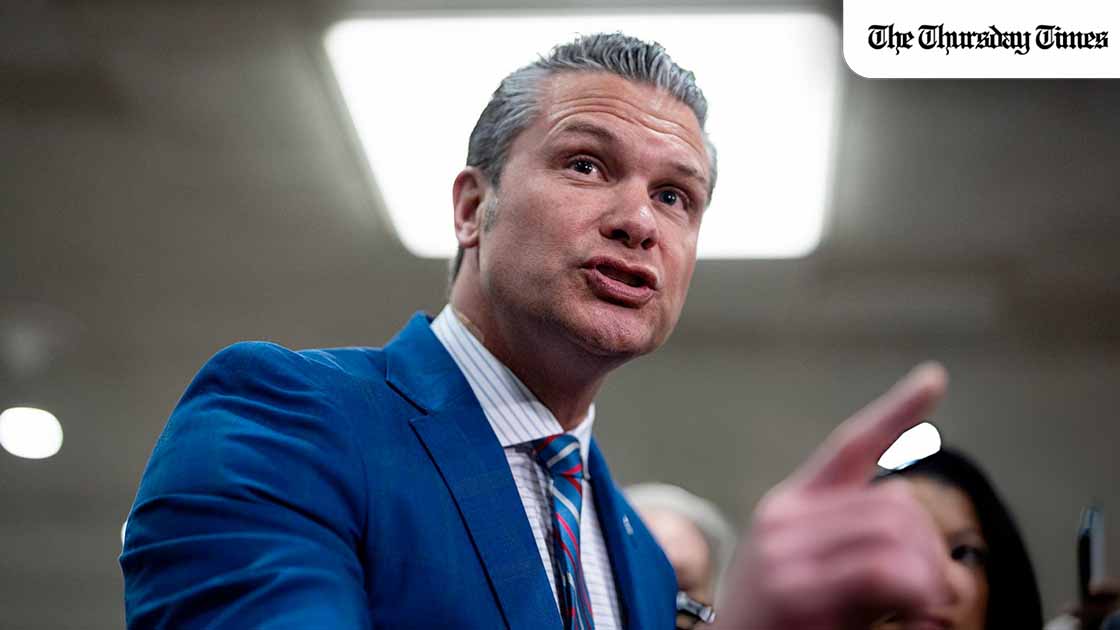
WASHINGTON, D.C. (The Thursday Times) — Pete Hegseth has pledged to release what he described as the most comprehensive internal review ever conducted by the department into a single chain of events, promising a sweeping examination of America’s withdrawal from Afghanistan and the deadly final days that culminated at Abbey Gate.
Speaking in forceful terms, Hegseth said officials had spent months revisiting the decisions that led to the collapse of the US-backed Afghan government, the frantic evacuation from Kabul, and the suicide bombing outside Kabul International Airport that killed 13 American service members and scores of Afghan civilians in August 2021. He said the report would be published later this summer.
The remarks signal that Afghanistan remains one of the most politically charged wounds in Washington, nearly five years after the last American troops departed. For supporters of the Trump administration, the withdrawal became shorthand for strategic humiliation. For defenders of the Biden White House, it was the inevitable and painful conclusion to a war that two decades of US presidents had failed to resolve.
Hegseth rejected the idea that prior investigations had settled the matter. He argued that congressional inquiries and earlier departmental efforts had only partially addressed what happened, and said the new review had brought in key figures involved in planning and execution to answer directly for their decisions. A Pentagon-led special review panel has previously said it interviewed senior civilian and military officials and examined extensive records.
At the heart of his argument was not simply Afghanistan itself, but what he said followed from it. Hegseth framed the withdrawal as a geopolitical turning point that weakened perceptions of American resolve. He said rivals and militant groups watched the chaotic scenes in Kabul and concluded the United States had lost its appetite for risk and confrontation.
That thesis has become increasingly common among hawkish Republicans, who link the disorder of August 2021 to later global crises. Hegseth explicitly named Vladimir Putin and Hamas, saying hostile actors “made choices” after concluding Washington would not respond decisively. It is a broad strategic claim, difficult to prove conclusively, but politically potent because it transforms Afghanistan from a single failed operation into the opening chapter of wider instability.
The imagery of those final days still carries enormous emotional force in US politics. Crowds pressed against airport gates. Families handed children over barbed wire. Transport aircraft lifted off with Afghans clinging to the fuselage. Then came the Abbey Gate bombing, one of the deadliest single days for US forces in the final phase of the war. The attack has remained central to criticism of both planning failures and force protection decisions.
Yet the political burden of Afghanistan has never fallen neatly on one administration. Biden oversaw the final withdrawal, but the process was shaped by the 2020 Doha agreement negotiated under Donald Trump, which committed the United States to leaving Afghanistan and accelerated the military drawdown. Previous government reviews and congressional findings have pointed to failures spanning more than one presidency.
That complexity has not stopped the issue becoming a symbol. For Republicans, it represents what they see as drift, weakness and elite mismanagement. For many Democrats, it remains a brutal but necessary exit from an unwinnable war whose continuation carried its own costs in blood and treasure.
Hegseth said restoring deterrence has become one of the department’s core pillars. In practical terms, that means using Afghanistan as a cautionary tale: showing allies that Washington remains dependable, while convincing adversaries that retreat in one theatre does not equal passivity everywhere else.
Whether the forthcoming report changes public understanding is another matter. Americans have already seen years of hearings, memoirs, inspector general reports and partisan recriminations. The facts of the collapse are broadly known: Afghan forces melted away faster than expected, Kabul fell with stunning speed, evacuation plans were overtaken by events, and the final withdrawal descended into crisis.
What Hegseth appears to be offering instead is not merely more evidence, but a sharper narrative of blame. In that version, Afghanistan was not the end of a war. It was the moment the world tested American weakness.
If the report lands as promised this summer, it will reopen one of the most painful chapters of recent US foreign policy and place it back at the centre of the debate over American power, credibility and decline.