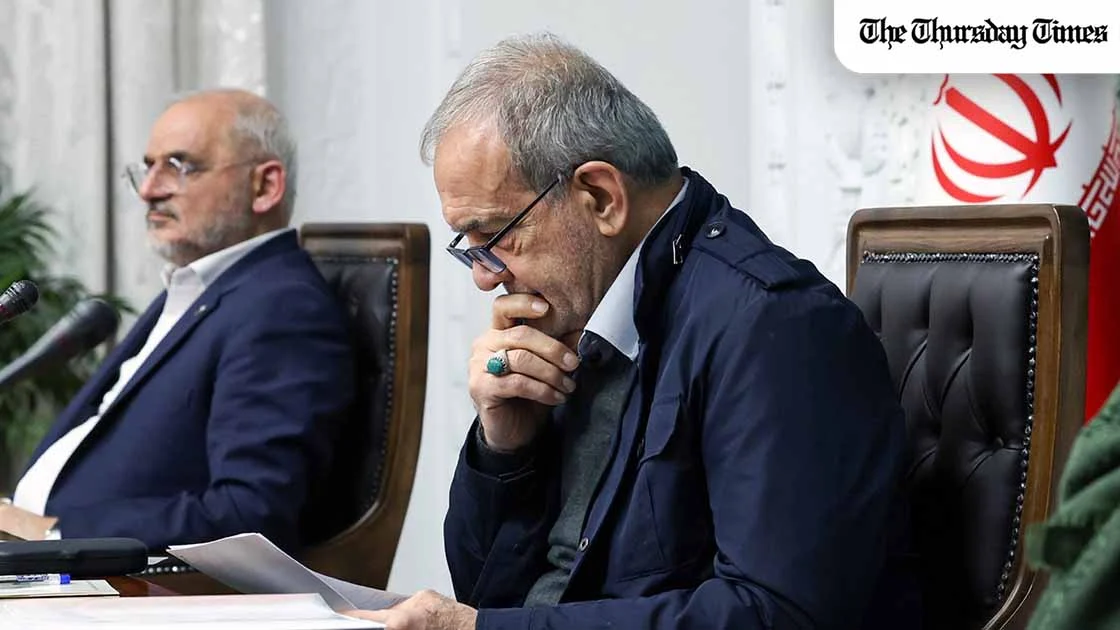
ISLAMABAD (The Thursday Times) — Iran International, a London-based outlet covering Iranian affairs, reported on Sunday that Iranian President Masoud Pezeshkian submitted an official letter of resignation to the office of Supreme Leader Mojtaba Khamenei, citing the Islamic Revolutionary Guard Corps’ effective takeover of large portions of the Iranian government. Iran’s presidency denied the report within hours, calling it “ridiculous media games.” The resignation has not been officially confirmed. The Thursday Times reports what is known and what remains contested.
What Iran International reported
Iran International, citing a source familiar with the matter, reported that Pezeshkian sent the letter on Sunday 31 May 2026. The letter stated that the president and his government had been excluded from major and vital decision-making processes, and that the vacuum created had enabled hardline IRGC factions to take control of key affairs. Pezeshkian wrote that under these circumstances he was unable to run the government or fulfill his legal responsibilities and requested to step down immediately. Iran International added that it was unclear whether Mojtaba Khamenei would accept the resignation.
Anonymous sources told Iran International that the core disagreement between Pezeshkian and the IRGC leadership centred on how the war with the United States has been managed and its devastating impact on people’s livelihoods and the national economy. This is not the first public signal of tension. In May, Pezeshkian publicly referred to the IRGC’s conduct as “madness”, a word choice that, in the careful lexicon of Iranian politics, is roughly the equivalent of an open rupture. Since March, the IRGC has reportedly blocked key presidential appointments including nominees for intelligence minister.
The denial
Iran’s presidency denied the report within hours. Seyed Mehdi Tabatabaei, the presidency’s deputy head of communications, posted on X calling the claim “a continuation of previous ridiculous media games” and accusing Iran International of publishing “their own wishful thinking in place of reality.” He said Pezeshkian “will not retreat from serving the people.” Tasnim News Agency, which is widely described as close to Iran’s IRGC, also denied the report, citing an unnamed government source saying Pezeshkian has not resigned and continues his duties.
The denial from Tasnim is notable. If the IRGC had forced Pezeshkian out, Tasnim would have no reason to deny it. The fact that the IRGC’s own media arm is denying the resignation suggests either the report is inaccurate or the situation is more complicated than a simple forced resignation.
Khamenei in seclusion
The most significant confirmed detail to emerge on Sunday is separate from the resignation report. US officials told CBS News that Supreme Leader Mojtaba Khamenei is currently secluded at an undisclosed location with extremely limited external contact, reachable only through a tightly controlled chain of intermediaries described as a “labyrinth” of couriers. If accurate, this raises a direct question about the US-Iran deal: the Supreme Leader must approve any agreement on Iran’s behalf. If he is effectively unreachable, who has the authority to sign?
What this means for the deal
President Trump posted the terms of a US-Iran agreement from the Situation Room on 29 May but said he was heading to make a “final determination”, meaning he had not yet signed. Pakistan’s Deputy PM Ishaq Dar was in Washington meeting Secretary Rubio at the same moment. As of Sunday evening, Trump had still not signed. Iran had not publicly confirmed the deal terms. And now Iran’s internal leadership situation has added a new layer of uncertainty to an already complex final stage.
Pakistan’s mediation has been conducted primarily through Iran’s civilian government. Field Marshal Asim Munir met Pezeshkian directly in Tehran on 22 and 23 May. Iran’s Foreign Ministry, part of the civilian government, publicly thanked Pakistan by name on 25 May. If Iran’s civilian government is in a power struggle with the IRGC, Pakistan’s carefully built diplomatic channel may face a more complicated final stage than anticipated. However Tasnim, the IRGC’s own outlet, had earlier credited Pakistan’s “effective efforts” and signalled the deal was close, suggesting the IRGC was not opposed to the mediation itself.∎