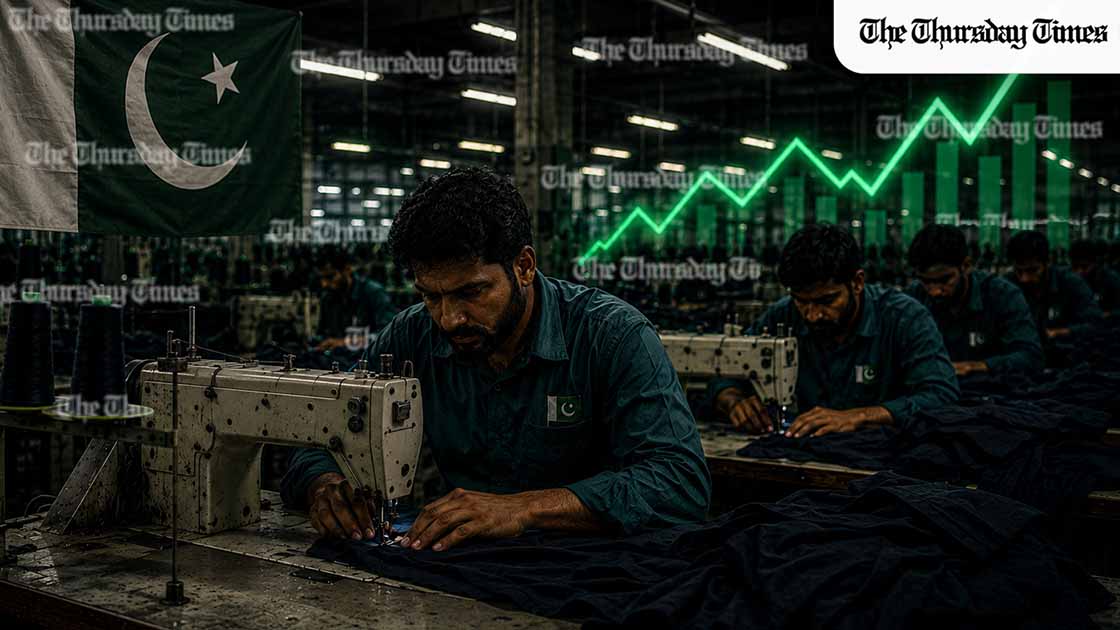
ISLAMABAD (The Thursday Times) — Pakistan’s manufacturing sector returned to growth in May after a brief setback the previous month, buoyed by a recovery in new orders and the strongest increase in export demand in more than a year, according to the latest purchasing managers’ survey released by HBL and S&P Global.
The HBL Pakistan Manufacturing Purchasing Managers’ Index rose to 50.9 in May from 49.9 in April, moving back above the 50-point threshold that separates expansion from contraction. The reading suggests that operating conditions improved modestly across the sector after April’s mild decline.
The latest survey offers one of the clearest indications yet that demand conditions are beginning to stabilise for manufacturers after a prolonged period of economic adjustment marked by high inflation, elevated borrowing costs and subdued consumer spending.
Much of May’s improvement was driven by a return to growth in new orders. Manufacturers reported stronger demand from domestic customers, allowing firms to rebuild order books that had softened in previous months. While the pace of expansion remained moderate, the shift marked a notable change in direction for a sector that has struggled to sustain momentum in recent years.
Export demand provided an even brighter spot.
According to the survey, export orders increased at their fastest rate since February 2025, suggesting that overseas buyers have become more active despite an uncertain global economic environment. The rise points to improving conditions for export-oriented industries and may offer support to Pakistan’s efforts to strengthen foreign exchange earnings through manufactured goods.
The rebound in orders did not immediately translate into stronger production. Manufacturing output was broadly unchanged from the previous month, with the survey’s output index registering exactly 50.0. Companies reported that while incoming business had improved, higher raw material costs and slower supplier deliveries limited their ability to expand production more aggressively.
Even so, maintaining output levels amid those pressures reflected a degree of resilience among manufacturers navigating a challenging operating environment.
The survey highlighted a renewed rise in cost pressures during May. Firms reported steeper increases in input prices, particularly for raw materials, while supplier delivery times lengthened. Those developments complicated production planning and added pressure to margins.
Many manufacturers responded by passing part of those higher costs on to customers through increased selling prices, continuing a trend that has characterised much of the post-pandemic period.
Employment conditions remained subdued, though there were signs that the pace of workforce reductions had eased. Manufacturers reported a second consecutive monthly decline in staffing levels, but job shedding was less pronounced than in April.
At the same time, companies reduced outstanding workloads at a sharp rate, prioritising the completion of existing orders. Economists often view falling backlogs as a sign of spare capacity within the sector, though in this case the pattern also reflected cautious management of resources as firms balanced improving demand against persistent cost pressures.
The survey was conducted between May 12 and May 22 and captures sentiment among purchasing managers across Pakistan’s manufacturing industries.
While a single month of expansion is unlikely to settle questions about the durability of the recovery, the combination of stronger new orders, improving export demand and stable production suggests that conditions in the manufacturing sector may be beginning to improve after a difficult period.
For policymakers and investors alike, the export figures may draw particular attention. Pakistan’s industrial sector has long been viewed as central to efforts to boost economic growth, create jobs and strengthen external balances. The strongest rise in export orders in fifteen months offers tentative evidence that some manufacturers are finding opportunities beyond the domestic market, even as challenges at home persist.
The broader picture remains mixed. Cost inflation has yet to ease meaningfully, supply chain disruptions continue to affect operations and employment remains under pressure. Yet the return of the PMI to expansion territory provides a measure of encouragement for a sector that has spent much of the past two years grappling with economic headwinds.
For the mean time, manufacturers appear to be entering the summer with a cautiously improved outlook, supported by recovering demand, strengthened export activity and a modest return to growth.