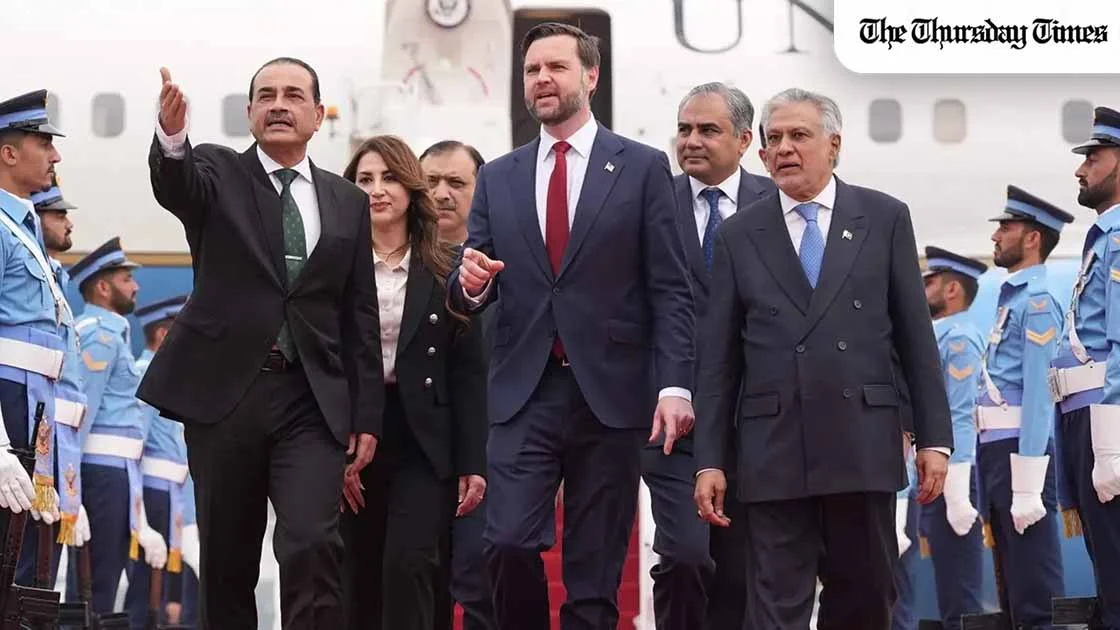
ISLAMABAD (The Thursday Times) — Senior security officials held a detailed briefing with the media on the regional security situation, Pakistan’s mediation efforts, the Islamabad Peace Agreement, and the role of the country’s civil and military leadership.
According to security sources, Pakistan’s mediation role was not driven by any narrow political or diplomatic interest. Instead, its purpose was to promote regional stability, prevent war, and ensure peace among Muslim countries at a time of heightened tension.
The sources said Pakistan’s civil and military leadership played a responsible, careful and serious role in reducing tensions between the United States and Iran. They said Pakistan engaged in consultation, coordination and cooperation with all major stakeholders to help prevent a wider war whose consequences could have been extremely serious for the region.
According to the sources, Field Marshal Asim Munir showed exceptional patience, judgement, diplomatic restraint and practical capability throughout the process. They said this was a war that was never physically fought, but preventing it was itself a major achievement. Field Marshal Asim Munir, they added, helped win a war for the wider good of humanity through sincerity, competence, intelligence and the help of Allah, not on the battlefield but through strategy, diplomacy and restraint.
Security sources said the highest form of strategy is to stop a war before it begins. They warned that the confrontation towards which the region was being pushed would not have remained limited to one or two countries. Instead, it could have engulfed the wider region and placed Muslim countries on opposing sides, damaging regional peace, energy flows, global trade, the world economy and the political unity of the Muslim world.
The briefing was told that the diplomatic process behind the Islamabad Peace Agreement was highly sensitive, complex and confidential. As a responsible mediator, Pakistan could not afford speculation, irresponsible public commentary or the premature disclosure of diplomatic material. For that reason, Pakistan would avoid unnecessary comments on the content of the talks, their details and the next phases of the process.
The sources said Pakistan’s responsibility is to move the peace process forward with seriousness, caution and trust. In sensitive diplomatic negotiations, they said, words, signals and timing all matter. Pakistan therefore views the process not through the lens of political projection or immediate claims, but through the longer-term interest of peace and regional stability.
The briefing also noted that certain elements and opposing forces would continue trying to undermine the peace process. According to the sources, such spoilers may use speculation, misinformation, pressure or regional division to disrupt peace efforts. However, Pakistan would continue working with its partners with sincerity, seriousness and consistency to pursue peace.
Security sources also highlighted the important role played by Saudi Arabia, Qatar, Türkiye, Egypt and other Muslim countries. They said Saudi leadership, in particular, showed exceptional wisdom, restraint and responsibility. The briefing noted that Saudi Arabia demonstrated deep prudence in helping avoid a war that could have engulfed the entire region.
According to the sources, Qatar’s diplomatic efforts, Saudi Arabia’s wisdom, the initiatives of Türkiye and Egypt, and Pakistan’s active coordination were part of a shared regional framework designed to prevent confrontation and give negotiations a chance. The briefing said reducing tensions within the Muslim world was one of Pakistan’s core objectives, as a new regional war could have had far-reaching geographical, religious, economic and political consequences.
Security sources said Pakistan’s mediation should not be viewed as alignment with one country or against another. Military diplomacy, defence contacts and high-level engagement with any friendly country cannot be seen through a narrow lens. Such relationships are part of national interest, regional stability and a broader diplomatic strategy.
The briefing made clear that Pakistan’s foreign and security policy does not revolve around one capital or one crisis. Pakistan builds relations with every country on the basis of national interest, mutual respect and peace in the region. Military diplomacy, therefore, is not a separate or contradictory track, but part of Pakistan’s wider diplomatic policy.
According to the sources, Pakistan’s position is that diplomacy is not limited to formal statements or public meetings. At times, backchannel engagement, confidence-building, a quiet role during crisis, and constant efforts to keep parties away from confrontation matter far more. The Islamabad Peace Agreement was described as an example of that kind of diplomacy.
The briefing said Pakistan approached its responsibility through the lens of regional peace, unity in the Muslim world and global stability. Security sources said Pakistan’s role was not based on short-term political gain, but on the principle that preventing war, keeping dialogue alive and saving the region from a destructive confrontation is the greatest diplomatic success.
Security sources said Field Marshal Asim Munir’s role was important because he carried the process forward through a combination of strength, restraint, diplomatic understanding and responsibility. According to the sources, the achievement reflects Pakistan’s ability to play a meaningful role not only through military capability, but also through military diplomacy and crisis resolution.
The meeting was also told that Pakistan would continue to play its role for peace in the future, while maintaining respect for the sensitivity of the diplomatic process. Security sources said unnecessary speculation about the details of the agreement, its contents and future steps must be avoided, as such matters can only move forward through trust, caution and step-by-step diplomacy.∎