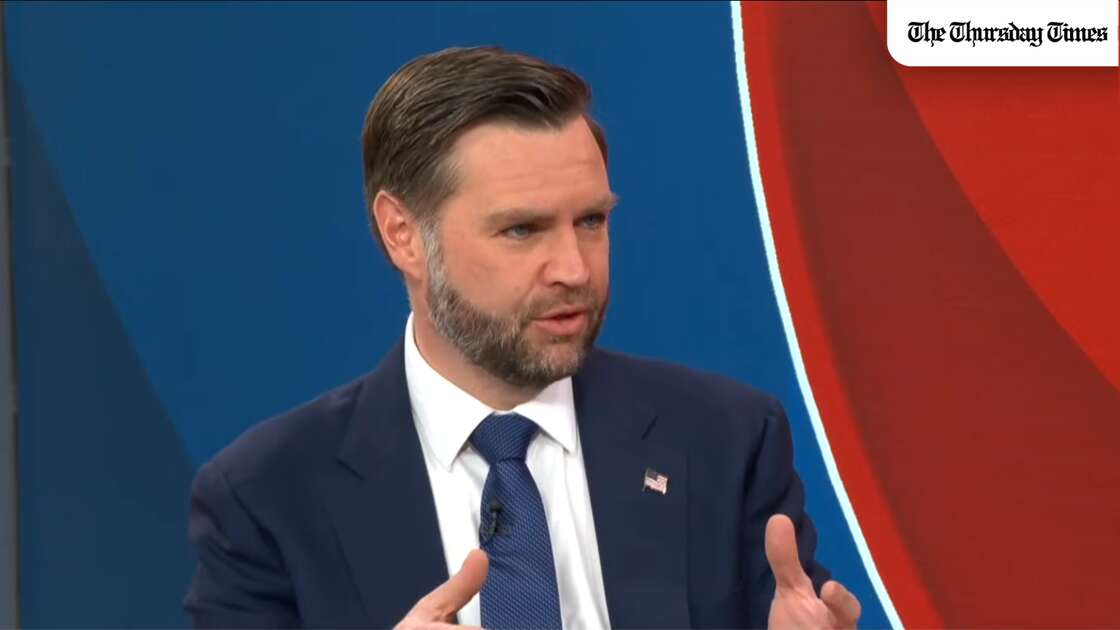
WASHINGTON, D.C. (The Thursday Times) — US Vice President JD Vance has said Pakistan and Qatar played an important role in mediating the emerging US-Iran agreement and asked Washington to delay releasing the full text of the memorandum of understanding for “a little while”.
Speaking on CBS Mornings, Vance said the document would be made public by Friday at the latest, while adding that the White House was pressing for an earlier release so Americans could see the terms directly.
“We’re actually trying to push them to get it out today, because we want to tell the American people what’s in this deal,” Vance said, referring to the request from Pakistani and Qatari negotiators.
JD Vance says Pakistan and Qatar helped mediate the US-Iran agreement and asked Washington to delay releasing the full text “for a little while.”
He says the deal will be public by Friday at the latest, with one key outcome: reopening the Strait of Hormuz. pic.twitter.com/s70LCirLig
— The Thursday Times (@thursday_times) June 17, 2026
The vice president said he had seen what he described as misrepresentations about the agreement and argued that the core outcome was straightforward. According to Vance, the deal would reopen the Strait of Hormuz immediately and provide a framework for further engagement with Tehran.
The Strait of Hormuz has become the central strategic point in the agreement because of its role as one of the world’s most important energy corridors. The disruption of traffic through the waterway has raised oil market concerns and placed pressure on governments already dealing with inflation, supply chain risks and wider instability in the Middle East.
Vance said the deal would allow Iran to receive benefits only if it met US requirements, including ending the pursuit of a nuclear weapon and stopping the funding of terrorism. He described those benefits as sanctions relief and possible reintegration into the world economy, but stressed that they would depend on Iranian behaviour.
The agreement has not yet been formally released, and that absence of a public text has fuelled political pressure in Washington. Several lawmakers have demanded briefings and warned that any arrangement with Tehran must include enforceable guarantees, especially over nuclear inspections, enriched uranium and the future security of shipping routes.
President Donald Trump has presented the memorandum of understanding as a breakthrough, while also saying it is not yet a final settlement. Speaking at the G7 summit in France, Trump warned that the United States could return to military action if Iran failed to comply with the terms being negotiated.
The public role of Pakistan and Qatar has become a key diplomatic feature of the agreement. Reports from regional and international outlets have described Pakistani and Qatari mediation as central to the talks, with Pakistan hosting or facilitating key contacts and Qatar helping to bridge communication with Tehran.
Pakistani Prime Minister Shehbaz Sharif previously said the agreement would be signed during an official ceremony in Switzerland on Friday, June 19. Iranian officials have also indicated that the memorandum’s text has been finalised and would be made public after signing.
For Islamabad, Vance’s remarks represent a rare and direct acknowledgement from the top level of the US administration that Pakistan helped shape not only the diplomatic negotiations but also the timing of the agreement’s public rollout. The mention of Pakistan alongside Qatar places Islamabad inside the small circle of states credited with easing one of the most dangerous regional confrontations of the year.
The deal is expected to begin a further technical phase rather than resolve every dispute immediately. US officials have indicated that future negotiations will address Iran’s nuclear programme, inspection arrangements and the conditions under which economic relief may be granted.
The lack of a released text means several major questions remain unanswered. These include the precise timetable for reopening the strait, the mechanism for verifying Iranian compliance, the role of international nuclear inspectors, and whether any sanctions relief or frozen funds will be linked to measurable benchmarks.
Even so, Vance’s comments sharpened the public understanding of the agreement’s immediate purpose. In the administration’s telling, the first test of the deal is practical and visible: whether the Strait of Hormuz reopens, whether shipping resumes with confidence, and whether the text released by Friday can withstand scrutiny in Washington, Tehran and the wider region.