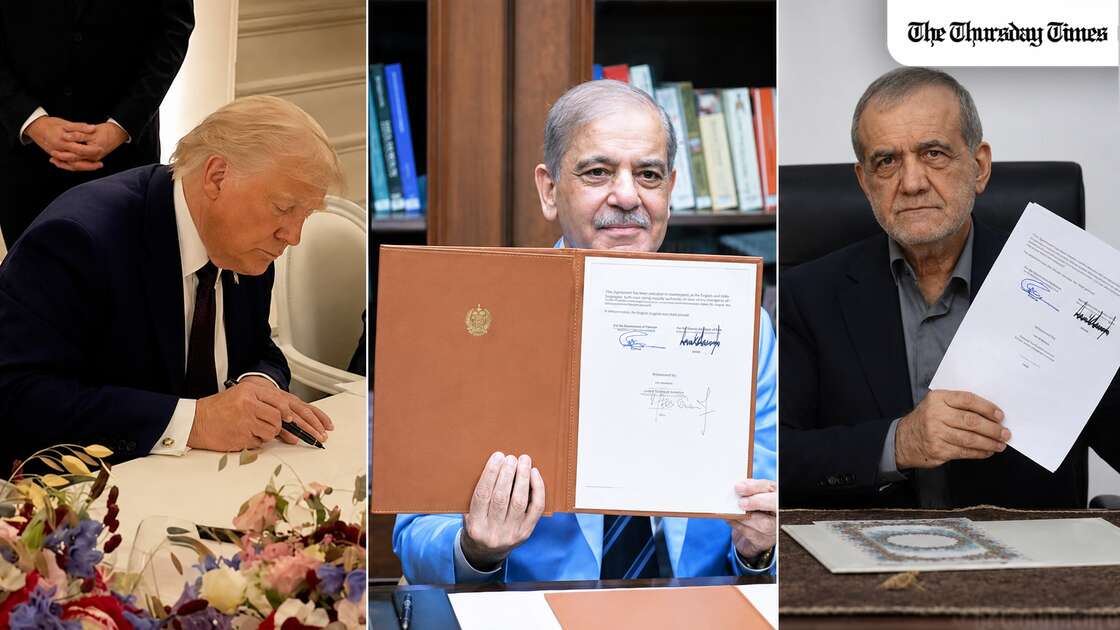
ISLAMABAD (The Thursday Times) — Pakistan did what many thought impossible. The Islamabad Memorandum of Understanding has entered into force after electronic signatures by the United States and Iran, moving one of the world’s most dangerous crises from confrontation into a structured implementation process.
The breakthrough means Islamabad’s role is no longer limited to mediation between two hostile capitals. Pakistan has helped deliver an agreed framework, de-escalate a wider regional crisis, and open a path for technical talks on the most difficult parts of a final settlement.
Prime Minister Shehbaz Sharif said the memorandum had been signed by the leadership of both countries and that, as a first step, Iran would reopen the Strait of Hormuz while the United States would move to lift its naval blockade. The statement placed Islamabad at the centre of the agreement’s transition from political announcement to implementation.
The agreement, read out by a senior United States official and reported by Reuters, is titled the Islamabad Memorandum of Understanding between the United States of America and the Islamic Republic of Iran. It sets out a 14-point framework intended to halt hostilities, reopen maritime passage, and begin a 60-day period for negotiations toward a final deal.
That structure is important because it separates the symbolic moment from the substance of the process. The political breakthrough has already been secured at the highest level. What follows now is disciplined follow-through through technical tracks, expert negotiations, verification work, and sequencing.
Iran’s Foreign Ministry spokesperson Esmaeil Baghaei said no formal signing ceremony would take place in Switzerland because the document had already been signed digitally. Negotiating teams are still expected to continue the process, but the absence of a ceremony does not mean the agreement has stalled. It means the agreement is already alive.
For Pakistan, that distinction matters. The original objective was not to stage diplomatic theatre. The objective was to secure an agreed framework, prevent further escalation, protect regional stability, and create a mechanism through which Washington and Tehran could move from war management to negotiated settlement.
The next phase is expected to move into separate technical-level tracks covering sanctions relief, maritime security, nuclear-related measures, verification, sequencing, frozen assets, oil export waivers, and regional assurances. These are the details that will determine whether the memorandum becomes a durable final settlement.
Under the text reported by Reuters, both sides commit to a permanent termination of military operations on all fronts, including Lebanon, and undertake to respect each other’s sovereignty and territorial integrity. The final deal is expected to confirm those commitments once the technical negotiations are completed.
The Strait of Hormuz remains one of the most urgent elements of the arrangement. The memorandum says the United States will begin removing its naval blockade immediately and fully end it within 30 days, while Iran will make arrangements for safe commercial passage from the Persian Gulf to the Sea of Oman and back.
The agreement also gives both sides a maximum 60-day period, extendable by mutual consent, to reach a final deal. That timeline creates pressure on the negotiating teams while also allowing space to settle issues that could not be resolved in a single political announcement.
The nuclear track is likely to be among the most sensitive. Iran reaffirms that it will not procure or develop nuclear weapons, while the parties are to resolve the handling of enriched material through a mutually agreed mechanism, with down-blending on site under the supervision of the International Atomic Energy Agency described as the minimum methodology.
Sanctions relief is another central track. The memorandum commits the United States to address the termination of sanctions in an agreed schedule as part of the final deal, while also providing for immediate Treasury waivers linked to Iranian crude oil, petroleum products and associated services pending that final settlement.
The document also refers to frozen or restricted Iranian funds and assets, with both sides to agree procedures for their release during the negotiation process. An executive mechanism is to monitor implementation of the memorandum and future compliance with the final agreement.
The agreement remains fragile. The Guardian reported that unresolved questions around sanctions, nuclear measures, Lebanon, maritime administration, and enforcement could still test the process. A senior United States official also warned that sequencing would be critical because each side’s obligations must be matched carefully to the other’s steps.
Even so, the immediate diplomatic meaning is clear. Pakistan did not merely host optics or issue statements from the sidelines. Islamabad helped shape a comprehensive framework that now requires expert-level work, international monitoring, and sustained regional coordination.
The postponed or cancelled ceremony should therefore be understood differently. It was not postponed because diplomacy failed. It became less urgent because diplomacy worked, the agreement was signed, the memorandum entered into force, and the process moved into implementation.
Pakistan did what many thought impossible by helping move the United States and Iran from a dangerous confrontation into an agreed diplomatic framework. The harder test now begins, as the Islamabad MoU moves from signature to substance.