
WASHINGTON, D.C. (The Thursday Times) — Pakistan and the United States have opened fresh discussions on expanding their economic partnership, as shifting global dynamics and regional instability push both sides to recalibrate trade and investment priorities.
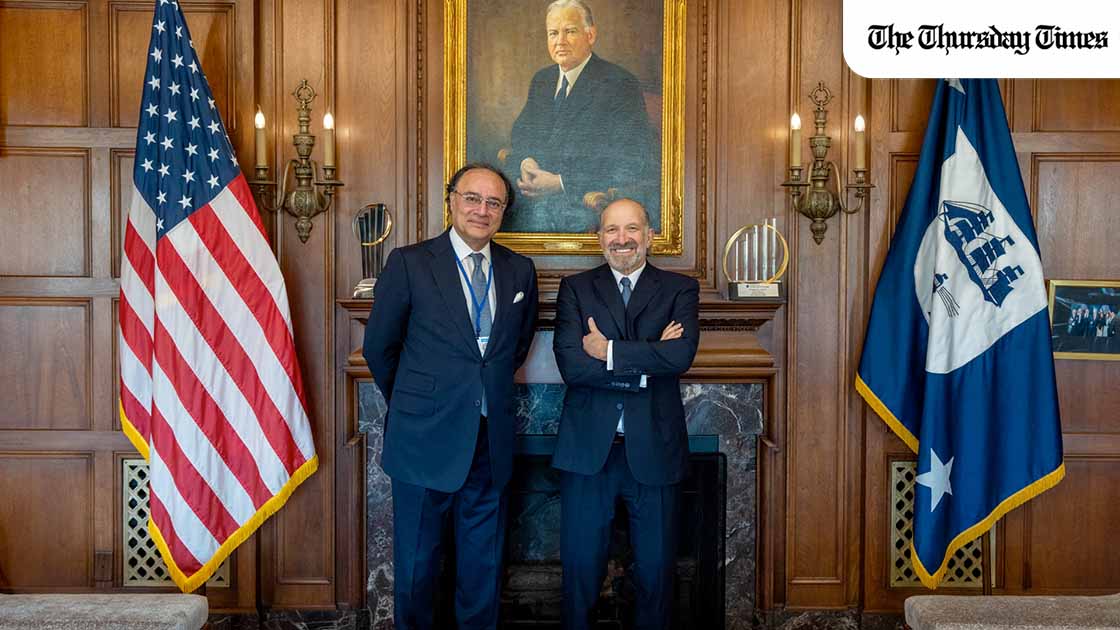
Secretary Lutnick met with Pakistan’s Finance Minister Muhammad Aurangzeb to further economic interests for both countries and advance trade that also benefits the United States. pic.twitter.com/YUxnWMuJYu
— U.S. Department of Commerce (@CommerceGov) April 15, 2026
At the centre of the talks was Pakistan’s Finance Minister, Muhammad Aurangzeb, who met with Howard Lutnick during the World Bank–IMF Spring Meetings 2026 in Washington. Officials described the exchange as focused and forward-looking, with both sides identifying practical avenues to strengthen trade flows, encourage investment, and deepen private-sector cooperation.
The discussions touched on sectors increasingly seen as strategic in a fragmented global economy, including mining, energy, and information technology. For Pakistan, these areas represent both immediate growth opportunities and long-term resilience. For the United States, they align with broader efforts to secure supply chains and diversify economic partnerships beyond traditional hubs.
The timing of the talks reflects a wider recalibration underway in global markets. Speaking at a panel hosted by the International Monetary Fund, Aurangzeb described the ongoing Middle East conflict as one of the most significant supply shocks in recent memory, drawing comparisons to the demand shock that defined the COVID-19 pandemic. The crisis, he said, has forced governments and institutions to rethink assumptions about energy security and the stability of global supply chains.
Pakistan’s exposure to these disruptions has been immediate. Rising fuel costs and volatility in global markets have placed pressure on inflation, while uncertainty continues to weigh on remittances, exports, and capital flows. Yet officials in Islamabad have also pointed to unexpected openings.
Aurangzeb noted that transhipment activity at Karachi Port has surged in recent weeks, surpassing volumes recorded over the previous year. The increase suggests that shifting trade routes and logistical adjustments, triggered by instability elsewhere, may be redirecting commercial flows toward Pakistan.
Still, the government’s approach remains cautious. The finance minister emphasised the importance of maintaining fiscal discipline while strengthening targeted support mechanisms. He also pointed to technology as a critical tool in managing economic shocks, particularly in improving efficiency and transparency across financial systems.
Beyond formal meetings, Aurangzeb used the visit to engage with the Pakistani diaspora, addressing an event centred on the Roshan Digital Account initiative. The scheme, designed to channel overseas investment into Pakistan’s financial system, has become a key pillar of the country’s external financing strategy.
He underscored that even during periods of acute balance-of-payments stress, deposits in these accounts were not restricted, a point aimed at reinforcing confidence among overseas investors. The diaspora, he said, continues to play a central role in stabilising Pakistan’s economy, not only through remittances but increasingly through structured investment.
The renewed economic dialogue between Islamabad and Washington comes at a moment when geopolitical tensions are reshaping economic alignments. While security considerations have long dominated the bilateral relationship, both sides now appear intent on placing greater weight on economic cooperation.
Whether these discussions translate into tangible outcomes will depend on sustained engagement and the ability to navigate competing pressures at home and abroad. For now, officials on both sides are signalling that, amid uncertainty, economic ties may offer a more stable foundation for the relationship’s next phase.