
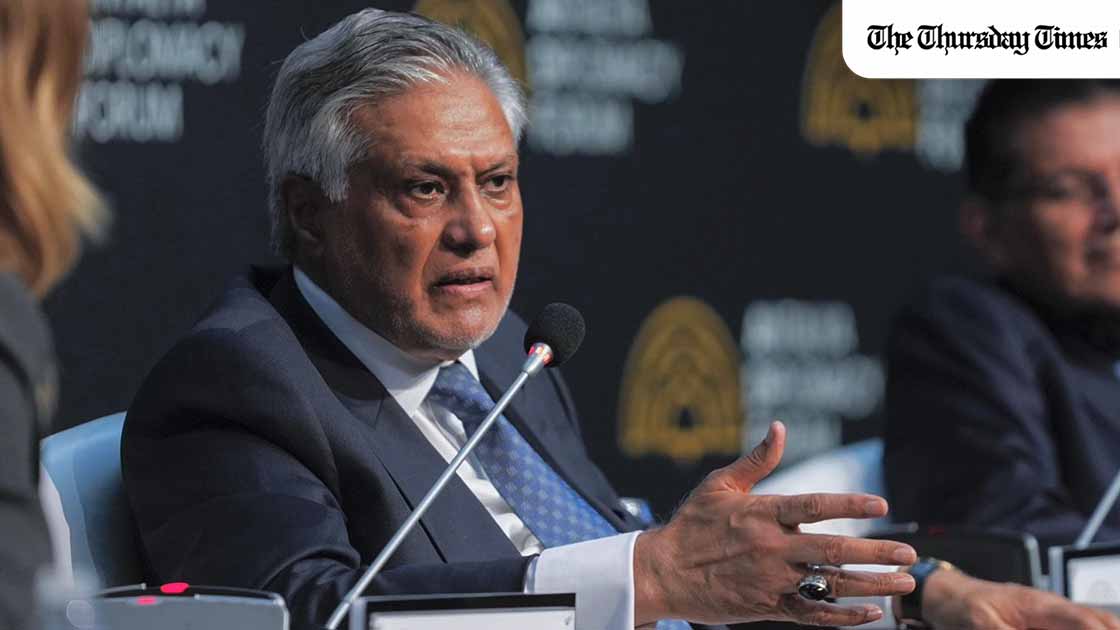
ANTALYA (The Thursday Times) — Deputy Prime Minister and Foreign Minister of Pakistan Ishaq Dar has said that Pakistan is seeking to build alternative forms of regional cooperation beyond the traditional framework of the South Asian Association for Regional Cooperation, arguing that political deadlock — particularly with India — should not prevent ordinary citizens from benefiting through travel, trade and tourism.
Speaking at the Antalya Diplomacy Forum in remarks which signal a renewed diplomatic push, Mr Dar said all members of SAARC had shown willingness to cooperate, but that the principal obstacle had come from India. Pakistan, he said, remained committed to regional progress but believed such goals could only be achieved through equality, mutual respect and a shared commitment among member states.
His comments revive a long-running debate over the future of SAARC, a bloc founded in 1985 to deepen economic and political ties across South Asia, but which has struggled for years amid tensions between its two largest members, India and Pakistan. Formal summits have repeatedly stalled, and many regional initiatives have advanced slowly or not at all.
Mr Dar indicated that Islamabad was now exploring more flexible arrangements outside that paralysis. He cited ongoing engagement with China, Afghanistan and Bangladesh, while suggesting that Myanmar or Sri Lanka could also become part of a broader cooperative framework.
Though he did not outline a formal new organisation, the remarks suggest Pakistan is considering a looser network centred on practical connectivity rather than grand institutional design. Trade facilitation, tourism flows, transport links and people-to-people exchanges are areas where governments often find progress easier than on harder security disputes.
Pakistan has increasingly argued that regional populations should not bear the cost of unresolved political disagreements. That framing places economic opportunity and mobility at the centre of diplomacy, rather than making them hostage to wider rivalries.
Mr Dar also linked the regional discussion to broader international disputes, saying issues from Kashmir to Palestine could only be resolved through dialogue, diplomacy and a stronger multilateral order. The language reflects Islamabad’s longstanding call for negotiated settlements on territorial conflicts and greater reliance on international institutions.
For India, which has sought to expand influence through alternative forums such as BIMSTEC and bilateral initiatives, Pakistan’s latest position may be read as an attempt to reassert relevance in shaping South Asia’s regional architecture.
Whether such ideas gain traction will depend on the willingness of neighbouring capitals to separate commerce and connectivity from geopolitical rivalry. That has proved difficult in the past. Yet with supply chains shifting and economic pressures mounting across the region, the incentive to revive cooperation — even in a new form — may be stronger than before.
For now, Pakistan appears to be signalling that if old institutions remain frozen, new pathways may have to be built around them.