
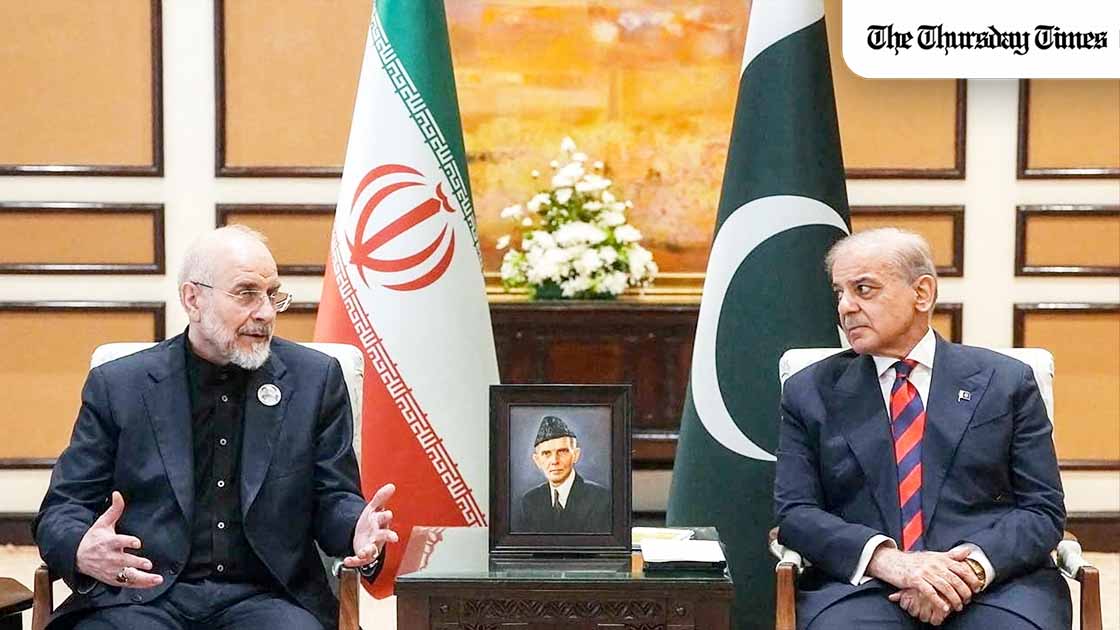
ISLAMABAD (The Thursday Times) — After inconclusive talks between Iranian and American delegations in Islamabad last weekend, Pakistan mounted an extraordinary air operation to escort Iran’s negotiators safely home, according to Reuters and multiple sources familiar with the mission, underscoring how perilous even diplomacy has become in a war that has already pushed the region close to the edge.
The reported mission, which involved fighter aircraft and airborne surveillance support, appears to have gone far beyond normal diplomatic security arrangements. According to the Reuters report, Pakistani military planners acted after concerns were raised that the Iranian delegation could face a possible Israeli threat while returning from the talks. The operation reflected not only the volatility of the present conflict, but also Pakistan’s increasingly consequential role as a mediator trying to keep a channel open between Washington and Tehran.
The Iranian side, led by Foreign Minister Abbas Araqchi and Parliament Speaker Mohammad Baqer Qalibaf, had travelled to Islamabad for what amounted to the highest-level known engagement between Iran and the United States since the 1979 Islamic Revolution. The discussions ended without a breakthrough. But even as the delegations left without an agreement, the diplomacy itself appeared too important, and too fragile, to be allowed to collapse entirely into violence.
That fragility shaped what followed.
According to the Reuters account, Pakistani officials deployed roughly two dozen aircraft, including Airborne Warning and Control System support, to accompany the Iranian delegation as it departed. One source said Pakistan’s top fighter, the Chinese-made J-10, was used as part of the escort. Another said that similar cover could be arranged again if future rounds of talks proceed and the Iranians seek it.
The operation, if confirmed in full, would represent one of the starkest illustrations yet of how conventional diplomatic protocol has been overtaken by wartime calculations. In another era, negotiators might have departed through tightly choreographed airport procedures and discreet security convoys. In this moment, officials appear to have been weighing the possibility that senior delegates might be attacked in transit.
One security source cited by Reuters said the Iranian side grew uneasy after the talks failed to produce a result and feared they could be targeted. A diplomat briefed by Tehran suggested the concern may initially have been raised more hypothetically, but said Pakistan insisted on providing protection once the possibility was discussed. Either way, the message was the same: even the act of returning home from peace talks had come to be viewed through the logic of war.
That reality has become central to the broader regional picture. Israel has kept up intense pressure on Iran’s political and military leadership, while the United States, despite public statements in favour of diplomacy, remains directly tied to a conflict whose scope has repeatedly threatened to widen. Against that backdrop, Islamabad has tried to position itself not as a combatant, but as a state capable of preserving contact when others are exchanging threats.
The Reuters report also said Pakistan had urged Washington to help ensure that key Iranian negotiators were not treated as military targets, on the grounds that removing them would leave no credible channel for further dialogue. That claim, if accurate, would reveal how deeply Pakistan has involved itself not merely in hosting talks, but in trying to preserve the minimum conditions under which talks can continue at all.
For Pakistan, the escort mission carried both risk and symbolism. Operationally, it meant assuming responsibility for the safety of foreign delegates beyond Pakistani territory or, at the very least, far beyond the narrow perimeter usually associated with summit security. Politically, it reinforced Pakistan’s attempt to present itself as a serious diplomatic actor at a time when larger powers are struggling either to restrain events or to control their consequences.
It also highlighted the paradox at the heart of the current crisis. The same region that is witnessing missile strikes, existential rhetoric and open threats against senior officials is also relying on discreet diplomacy to prevent a broader catastrophe. Peace efforts are not unfolding apart from the conflict. They are unfolding inside it, exposed to the same fears, the same military calculations and the same possibility of sudden escalation.
President Donald Trump said on Thursday that the war should be ending soon and that talks could resume in Islamabad as early as this weekend. That suggestion, combined with Reuters’ reporting that preparations for another round were already underway, indicates that the diplomatic track remains alive, even if only narrowly.
But the need for an air escort says as much about the present state of the region as any official communique could.
It suggests that no party truly believes the danger has passed. It suggests that even those sitting at the negotiating table assume they may still be living on borrowed time. And it suggests that countries like Pakistan, which are trying to keep diplomacy standing, now have to do so in a theatre where the line between negotiation and battlefield exposure has become alarmingly thin.
If another round of talks does take place in Islamabad, it will not simply be a diplomatic meeting. It will be a test of whether mediation can survive in a conflict where even the negotiators may need fighter cover to get home.