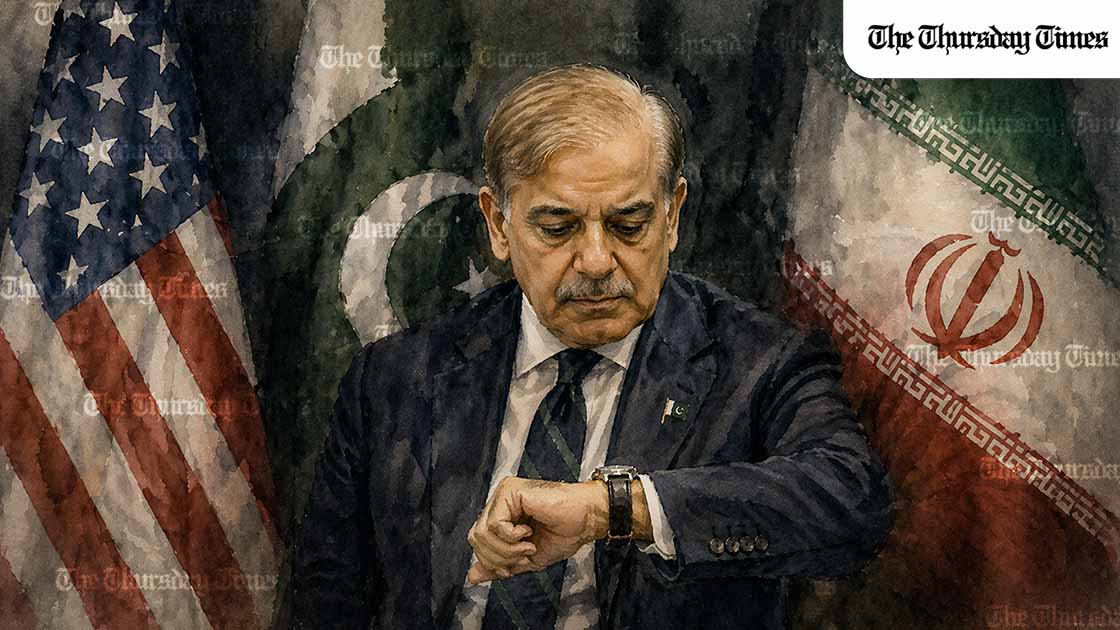
WASHINGTON, D.C. (The Thursday Times) — Pakistan is once again trying to hold together a diplomatic process that has looked fragile from the beginning, with the latest push coming as the ceasefire clock runs down and uncertainty grows over whether Iran will return to the table in Islamabad at all. Pakistan’s role did not emerge overnight. It became central because it is one of the few states still able to speak to both Washington and Tehran at a high level while also carrying enough regional weight to be taken seriously by each side.
The road to this moment began with the sharp escalation of February 28, when Israel and the United States launched strikes on Iran, triggering a wider military confrontation and plunging the region into a new phase of instability. Tehran responded with missile attacks, panic spread inside Iran, and the risk of a broader regional war quickly became real.
As the war dragged on, diplomacy slowly re-entered the picture not because trust had been rebuilt, but because the costs of continued escalation became harder for all sides to ignore. Energy markets were shaken, shipping lanes came under threat, and the Strait of Hormuz once again became a pressure point with global consequences. That gave Pakistan an opening. Islamabad was not seen as neutral in the abstract, but as usable, credible and reachable by both camps at a moment when more obvious venues carried too much baggage.
The first major breakthrough came on April 11, when U.S. and Iranian negotiators met in Islamabad for their highest-level direct talks in decades. Reuters described the meeting as the first direct U.S.-Iran encounter in more than a decade and the highest-level discussions since the 1979 Islamic Revolution. That alone made the session historic, even though it ended without a deal.
Those first Islamabad talks were never expected to produce an instant settlement. They were tense, ran deep into the night and left major issues unresolved. The core disputes were already clear: Iran wanted relief from pressure, movement on sanctions and room to preserve leverage; Washington wanted hard commitments on enrichment, on Iran’s stockpile and on the strategic threat posed by Hormuz. Yet despite the bitterness and the abrupt finish, both sides left the door open. That was the key outcome of round one. The process survived.
From there, the diplomacy became less about optimism and more about managing a narrow and unstable truce. The ceasefire that followed was never a political settlement. It was a holding arrangement, a pause meant to create room for a second round rather than a sign that the underlying conflict had been resolved. That is why every incident since then has mattered so much. Each provocation has not just threatened military escalation, but directly reduced the already limited space for diplomacy.
That brings the story to the past several days, when Pakistan began preparing for another round in Islamabad. Vice President JD Vance was expected to lead the U.S. side again, joined by Steve Witkoff and Jared Kushner, the same group tied to the earlier process. Reports initially suggested the American team was preparing to travel as the truce neared its end.
But by April 21, the diplomacy was visibly wobbling. Iran publicly insisted it had no plans to negotiate under threat, while Washington continued to apply military and naval pressure. The seizure of the Iranian-linked vessel Touska and the wider U.S. blockade posture in and around Hormuz injected new distrust into an already brittle process. Analysts told Al Jazeera and Reuters that these moves were not side issues. They cut to the heart of whether Tehran could justify returning to talks without appearing to surrender.
This is the central tension Pakistan is now trying to manage. Islamabad is asking Iran to come back to negotiations precisely when Tehran believes its leverage is under assault. From the Iranian point of view, the question is not only what the Americans are offering, but what message a return to talks would send domestically while ships are being stopped and pressure is intensifying. Analysts quoted by Al Jazeera said Iran’s internal balance matters here too, especially the pressure coming from hard-line security elements that do not want diplomacy to look like retreat.
On the American side, the problem has been different but equally serious. President Trump’s public messaging has often run ahead of the diplomacy, with statements suggesting progress or terms that were not yet finalised. That has repeatedly complicated the negotiating atmosphere because Iran does not simply hear bravado; it hears an attempt to rewrite the terms in public before they are agreed in private. Even analysts who see Trump’s rhetoric as posturing acknowledge that it makes Pakistan’s job harder, because Islamabad has to preserve a face-saving pathway for both sides.
That is why this feels like a race against time rather than an ordinary diplomatic delay. The problem is not merely scheduling. It is that the architecture of the talks has become compressed into a final political window. Trump has signalled little appetite for extending the truce much further, while Iranian officials have publicly denied that any delegation is definitely on the way. Meanwhile, Pakistan has tightened security and continued its contacts, trying to keep the process alive long enough for either side to step back from the brink.
There is also a broader reason the Islamabad track matters. These talks are not just about uranium, shipping or one ceasefire deadline. They are about whether a war that began with direct military escalation can still be pulled back into a negotiated channel before it hardens into a longer regional conflict. If Pakistan succeeds in getting Iran back into the room, it will not mean peace has arrived. It will mean the process has survived long enough for diplomacy to remain possible. If it fails, the likely alternative is not a clean diplomatic reset, but renewed confrontation under worse conditions than before.
In that sense, the previous talks matter because they showed something important even in failure. The first Islamabad round did not resolve the dispute, but it proved that direct contact was still possible after weeks of war. The current crisis is about whether that narrow opening can be preserved, or whether the combination of military escalation, public threats and domestic political pressure will shut it completely. Pakistan is now trying to stop that door from closing.