
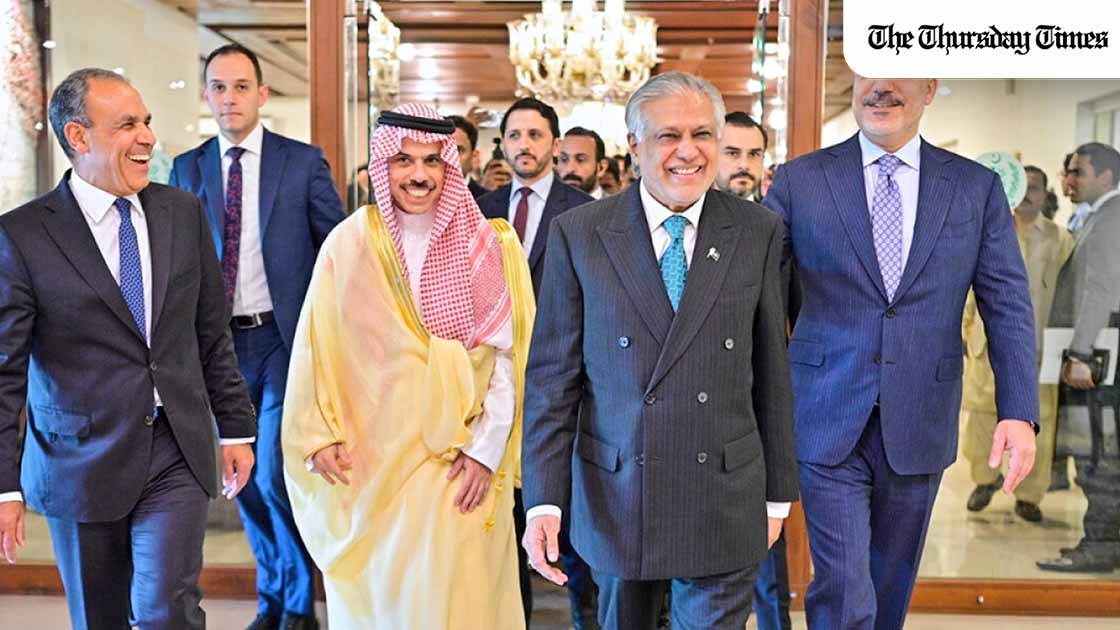
RIYADH/ISLAMABAD (The Thursday Times) — Saudi Arabia moved on Tuesday to publicly reinforce Pakistan’s diplomatic efforts in the region, with Saudi Foreign Minister Prince Faisal bin Farhan Al Saud expressing support for Islamabad’s continuing role in promoting dialogue and de-escalation during a call with Pakistan’s Deputy Prime Minister and Foreign Minister Mohammad Ishaq Dar.
Deputy Prime Minister / Foreign Minister Senator Mohammad Ishaq Dar @MIshaqDar50 spoke this evening with Saudi Foreign Minister Prince Faisal bin Farhan Al Saud @FaisalbinFarhan.
The two leaders discussed the latest regional developments and emphasized the importance of… pic.twitter.com/VGicvnbXKB
— Ministry of Foreign Affairs – Pakistan (@ForeignOfficePk) April 21, 2026
According to an official Pakistani statement, the two ministers spoke in the evening and reviewed the latest regional developments, at a time when governments across the Middle East and South Asia are closely monitoring whether diplomacy can hold against renewed instability.
Both leaders emphasised the importance of engagement and dialogue as the foundation for achieving lasting peace and stability. The Saudi foreign minister also reiterated the kingdom’s support for Pakistan’s efforts, underlining Riyadh’s confidence in Islamabad’s active diplomatic role.
The call is significant because Saudi Arabia remains one of the most influential political and economic powers in the Muslim world, with longstanding relationships across the Gulf, Washington and key regional capitals.
Its public endorsement of Pakistan’s diplomatic activity gives added weight to Islamabad’s recent attempts to position itself as a constructive intermediary capable of maintaining communication lines with multiple actors.
Pakistan has in recent days stepped up engagement with partners across the region, arguing that dialogue remains the only credible path to prevent a wider crisis and preserve regional stability.
Saudi support also matters symbolically. Riyadh’s backing signals that Pakistan’s diplomatic outreach is not being viewed as isolated or unilateral, but as part of a broader regional desire to avoid escalation.
For Islamabad, building visible support from capitals such as Riyadh strengthens its claim to be acting in the collective interest of regional calm rather than narrow geopolitical advantage.
Officials in Pakistan have increasingly framed the country as a state able to talk across divides and maintain working relations with rival powers at moments when formal channels are strained.
The agreement between Mr Dar and Prince Faisal to remain in close contact suggests consultations may continue in the coming days if tensions intensify or new openings emerge.
Pakistan and Saudi Arabia have long shared close defence, economic and political ties. Successive governments in Islamabad have viewed Riyadh as one of their most important international partners, while Saudi Arabia has often looked to Pakistan as a strategically significant ally with influence beyond South Asia.
That history gives Tuesday’s call greater significance than a routine diplomatic exchange. At a moment of uncertainty, it showed Saudi Arabia choosing to publicly align itself with Pakistan’s diplomatic push for restraint and negotiated outcomes.
While no immediate breakthrough was announced, the language of the statement suggested continuity rather than crisis: consultation, coordination and support.
As uncertainty persists across the region, Pakistan appears intent on building a wider coalition around diplomacy. Saudi Arabia’s endorsement gives that effort added credibility at a moment when credibility may matter most.