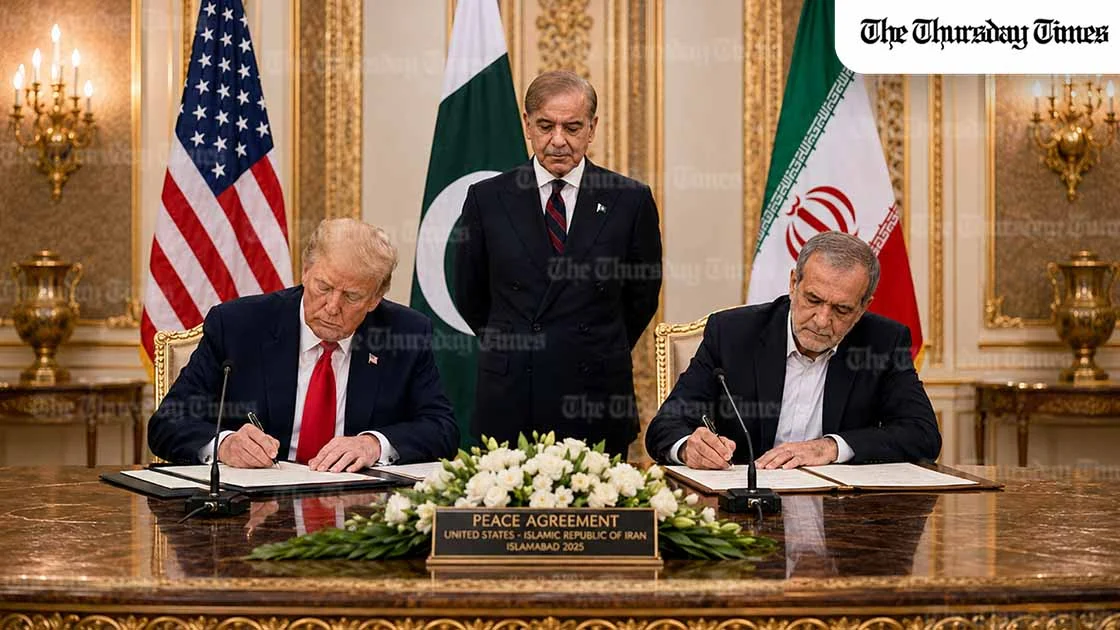
ISLAMABAD (The Thursday Times) — Prime Minister Shehbaz Sharif announced early Monday that the United States and Iran had reached a peace agreement after intensive negotiations, presenting the accord as a major diplomatic breakthrough for Pakistan and a potential turning point in a conflict that had drawn in regional powers, strained global energy markets and threatened to widen across the Middle East.
Following intensive talks, we are pleased to announce that the Peace Deal between the United States of America and Islamic Republic of Iran has been REACHED. Both sides have declared the immediate and permanent termination of military operations on all fronts, including in…
— Shehbaz Sharif (@CMShehbaz) June 14, 2026
In a statement posted on X shortly after midnight, Mr Sharif said the “Peace Deal between the United States of America and Islamic Republic of Iran has been reached,” adding that both sides had declared the “immediate and permanent termination of military operations on all fronts, including in Lebanon.”
The formal signing ceremony, he said, would take place on Friday, 19 June, in Switzerland.
The announcement, if implemented, would mark one of the most consequential diplomatic moments in the region in years: a direct understanding between Washington and Tehran, reached not through a traditional Western-led framework, but through a mediation channel in which Pakistan, Qatar, Saudi Arabia and Türkiye appear to have played visible roles.
Mr Sharif thanked the United States and Iran for what he described as their commitment to a diplomatic solution. He reserved particular praise for Qatar, calling its leadership “brothers in this mediation effort,” and also credited Saudi Arabia and Türkiye for what he described as their “immense contributions.”
The Pakistani premier said mediators would now facilitate a series of meetings this week before the official signing. Those meetings, he said, would prepare the ground for technical talks and for the implementation of the agreement.
President Donald Trump appeared to confirm the agreement in a separate statement, declaring that the “deal with the Islamic Republic of Iran is now complete” and announcing the reopening of the Strait of Hormuz without tolls. He also said he had authorised the immediate removal of the United States naval blockade, casting the development not only as a diplomatic breakthrough but as a restart of one of the world’s most sensitive energy corridors.
“Ships of the world, start your engines. Let the oil flow,” Mr Trump wrote, using the kind of theatrical language that has often defined his public diplomacy. But behind the flourish was a serious strategic signal: Washington was moving to restore commercial passage through a maritime route central to global oil and gas markets.
The Strait of Hormuz has been one of the most dangerous pressure points in the conflict. Any closure, toll regime, blockade, or military disruption there carries consequences far beyond the Gulf, shaping crude prices, shipping insurance, inflation expectations and the calculations of governments dependent on Gulf energy exports.
Mr Trump’s statement also gives the agreement a more concrete economic dimension. Mr Sharif’s announcement framed the deal as a ceasefire and diplomatic settlement. Mr Trump’s post presented it as the unlocking of sea lanes, the lifting of naval pressure and the resumption of oil flows.
That distinction matters. For energy markets, the immediate question is whether commercial shipping will return quickly and safely. For diplomats, the larger question is whether the opening of Hormuz becomes the first visible proof that the US-Iran agreement is being implemented, or merely an early promise in a deal still vulnerable to regional escalation.
The details of the deal remain limited. Mr Sharif’s statement did not disclose the full text, the enforcement mechanism, the monitoring framework, or the precise obligations accepted by each side. But the language used by the Pakistani prime minister suggested that the agreement is intended to go beyond a temporary pause in fighting.
The inclusion of Lebanon in the announcement is especially significant. Any ceasefire that extends to that front would require not only restraint from Washington and Tehran, but also discipline among allied and aligned actors operating in a region where escalation has often moved faster than diplomacy.
The announcement came after days of public signals that an agreement was close. Pakistani officials had previously said that the final wording of a US-Iran deal had been settled, while mediators worked to finalise the sequence of next steps.
For Islamabad, the announcement offers a rare moment of international diplomatic visibility. Pakistan has long sought a larger role in Muslim-world diplomacy, but its mediation between Washington and Tehran places it in a more ambitious position: not merely commenting on a crisis, but claiming a hand in ending one.
For Mr Sharif, the language of the announcement was deliberately expansive. It was not framed as a narrow security arrangement or a procedural memorandum. It was presented as a peace deal, a ceasefire, and the beginning of a structured diplomatic process.
That framing may matter. The first test of the agreement will not be the ceremony in Switzerland, but whether the parties and their regional allies observe the ceasefire in the days before it. In conflicts involving multiple fronts, the period between announcement and signature is often the most fragile.
Washington’s position will also be watched closely. President Donald Trump was tagged in Mr Sharif’s announcement, along with Vice President JD Vance, Secretary of State Marco Rubio, Steve Witkoff and other American officials. The public tagging appeared designed to place the announcement within a wider diplomatic chain, not simply as a Pakistani declaration.
Iranian officials were also named, including President Masoud Pezeshkian, parliamentary speaker Mohammad Bagher Ghalibaf and Foreign Minister Abbas Araghchi. Their inclusion signalled that Islamabad is portraying the deal as one accepted across Iran’s political leadership, not only through a single negotiating channel.
Still, the most difficult questions remain unresolved in public. Any durable US-Iran agreement will have to address Iran’s nuclear programme, sanctions relief, maritime security, regional militias, oil flows, and the future of military operations around the Gulf and the Levant.
The choice of Switzerland as the venue is notable. Switzerland has often served as a neutral diplomatic setting and has historically played a role as an intermediary between states without normal diplomatic relations. A signing there would give the deal a formal, international setting without placing it under the direct ownership of any one regional capital.
For the wider region, the announcement will be read with both relief and caution. Gulf states have an interest in restoring energy stability and preventing further disruption. Lebanon, already weakened by years of political and economic crisis, would be among the first places to feel the difference if the ceasefire holds.
For Pakistan, the diplomatic stakes are high. If the deal survives, Islamabad will claim one of its most important foreign-policy achievements in recent memory. If it collapses, Pakistan will have attached its name to a process that may be remembered as premature.
The coming days will therefore be decisive. The agreement has been announced, the ceremony has been scheduled, and the mediators have stepped into view. What remains is the harder part: turning a public declaration into a ceasefire that holds beyond the first news cycle.∎