KARACHI (The Thursday Times) — For two years, Imran Khan’s party has run on one promise: the captain does not bend. This week, one of his closest aides quietly took that promise back.
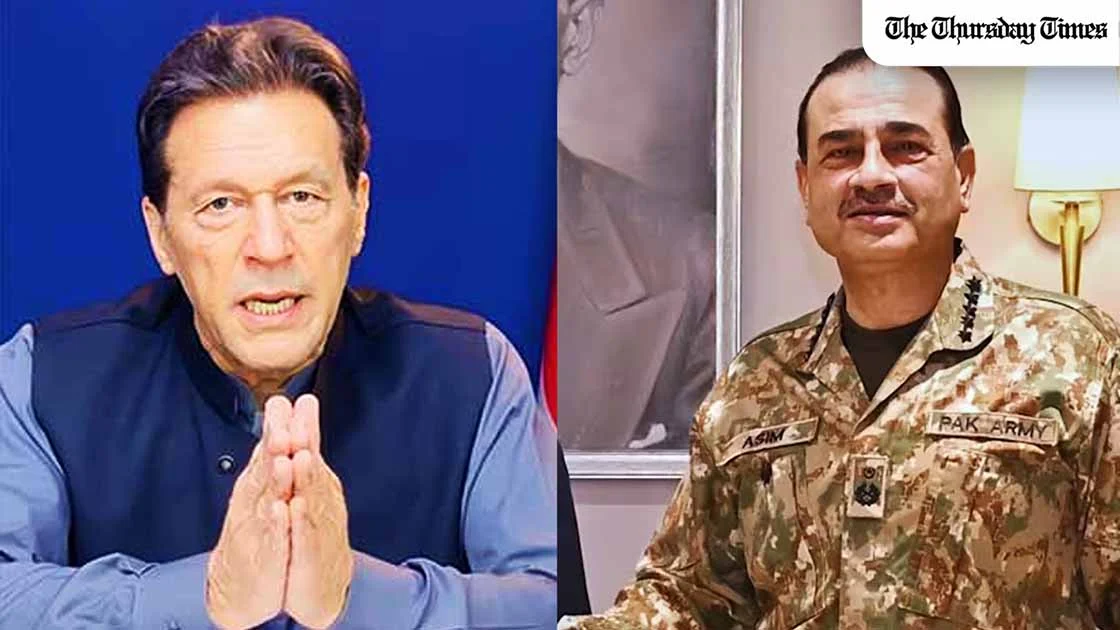
Reuters reported that Imran Khan would not confront army chief Asim Munir if he were freed from prison, according to Zulfikar Bukhari, one of the jailed former prime minister’s closest aides. The comments came days after Pakistan’s top court ordered Khan moved to hospital for treatment, and they marked, in Reuters’ own framing, “a significant change in rhetoric” from a party that has spent two years building its identity around the opposite promise.
That framing is too polite for what actually happened.
Bukhari is not a minor figure reading from a press release. He is part of Khan’s original inner circle, a former federal minister who has retained access to Khan through the arrests, the court cases and the long silence of imprisonment. When PTI wants to say something it cannot yet say through Khan himself, Bukhari is one of the very few people whose words carry the weight of speaking for the captain. That is precisely what makes this significant, and precisely why it cannot be waved away as one aide freelancing to a foreign wire service.
Since Khan’s removal from office in 2022, PTI’s entire mobilising energy has rested on a single idea, distilled into the slogan “dut kar khara hai kaptaan”: the captain stands, unbroken, unbending. It is not incidental branding. It is the emotional architecture that has kept a movement engaged through crackdowns, mass arrests and a leader who has spent years behind bars. The promise to the base was that Khan, unlike the political dynasties who came before him and eventually made their peace with the generals who removed them, would not bend. He would not trade his position for comfort. He would not sit across a table from the men who jailed him.
Bukhari’s language does not defend that promise. It surrenders it, and dresses the surrender up as virtue.
“You control your own hurt. You curb your own pain. You swallow it for the betterment of your country,” he told Reuters, describing a hypothetical released Khan as “magnanimous” and insisting that “you don’t go loggerheads with the establishment, with the military leader.” Strip away the packaging and this is a demand that Khan accept his own subordination gracefully. It asks him to absorb what was done to him and call the absorbing a virtue. And the aide making that demand is describing the same man Khan once called “mentally unstable,” Asim Munir, as someone capable of extending a “healing hand.”
There is no reading of that combination that amounts to a diplomatic overture. It is a request that Khan’s supporters retroactively reinterpret two years of defiance as something that was always negotiable, so long as the terms get called magnanimity instead of what they are.
The timing is doing its own quiet work. Bukhari’s comments followed a court order sending Khan to hospital, a legal and medical matter with no political content of its own. Attaching a reconciliation signal to that ruling lets PTI dress a court’s decision up as the first thread of a broader thaw, whether or not the ruling has anything to do with one. It is a narrative built on top of a fact, not out of it.
None of this means Khan has authorised any of it, or that a deal is imminent, or that Munir’s silence, and the government’s, should be read as anything but silence. But the “dut kar khara hai kaptaan” story was never really about Khan alone. It was about what his supporters were asked to endure on the promise that their leader would never make the calculation Bukhari is now describing out loud, on the record, to an international wire service. That promise is the thing that just quietly died, and it died in the mouth of one of the very people Khan trusted to keep it alive.∎